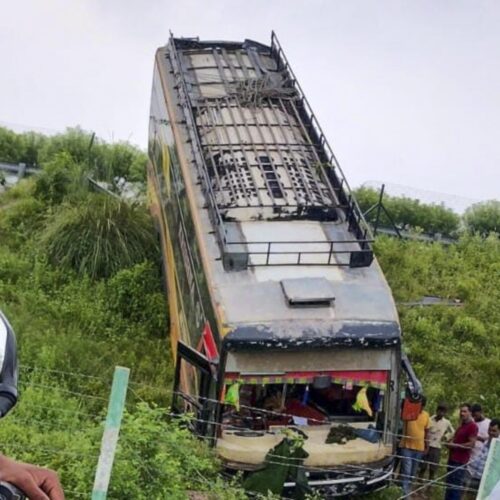
It is 7:40 AM in Bengaluru. A BMTC (Bengaluru Metropolitan Transport Corporation) bus on Route 600D pulls away from a stop on Outer Ring Road. There are 68 passengers on board. The driver has been at the wheel since 5:30 AM. He will complete four round trips today, covering roughly 160 kilometres in stop-start city traffic. Navigating signal violations, two-wheelers cutting across his path, pedestrians stepping out mid-block, and a dozen unprotected left turns at intersections where no one gives way.
By the time he completes his final trip at 8 PM, he will have made approximately 14,000 individual driving decisions across his shift. A figure consistent with research on urban bus driver cognitive load in high-density traffic environments. Each one carries consequences not just for himself but for the 50 to 70 people who happen to be on the bus at any given moment.
This series has already shown that no commercial driver in India carries a small burden. The overnight bus driver in Part 2 holds the lives of forty sleeping passengers for ten hours through the body’s most dangerous biological window. The long-haul trucker in Part 3 absorbs a freight system’s failures alone, at speed, on a dark highway. But the city bus driver carries a version of this risk that is constant rather than occasional: thousands of individual decisions, every single day, each one shared with dozens of people who never chose to be part of that risk.
This is Part 5, the final part of Attento’s series on India’s commercial driving crisis. It is about the category where the stakes are highest, and about a question this series has not asked plainly enough until now: why do Indian cities keep producing buses that are structurally set up to fail?
The Number Nobody Operationalises
WRI India’s research on city bus safety found that BMTC and BEST(Brihanmumbai Electric Supply and Transport), despite accounting for 20 to 32% of mode share in Bengaluru and Mumbai respectively, were involved in only 5 to 13% of road fatalities in those cities over a five-year period. Public buses, managed properly, are statistically among the safest forms of urban transport. But when they go wrong, the consequences are disproportionate: more than 80% of crash victims in bus accidents studied by WRI India were vulnerable road users, motorcyclists, pedestrians, and passengers.
That statistic and the numbers that follow are not in tension. A mode of transport can be safer per kilometre than the alternative and still produce a large absolute death count, simply because of how many kilometres it covers and how many people share the road with it every day. In Bengaluru alone, BMTC buses were involved in accidents that killed 80 people between 2024 and August 2025, according to Deccan Herald’s review of Bengaluru Traffic Police data. In 2024-25, Delhi’s public bus fleet, DTC (Delhi Transport Corporation) and DIMTS (Delhi Integrated Multi-Modal Transit System) cluster buses combined, was involved in approximately 150 accidents, of which 40 were fatal.
Here is the part that rarely gets asked. Why, structurally, does a relatively safe mode of transport still produce these numbers, year after year, across nearly every Indian city?
The Hidden Incentive Nobody Talks About
The honest answer starts with what bus corporations actually measure.
Most state transport corporations and private bus operators in India track punctuality, route completion, and fleet utilisation as their primary performance indicators. These are the numbers that appear on operational dashboards, in monthly reviews, and in whatever determines whether a depot is considered well-run. Fleet utilisation, in particular, is the number that decides whether a bus is earning its keep: a vehicle that is moving is earning revenue, a vehicle that is idle is not.
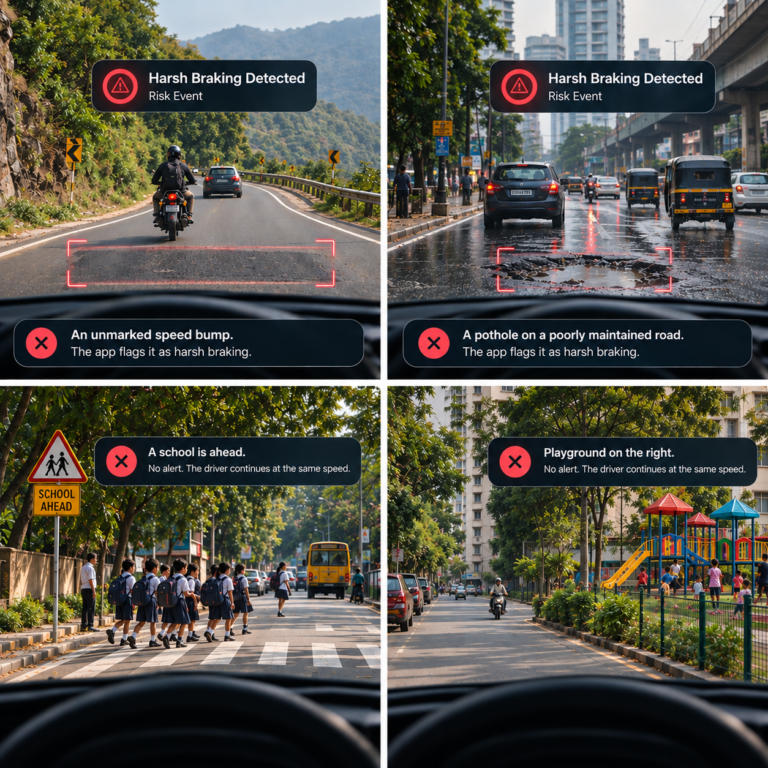
What is far less commonly tracked, even by global standards, is the behaviour that produces the crashes: harsh braking, close following distance, repeated speeding at the same intersection, sudden lane changes to recover a missed schedule. Industry research on fleet key performance indicators consistently finds that operators default to financial and operational metrics, cost per kilometre, on-time percentage, vehicle downtime, and treat behavioural safety metrics as an advanced add-on rather than a baseline requirement.
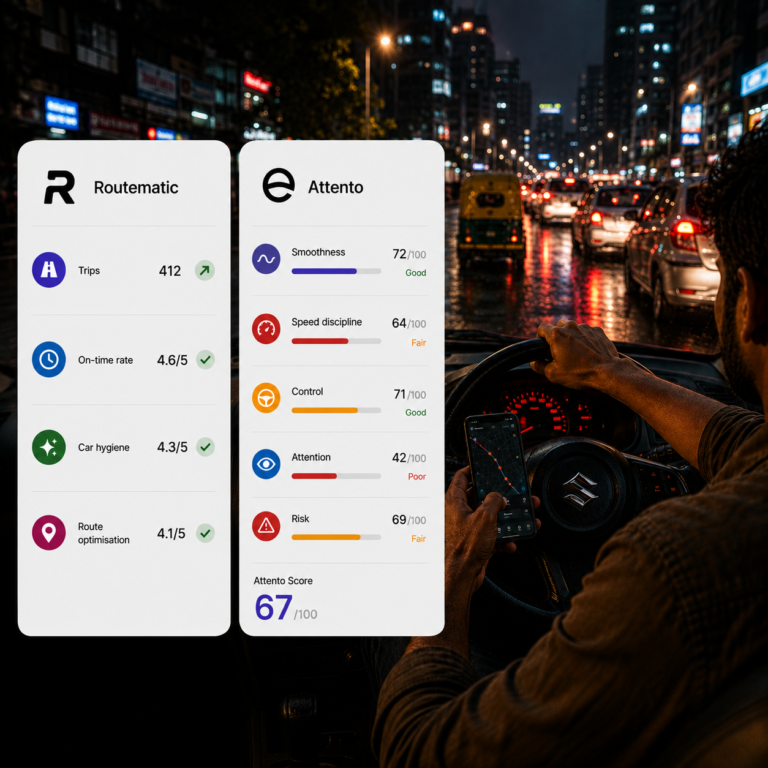
This is precisely the pattern Part 1 of this series identified in gig platforms: a system that rewards speed and availability without ever measuring the manner in which that speed was achieved. The mechanism is identical in a formal, unionised, government-run bus corporation as it is in an app-based gig platform. A late bus generates passenger complaints, which generate operator pressure, which generates schedule enforcement, which produces exactly the harsh braking and intersection speeding this series has traced throughout every part. The driver pushing to recover ten lost minutes is not behaving irrationally. He is responding precisely to the only signal the system sends him.
Did you know? river coaching focused on near-miss events, not post-crash reviews, cuts fleet crash rates significantly within the first year. India has almost no data on this, because so few fleets track behavioural events at all.
What Electric Buses Actually Exposed
India’s public electric bus fleet has grown to more than 10,000 vehicles across 50 cities, with 20,000 more in procurement, according to the World Resources Institute. The shift has also coincided with a cluster of serious accidents: 18 accidents, six of them fatal, in Bengaluru over 15 months ending August 2025, according to Rest of World’s investigation, and a string of separate fatal incidents in Mumbai and Gujarat.
The easy explanation is mechanical: electric buses accelerate faster and brake more responsively than the diesel buses most drivers spent decades learning to operate, and the transition training has been minimal.
That explanation is true but incomplete, and stopping there misses the more useful insight. Electric buses did not create unsafe drivers. They exposed a training system that had been outdated for decades and had simply never been tested by a vehicle different enough to reveal the gap. India still certifies commercial drivers primarily on the ability to operate a vehicle, not on behavioural adaptation to a vehicle that handles differently from the one they trained on. When the vehicle changes faster than the certification system does, the accidents that follow are not surprising. They are close to inevitable.
Did you know? In November 2024, a BEST electric bus in Mumbai struck pedestrians near Bhandup station, the second such incident in two months. BEST announced mandatory simulator training for electric bus drivers afterward, not before.
What Nobody Asks About Cities
This series has consistently located failure inside transport systems. But one variable in city bus safety sits outside any operator’s control: the road itself.
Bus stops placed immediately after intersections force drivers to brake hard twice in quick succession. The absence of dedicated bus bays in most Indian cities means a stopping bus blocks a live traffic lane, forcing both the bus driver and everyone behind it into compressed, high-pressure manoeuvres. Illegal parking narrows the usable carriageway on approach to stops. Pedestrians crossing mid-block, autorickshaws parked across bus lanes, and signal timing that does not account for a vehicle the length and weight of a bus all combine to force harsh braking from drivers who are, on paper, doing nothing wrong.
An experienced, well-rested, well-trained driver operating inside this geometry will still produce harsh braking events, because the road is asking him to. Urban design is not a backdrop to bus safety. It is one of its variables, and one of the few this series has not yet named directly.
The School Bus: Supervising and Driving at Once
India’s school bus sits in a unique position. It is the vehicle parents trust most, and one of the better-regulated categories of large vehicle transport. The record is still not reassuring.
In April 2018, a school bus in Kangra, Himachal Pradesh, was speeding when the driver lost control at the edge of a gorge. The bus fell roughly 60 metres. Twenty-three children and four adults, including the driver, died. The investigation found the driver was speeding. It did not examine what schedule pressure preceded the decision. In July 2025, a train collided with a school bus at a manned railway crossing in Cuddalore, Tamil Nadu, killing two students, after the bus driver attempted to cross while the gatekeeper was still closing the gate. Both incidents had functioning vehicles. Both had a driver who made a single decision under time pressure that a dozen lives depended on.
What is rarely said plainly is that a school bus driver is not only driving. He is simultaneously supervising dozens of children who are, by nature, unpredictable road users: standing when the bus is moving, shouting, reaching for windows, distracting each other and him at once. That is a second cognitive load layered directly on top of navigating traffic, and it is highest at exactly the moment research identifies as the riskiest part of the school transport cycle: the approach to the school gate, where vehicles stop in the road and children disembark into moving traffic. It is not the highway. It is the last 100 metres, driven by someone doing two jobs at once.
Crashes Are the Wrong Metric to Count
Every section of this part has, so far, used crash data to make its case. That is itself worth questioning.
In aviation, the industry does not wait for crashes to act. It measures near misses, unstable approaches, and pilot deviations, because a crash is understood to be the rare, final event at the end of a long chain of smaller, recoverable failures. Healthcare measures adverse events. Manufacturing measures quality defects long before a faulty product reaches a customer. Road transport in India still, almost universally, measures crashes and stops there.
A fleet that records ten crashes in a year probably experienced thousands of unsafe events before any of them. The absence of a crash is not evidence of safety. It may simply be evidence of luck that has not yet run out.
What Good Operators Do Differently
Safe fleets, internationally, share four characteristics: driver monitoring that precedes incidents rather than reviewing footage after one, shift management that tracks fatigue as it builds rather than only checking compliance with legal hour limits, a culture where near-misses are reported as information rather than evidence of fault, and incentive structures that recognise consistently safe driving rather than only punishing crashes.
London offers a working example of the first of these at city-bus scale. Transport for London buses use a telematics system called Drivewell, which scores drivers on recordable events like abrupt braking and irregular turning, with the data fed back to drivers and operators continuously rather than only after an incident. Academic research studying its rollout found that drivers both accommodated and resisted the system, but that it measurably shifted how operators understood and responded to risky driving across the fleet. The relevant point is not that the technology is unique. It is that London’s bus network treats behavioural monitoring as baseline infrastructure, not an optional upgrade.
India has no equivalent at city-bus scale. A handful of private fleet operators use basic telematics for fuel monitoring. Behavioural safety monitoring the kind that would catch a gradual rise in harsh braking before it becomes a pattern is, in most Indian public bus fleets, entirely absent.
The last point about incentives matters more than it might appear. A fleet driver who drives cautiously, brakes early, yields at crossings, and maintains following distances will complete fewer trips per shift than a driver who pushes harder. Under most Indian fleet incentive structures, the cautious driver earns less and is rated lower. This is the same dynamic Part 1 identified in gig platform management, and it operates identically in formal, government-run fleet environments.
The Missing Layer Across All Five Parts
This series has returned repeatedly to a single absence: a portable, verified record of how a driver actually drives, that travels with them from employer to employer, city to city, vehicle type to vehicle type.
A BMTC driver with six years of clean behavioral data has no way to demonstrate that record when applying to a private operator. A school bus driver who has never had a harsh braking event in 10,000 trips has no professional identity that reflects this. An auto driver who has driven safely for a decade carries exactly the same documentation as one who hasn’t.
India’s credit system solved an equivalent problem. Before CIBIL, a borrower’s repayment history didn’t follow them between banks. After CIBIL, it did. The result was a more efficient, more fair, more accountable credit market.
Commercial driving needs the same infrastructure. Not a platform rating that resets when you switch apps. Not a paper logbook nobody checks. A behavioral identity – fair, explainable, portable that accumulates over a career and means something to every operator, insurer, and regulator who needs to know whether this driver, on this vehicle, in this city, is someone they can trust.
That is what Attento is working to build.
What This Series Has Argued
Across five parts, a single pattern has emerged.
- Part 1: Algorithmic management rewards speed and availability, not safe driving
- Part 2: Overnight schedules are built on the assumption that human biology is negotiable
- Part 3: The freight system transfers every delay downward until it sits with the driver, who absorbs it at speed
- Part 4: Millions of commercial drivers operate in a regulatory environment where oversight is documented but never delivered
- Part 5: Mass transport carries the highest-stakes version of every failure in this series at once, and a rushed electric vehicle transition has added a new one nobody planned for
The common thread is not driver recklessness. It is what gets measured. Commercial drivers in India rarely wake up intending to drive unsafely. Most unsafe behaviour is produced by incentive systems, scheduling systems, logistics systems, and regulatory systems that were built to track punctuality, utilisation, and compliance, and were never built to track the thing that actually determines whether someone arrives alive.
Every aviation disaster changes procedures for every future flight. Every major industrial accident rewrites operating manuals. Road transport in India rarely learns at the same speed. Each crash is investigated in isolation, as a single bad outcome, rather than as one more signal inside a much larger and entirely visible behavioural pattern.
At Attento, we do not measure crashes. We measure the behaviours that make crashes more likely, because no fleet manager can watch 300 buses at once, and no human supervisor can notice a gradual rise in harsh braking spread across hundreds of shifts before it becomes a pattern worth worrying about. That is not a case for replacing people. It is a case for noticing what people, at this scale, structurally cannot.
Every morning, millions of Indians board a bus without knowing whether the operator measures only whether it arrived on time, or whether it also measures how safely it got there. That difference is invisible to passengers, but it determines the quality of every decision made behind the wheel. Until safety becomes a metric as important as punctuality, the system will keep rewarding the wrong outcome.
The driver on Route 600D will be back on the road tomorrow at 5:30 AM. He will make roughly 14,000 decisions again, and the 50 to 70 people who board his bus will have no idea how many of those decisions were shaped by a schedule built to be measured in minutes, not in margins of safety.
What India’s Mass Transit Needs
Every failure mode in this series points to the same conclusion: India measures compliance, utilisation and punctuality far better than it measures driving behaviour. Until behaviour becomes a first-class operational metric, commercial road safety will improve more slowly than it could.
Behavioral safety metrics as mandatory KPIs. Punctuality and fleet utilisation should not be the only numbers on an operator’s dashboard. Harsh braking frequency, near-miss events, and speed variance at high-risk intersections should be there too.
Telematics as licensing condition, not premium add-on. Transport authorities can mandate basic behavioral monitoring for public bus contracts. London did. Singapore did. The technology cost is no longer a barrier.
Near-miss reporting culture. A driver who reports a near-miss should be recognized for it, not investigated. Until near-misses become information rather than evidence of fault, the data that could prevent crashes will stay invisible.
Electric bus transition training before deployment. BEST’s post-accident simulator announcement should have been a pre-deployment requirement. Every city procuring electric buses in the current 20,000-vehicle pipeline should mandate behavioral adaptation training before a single new vehicle enters service.
Incentive restructuring. A driver who consistently drives safely should earn more, not less. This requires operators to measure safety first.