50 vehicles. 50 completed routes. The fleet dashboard says everything went according to plan. But it does not tell you whether drivers were braking aggressively, overspeeding or showing increasingly risky driving behaviour. The fleet moved. The question is: how was it driven?
Fleet management systems have transformed the way businesses operate vehicles. They give fleet managers visibility into vehicle locations, routes, trip history, utilisation and, depending on the system, fuel consumption and maintenance. Some also capture driving events such as harsh braking, acceleration and speeding. These are essential tools for managing a modern fleet. But there is a distinction between collecting driving events and building a consistent understanding of the driver behind them. That distinction is where Attento fits in.
Where It Went vs. How It Was Driven
Fleet management systems are primarily built around the vehicle. They help answer questions such as where a vehicle is, which route it took, how long a trip lasted and whether it was utilised effectively. They can also flag individual driving events. But two vehicles can complete the same route, at roughly the same time, and still be driven very differently. One driver may accelerate smoothly, brake progressively and take corners consistently. Another may repeatedly accelerate hard, brake sharply and take corners aggressively.
On a fleet dashboard, both journeys can simply appear as:
Vehicle A: 42 km completed.
Vehicle B: 42 km completed.
Same distance. Same operational outcome. Very different driving.
The distinction becomes more important when those events need to be understood across multiple journeys. A single harsh brake is an event. Repeated harsh braking by the same driver over weeks is a behavioural pattern. Understanding that pattern requires looking beyond the individual vehicle and asking who is behind the wheel.
Because the vehicle is the asset, but the driver is the behavioural unit.
The Driver Is the Behavioural Unit
This becomes especially important as fleets grow. Consider a fleet with hundreds of buses. That represents thousands of hours of driving every day. No fleet manager can realistically observe those journeys individually, and a GPS dashboard is not designed to interpret every decision being made behind the wheel.
The opportunity is not to create another screen for the fleet manager to watch. It is to turn those hours of driving into structured driver-level insight.
There is another challenge: vehicles and drivers do not always have a one-to-one relationship. A fleet may have 300 vehicles and 500 drivers. Vehicles can be swapped, drivers can move between routes, and the same driver may operate different vehicles across different days.
A driver who operates Vehicle 17 today may be in Vehicle 42 tomorrow.
If driving behaviour stays permanently attached to the vehicle, that driver’s history becomes fragmented across multiple vehicles. But if the driver becomes the unit of analysis, the question changes:
How does this driver behave, regardless of which vehicle they are operating?
That is a fundamentally different type of intelligence.
Attento’s smartphone-based approach creates an opportunity to build that behavioural view around the driver rather than tying it exclusively to a particular vehicle. This can help make driver behaviour portable across vehicles, routes and trips, giving fleet operators a more consistent view of how individuals drive.
From Events to Patterns
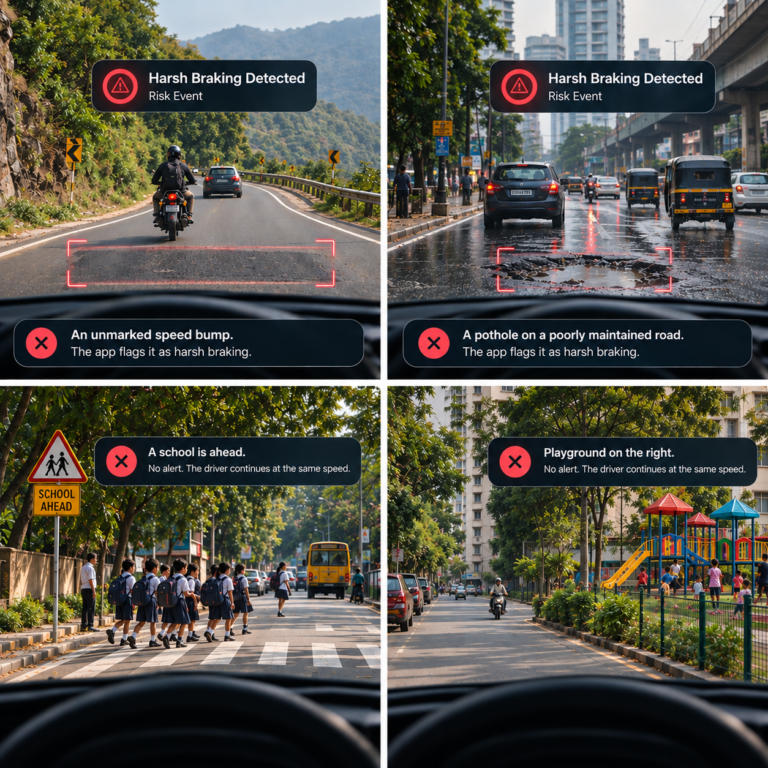
A single harsh braking event does not necessarily tell you much. A driver may brake hard once because a pedestrian stepped onto the road or traffic suddenly stopped. Treating that one event as evidence of consistently risky driving could lead to the wrong conclusion.
The more useful question is:
Is this an isolated event, or is it a pattern?
One harsh brake is an event. Repeated harsh braking across multiple trips is a pattern. If that pattern occurs primarily on a particular route or during a particular time period, it gains context. Once the context is understood, the organisation can decide whether an intervention is actually needed.
This creates a more useful progression:
Event → Pattern → Context → Intervention
Instead of looking at one trip in isolation, longitudinal driving data can help build a picture of behaviour across trips and over time. A driver who occasionally brakes hard is different from a driver whose harsh braking consistently increases over several weeks.
But even a persistent pattern needs context.
A driver who suddenly starts braking aggressively may not necessarily have a driver problem. They may have a route problem. A new delivery window, increased congestion, poorly planned schedules, unfamiliar roads or difficult road conditions could all influence driving behaviour.
That changes the question from “Who is driving badly?” to “What might be causing this behaviour?”
The data does not automatically provide every answer. But it can help turn a vague concern into a specific question worth investigating.
The Same Behaviour Can Have Different Causes
Consider a driver whose harsh braking has increased significantly over six weeks, particularly on a morning route.
A basic score might simply flag the driver as higher risk. A longitudinal view can reveal more.
Suppose the increase is concentrated on one route. The fleet manager now has something specific to investigate. Is there greater congestion on that route? Has the delivery schedule changed? Is the driver under time pressure? Is the road environment creating more sudden stops? Is the driver unfamiliar with the route? Or is the behaviour genuinely becoming more aggressive?
Instead of sending another generic “drive safely” reminder, the fleet manager has a behaviour, a time period and an operating context to investigate.
That is a much more actionable starting point.
Two Systems, Different Jobs
This is not an argument for replacing fleet management systems. In fact, Attento and fleet management systems can complement each other.
Fleet management provides the operational layer: where the vehicle is, which route it took, how long it was on the road, whether it was utilised effectively and what happened operationally. It may also capture individual driving events.
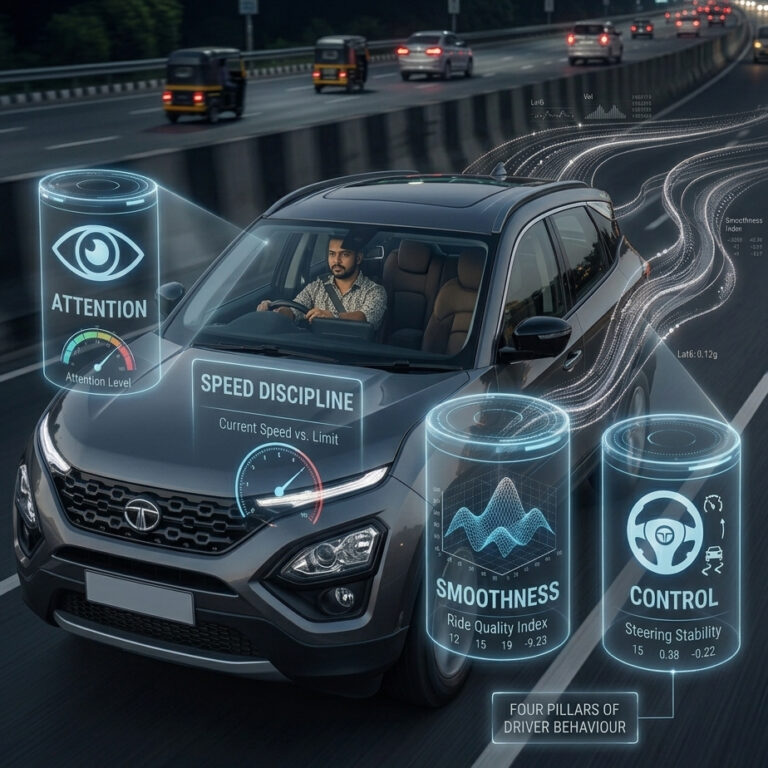
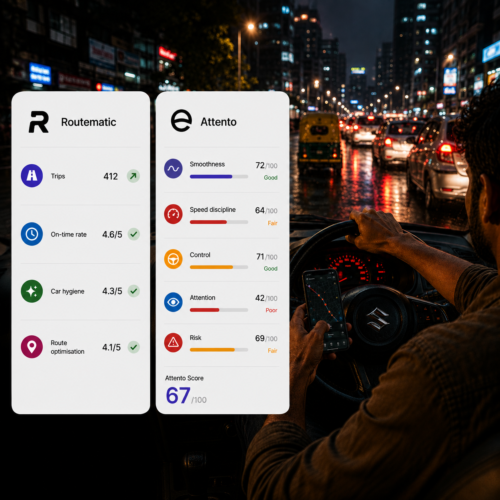
Attento adds another layer by helping connect driving behaviour across trips and vehicles, allowing organisations to look at patterns such as acceleration, braking, cornering, speed behaviour and consistency at the driver level and over time.
The distinction is not simply what data is being collected, but how that data is organised and understood.
Fleet management helps answer:
What did the vehicle do?
Driver intelligence helps answer:
What does this tell us about the person driving it?
Fleets do not necessarily need to replace the systems they already rely on to gain that additional perspective. Attento can sit alongside the existing fleet management stack, adding a driver-level behavioural layer to the operational information fleets already collect.
The goal is not another standalone dashboard.
It is to make existing fleet data more useful by adding context about the person driving the vehicle.
From Monitoring to Intervention
The ultimate value of driving behaviour data is not another score. It is what a fleet manager can do with the insight.
Suppose a driver’s harsh braking has increased significantly over six weeks, particularly on a morning route. The data has now created an opportunity to investigate the behaviour rather than simply label it.
The fleet manager can ask:
Measure: What behaviour is changing?
Understand: When, where and under what conditions is it happening?
Intervene: What action could address it?
Improve: Does the behaviour change?
Measure again: Did the intervention work?
This creates a continuous feedback loop:
Measure → Understand → Intervene → Improve → Measure again.
Instead of treating driver safety as a one-time training exercise, organisations can use driving data to identify specific behaviours, understand their context, intervene where necessary and measure whether behaviour changes.
That is where driving intelligence becomes more than monitoring.
Beyond the Moving Dot
GPS transformed fleet management by turning vehicles into visible points on a map. Fleet managers could see where vehicles were, where they had been and whether they were moving as expected.
But a moving dot tells you very little about the quality of the journey.
It does not tell you whether the driver accelerated smoothly or aggressively. It does not tell you whether a pattern of harsh braking is isolated or becoming more frequent. It does not tell you whether the same behaviour is appearing across different vehicles. And it does not necessarily tell you whether a driver is improving over time.
For that, the unit of analysis needs to move beyond the vehicle.
Because vehicles change. Drivers change vehicles. Routes change. Operating conditions change. But the behaviour of the person behind the wheel remains an important part of the equation.
That is why the distinction between fleet visibility and driver intelligence matters.
Vehicle A: 42 km. Vehicle B: 42 km.
Same distance. Very different driving.
Fleet management records the movement. Driver intelligence helps put the behaviour into context.
The vehicle is the asset. The driver is the behavioural unit.