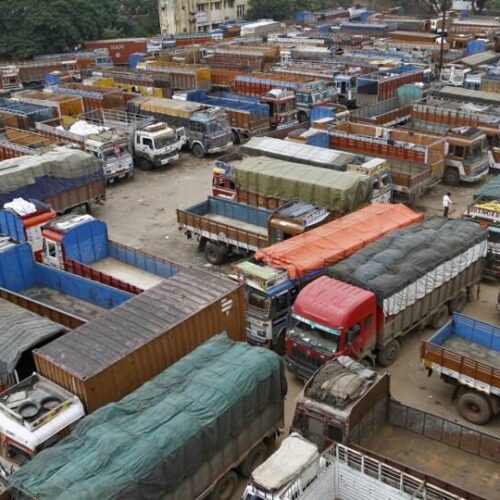
A truck loaded with Alphonso mangoes from Ratnagiri pulls into a warehouse in Navi Mumbai at 6 AM on a Monday. The driver has driven through the night. He is early. He is on schedule.
He parks and waits. And waits. For the loading dock to open.
Eight hours later, the dock opens. By the time the mangoes are unloaded, inspected, and signed off, it is 5 PM. The deadline for his return delivery to Pune was 4 PM. The consignment has already been marked late. The fleet owner is calling. The receiver in Pune is threatening to reject the cargo.
The driver gets back into his truck and drives to Pune in the dark, sleep-deprived, running late, on a deadline that was already broken before he turned the key.
Nobody in the chain that created this situation is in that truck with him. This is not a story about a reckless driver. It is a story about what happens to a human being when the system creates a delay and then refuses to absorb it.
Part 1 and Part 2 of this series examined the algorithmically managed gig driver and the overnight bus driver running against biology. This is Part 3: the long-haul trucker, and how India’s freight system turns waiting time into speeding time.
The 300-Kilometre Problem
An Indian truck covers an average of 250 to 300 kilometres per day, according to a World Bank analysis of Indian freight productivity. Its American counterpart covers 700 to 800 kilometres. A Chinese truck covers more than 500 kilometres.
The gap is not primarily about road quality or vehicle capability. It is about time lost at every stop along the way: warehouses that open late, loading docks with no appointment systems, weigh bridges with long queues, toll plazas with peak-hour congestion, and border crossing points that can add half a day to a cross-state journey.
According to a KPMG analysis of India’s logistics sector, toll queues and loading delays alone add one to two days per trip on major freight corridors. India has over 10 million trucks and a 22% driver shortage, a deficit of 1.2 million drivers, according to CRISIL’s 2025 Logistics Report. The trucks that are on the road are being pushed harder to compensate for the shortage. The drivers running those trucks are absorbing delays that the system created and the schedule refuses to account for.
Did you know? India’s logistics cost as a share of GDP stood at 7.97% in Financial Year 2023-24, down from the 13-14% figure cited for years, according to the first scientifically derived DPIIT-NCAER estimate.
Even at the revised figure, Indian trucks cover 250-300 km per day versus 700-800 km in the United States. The productivity gap, measured in kilometres per truck per day, is one of the most expensive inefficiencies in the Indian economy.
The Waiting Paradox
Here is the part that does not appear in any fleet manager’s dashboard.
When a truck sits at a warehouse for eight hours waiting for a dock, nobody compensates the driver for that time. The delay is absorbed by the person at the bottom of the chain. When the schedule resumes, it resumes at the same deadline. The eight hours of waiting do not extend the deadline. They compress what remains.
A study by SaveLIFE Foundation and Mahindra in 2020 surveying truck drivers across India found that drivers faced consequences for late delivery even when the delay was caused by factors entirely outside their control viz. warehouse queues, regulatory stoppages, and traffic. The incentive system does not distinguish between a delay the driver caused and a delay the system caused. The driver is simply late. And in many cases, simply unpaid or docked for the hours spent waiting at a dock that wasn’t ready for him.
This is the waiting paradox: the system creates the delay, the deadline absorbs none of it, and the driver is expected to make up the difference on the road. The only variable the driver controls is speed.
The Most Expensive Hours in Logistics
In American freight, this phenomenon has a name: detention time.
A truck arrives at a warehouse. The dock is not ready. The driver waits. The clock runs. The United States Federal Motor Carrier Safety Administration has published data showing that detention time is one of the primary contributors to Hours of Service violations. When a driver is detained for four hours, those four hours do not disappear from the driving day. They compress it.
India has no equivalent conversation. The term does not appear in Indian logistics policy. It is not tracked by fleet operators or shippers. A truck waiting outside a warehouse for eight hours is simply recorded as late at the next destination.
But the cost is real and distributed across every party in the chain, just not equally:
- The fleet owner loses vehicle utilisation
- The shipper loses capacity
- The supply chain absorbs the delay downstream
- The driver loses rest, the one thing none of the other parties loses
The road eventually absorbs all of it. Not the warehouse. Not the fleet owner. Not the shipper. The road, and whoever happens to be on it when the driver is finally moving again, behind schedule, sleep-deprived, and under pressure to arrive.
Did you know?A 2025 report found that Indian trucks spend an average of 30 to 40% of their total journey time waiting at warehouses, weigh bridges, toll plazas, and border checkpoints. For a truck on a 48-hour freight corridor, that is between 14 and 19 hours spent stationary. None of that waiting time is compensated to the driver. All of it compresses what remains.
Perishables, Pharma, and the Spoilage Clock
The pressure is not uniform across freight categories. It is most acute in the segments where time is directly tied to money or to human health.
India’s cold chain logistics sector is growing rapidly. Demand for refrigerated trucks surged 32% year-on-year in 2024, driven by perishables, dairy, and pharmaceutical cold chains, according to the NITI Aayog Cold Chain Report 2024. The Alphonso mango sitting in a warm truck for eight hours outside a closed warehouse is not just a productivity problem. It is a cargo that is losing value by the hour. A truckload of Alphonso mangoes worth Rs. 3-5 lakh can lose 20-30% of its value in a single day of improper storage. The driver knows this. The calls have already started.
Pharmaceutical cold chains carry the same logic with higher stakes. A temperature-controlled vaccine shipment that breaks the cold chain is not merely delayed. It is destroyed. And the consequences extend beyond financial loss, compromised vaccines in the supply chain are a public health event.
For drivers running these loads, the urgency is real and the pressure is not manufactured by a platform algorithm. It comes from the nature of what is in the back of the truck.
What the Driver Takes Instead of Rest
A driver who has been sitting at a warehouse for eight hours is not rested. He has been sitting, in a cab, in the heat, with no amenities, no clean toilet, and nowhere to go. India’s national highway network has almost no formal rest stops with reliable facilities for long-haul drivers. Drivers cook under their trucks. They sleep in the cab in conditions that do not permit genuine recovery.
When the dock finally opens and the deadline reasserts itself, the driver reaches for what is available. Tobacco. Energy drinks. And, according to a study published in the Indian Journal of Psychiatry, stimulants used by 27% of surveyed truck drivers in India specifically to manage fatigue during night driving.
A systematic literature review published in occupational health research found that amphetamines rank second on the list of most used substances among truck drivers globally, after alcohol. Among surveyed truck drivers in studies across South and Southeast Asia, the prevalence of stimulant use was consistently linked to schedule pressure and long working hours.
The drugs do not work as intended. Research published in the Indian Journal of Psychological Medicine found that stimulant use produces a period of heightened alertness followed by a crash that is more severe than the original fatigue. Amphetamines specifically have a relative risk of road traffic injury fatality of 5.17 compared to a sober driver, according to a study cited in the journal’s analysis of drug use and road traffic injuries. The driver is not fixing the fatigue. He is borrowing against it, at an interest rate that eventually comes due on a dark highway.
To put that in perspective: a drunk driver at India’s legal blood alcohol limit of 0.03% carries an elevated crash risk. A fatigued driver who has taken stimulants to compensate carries more than five times the fatal crash risk of a sober driver. Both are on the same roads.
What Would Actually Change This
The waiting paradox has solutions. They require accountability from parties who currently face none.
Warehouse appointment systems. Scheduled dock slots that create accountability for loading delays. Already standard in modern logistics markets. Almost absent in India.
Delay compensation for drivers. If a driver waits eight hours for a dock that wasn’t ready, those eight hours should be paid and the deadline adjusted accordingly. The cost of delay should not sit exclusively with the driver.
Driver hours tracking with GPS validation. Same argument as Part 2. A paper logbook is not a record. Real-time hours monitoring with automatic alerts when drivers approach legal limits.
Rest stop infrastructure on freight corridors. A driver who has nowhere to genuinely rest during mandatory breaks is not resting. Highway rest infrastructure for commercial drivers is one of the most cost-effective road safety investments available.
Cold chain loading priority. Perishables and pharmaceutical loads sitting in heat because of dock queues is a supply chain failure with road safety consequences. Time-sensitive cargo needs scheduled priority access.
The freight system transfers every delay to the driver. The road safety system pays the price. Neither needs to work this way.
The Final-Stretch Problem
At Attento, the most consistent finding across commercial driving data is also the least intuitive one.
The highest-risk part of a freight journey is not the long empty stretch in the middle of the night. It is the final 50 to 100 kilometres, when schedule pressure peaks, fatigue has accumulated across the full journey, and the driver knows the deadline is close.
Post-delay speed spikes are visible in the data. Harsh acceleration events increase near the end of long shifts. Braking responses lengthen in the final hour. The driver who held steady for 400 kilometres begins to push in the stretch where the system is watching most closely.
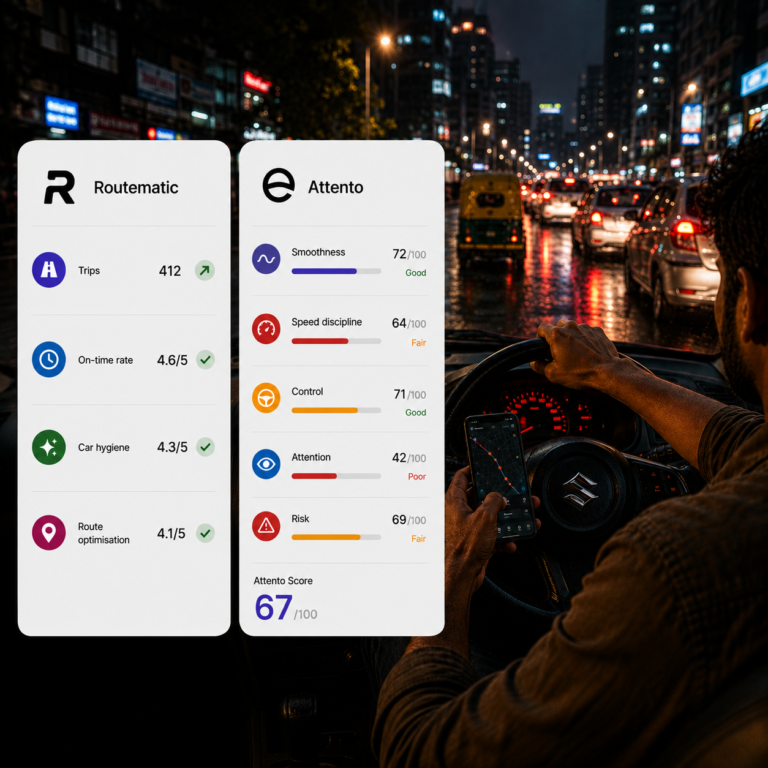
Traditional freight metrics measure outcomes: estimated time of arrival, delivery success rate, fuel consumption, on-time percentage. They tell you whether the truck arrived. They tell you nothing about what happened on the road to get there.
Behavioural data measures something different: the cost of meeting the estimated time of arrival. The speed variance in the final 80 kilometres. The braking profile after a warehouse detention. The acceleration pattern of a driver who is three hours late and 100 kilometres from the dock.
A truck that arrives on time after a smooth journey looks identical, in every logistics system in India, to a truck that arrives on time after a driver pushed through the final stretch fatigued, running on stimulants, having absorbed eight hours of uncompensated detention time. The delivery was made. The risk taken to make it is invisible.
That invisibility is not a data gap. It is a choice. The industry measures what it values. It has decided to value delivery time. The behavioural cost of meeting that time is carried entirely by the driver, and eventually by everyone else on the road.
The system creates the urgency. The road absorbs the consequences.