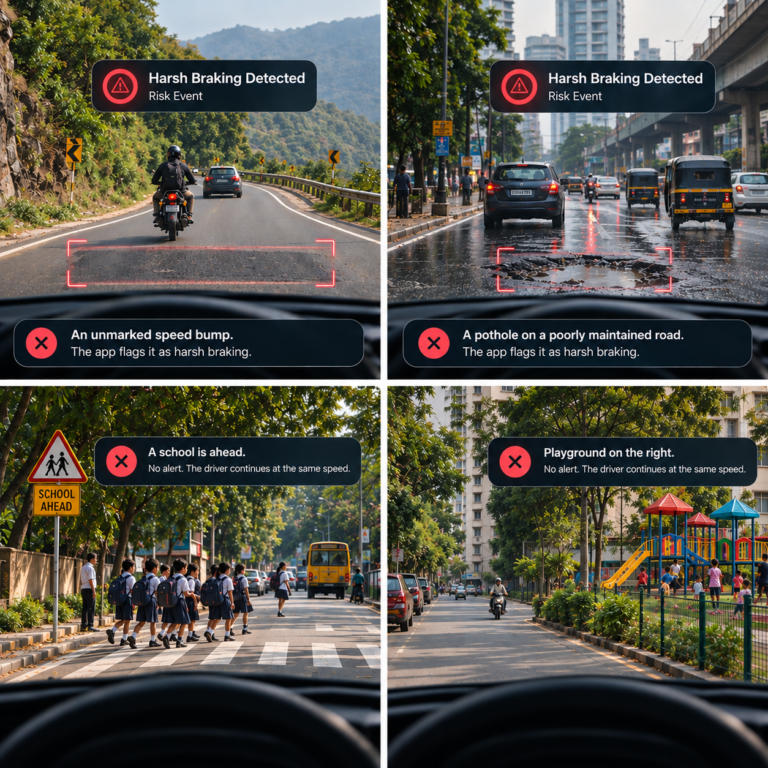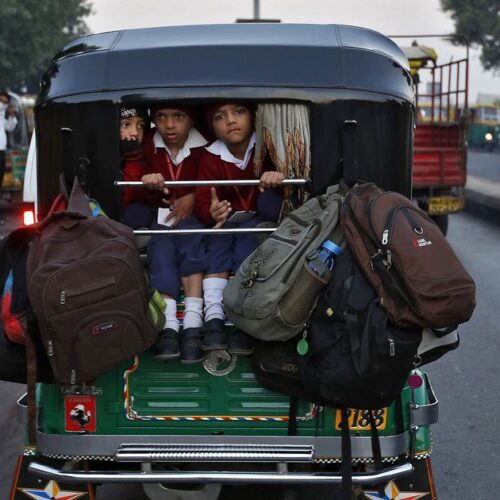
On 21 January 2026, a school van in Betul carrying more children than its capacity was hit by a jeep near a gas warehouse on the Purna river road. A five-year-old girl, died on the spot. Eleven children were injured. The van was, according to parents quoted in press reports, regularly overcrowded. The operator had not been stopped. The permit was valid.
Parts 1, 2, and 3 of this series examined gig drivers managed by algorithms, overnight bus drivers running against biology, and truck drivers absorbing the freight system’s delays. This is Part 4: the commercial drivers who operate entirely outside meaningful oversight and why that is not a fringe problem. It is the majority of India’s commercial driving.
The problem is not that these drivers operate outside the system. The problem is that the system measures everything except the thing that actually matters: how they drive.
The Scale of What Is Unregulated
India’s regulated commercial driving conversation focuses on a narrow category: state transport buses, large fleet operators, national highway trucking. Below it sits a much larger one that receives almost no attention. School vans run by individual operators. Auto-rickshaws carrying four or five passengers in a vehicle built for three. Tempo travellers hired for weddings and pilgrimages. Corporate and factory shuttle vans, contracted out to operators who compete on price rather than safety record. Mini trucks navigating city traffic, driven by people who never received formal training for it.
The school van and the school bus are not the same vehicle in law or in practice. Registered school buses operated by schools directly fall under stricter compliance requirements, with some institutions maintaining reasonable standards. The school van, contracted individually by parents, operated by a third party, often an unmarked Omni or Innova, sits in a different category entirely. It is the van, not the bus, where the oversight gap is most complete.
The corporate shuttle sits at the opposite end of the passenger profile from the school van. Its users are adults who chose to use the service. But the operator selection process is nearly identical: price-based tendering with paper compliance checks. A technology company that would never ship code without testing it will contract employee transportation to the lowest bidder and assume the vendor’s permit means the driver is safe.
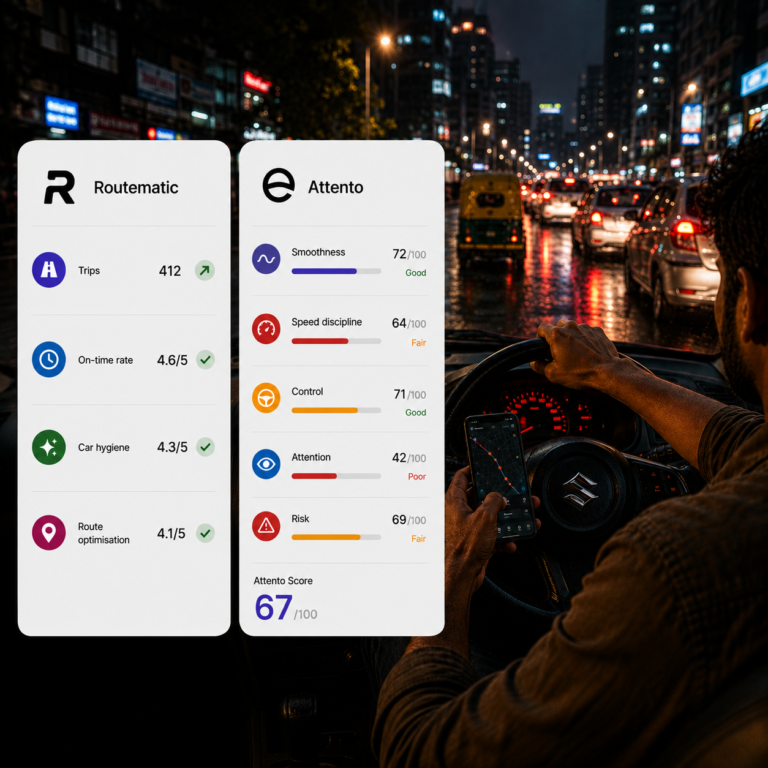
These vehicles carry tens of millions of passengers every single day. What unites every category is not that rules are absent. It is that every one of them is fully documented and almost entirely unmeasured. The vehicle has a fitness certificate. The driver has a licence. The operator has a permit. None of that paperwork records a single thing about how the driver actually drives.
There is a reason regulation evolved this way. Documents are cheap to verify; behaviour is not. A traffic officer can check a licence, permit or fitness certificate in minutes during a roadside stop. Determining whether a driver habitually speeds through school zones, brakes aggressively or overloads passengers requires observing hundreds of trips over weeks or months. For decades, that simply wasn’t practical. So governments learned to regulate what they could inspect rather than what they actually wanted to influence. Technology has fundamentally changed what can be measured. Regulation has not yet caught up. Regulation, in many cases, still reflects an era when continuous behavioural oversight was impossible.
The School Van Blind Spot
The Supreme Court of India has issued guidelines for school transport vehicles on multiple occasions, following the 1997 Yamuna bus crash that killed 28 children, following subsequent accidents, and through ongoing judicial monitoring. Those guidelines specify vehicle condition, driver licensing requirements, capacity limits, speed governors, and the presence of a trained attendant for younger children.
The gap between those guidelines and what happens outside many school gates every morning is enormous.
A 2018 Delhi Traffic Police review found that overloading, drivers using phones, vehicles without conductors, and rash driving were routine in school transport. A Bengaluru Traffic Police crackdown in 2020 found school vans carrying 15 children in vehicles with a stated capacity of five, including children perched on LPG cylinders. The Bengaluru Police Commissioner at the time posted a photograph of the van on X (formerly Twitter) and wrote: “Will parents and school management blame police if we start prosecuting these vans which ferry 15 children dangerously?”
The photograph went viral. The crackdown ran for a few weeks. The practice continued.
The school van is a vehicle that carries some of India’s most vulnerable passengers, young children who cannot assess risk, cannot move away from danger, and whose parents have made a trust-based assumption that someone has verified the safety of the arrangement. That assumption is almost entirely unfounded.
What parents are really paying for is not transportation but risk transfer. Every morning they hand over responsibility to someone else, assuming the school, operator or regulator has already verified the safety of that journey. The value of a school van lies less in moving children from one place to another than in the confidence that those children will return safely. When that confidence rests almost entirely on permits and paperwork rather than observed driving behaviour, trust becomes an assumption instead of a verification.
Did you know? School transport in Delhi answers to three different rulebooks: CBSE guidelines, Delhi Motor Vehicles Rules, and traffic police instructions. No single agency owns enforcement. When everyone is responsible, no one is.
The Categories Nobody Talks About
The auto-rickshaw sits in the same blind spot. India’s autos carry an estimated 50 million trips a day. A government report found 29,351 auto crashes killed 6,762 people in a single year, prompting a 2019 mandate for doors and headlamps to stop passengers being thrown out in a collision. Most autos on the road today still have neither. That single number sits inside a much larger one. India lost over 1.68 lakh lives to road accidents, a toll that continues to climb even as enforcement headlines suggest otherwise.
The deeper problem is not the open cabin or the fare haggling or the app notifications competing for attention. It is the complete absence of any behavioural record for the person driving it. A driver who brakes hard at every junction looks identical, on paper, to one who has never made a dangerous decision. Both carry the same permit. Neither has a behavioural record.
The same blind spot covers categories that rarely enter the conversation at all: wedding and pilgrimage tempo travellers crossing state lines with no professional oversight, corporate shuttles won on price rather than safety record, and mini trucks driven by people with no training for dense city traffic. None of these lack rules. All of them lack a way to know whether the rules show up in how the vehicle is actually driven.
Did you know? India has roughly 8 million auto-rickshaws on its roads, the main source of daily income for millions of drivers. Despite that scale, there is still no standard system tracking how safely any individual driver actually drives.
Documented and Undelivered
A fitness certificate confirms the brakes met a standard on inspection day. It says nothing about how they are used three months later. A licence confirms a test was passed, sometimes through a tout for a few thousand rupees. It says nothing about current following distances. A permit confirms a route is authorised. It says nothing about whether the driver speeds through it daily.
This is the entire story of commercial vehicle regulation in India: a certificate exists, a permit exists, a licence exists, and none of them predict speeding, distraction, harsh braking, or the slow accumulation of near-misses that precedes almost every serious crash. A study in Transport Policy found regulatory fragmentation, multiple agencies with overlapping jurisdiction, a primary barrier to enforcement. But fragmentation is a symptom. The agencies, even working together, are measuring paperwork, not the thing that actually causes crashes.
Did you know? Unsafe driving is rarely one catastrophic mistake. It is the same small habits repeated hundreds of times unchallenged: overloading, rolling stops, speeding past school zones. Every trip that ends fine without consequence just teaches the driver it’s fine to keep doing it.
What Oversight Would Actually Change
At Attento, the finding that matters most here is also the most sobering: unsafe driving is not randomly distributed. It clusters. A driver who speeds near one school tends to speed everywhere. Risk is a behavioural signature belonging to the driver, not a property of a single trip, and it is measurable if anyone is measuring. Behaviour is remarkably consistent across trips. Drivers don’t suddenly become unsafe one Tuesday afternoon. They develop habits. Those habits become patterns. Those patterns become crashes.
Permits identify vehicles. Licences identify drivers. Behaviour identifies risk.
Part 1 pointed to India’s missing reputation layer: an Uber rating that disappears the moment a driver switches to Ola. The informal sector covered here never had that layer to begin with. There is no rating to lose, because there was never anything tracking anything at all.
For a platform driver, the problem is that reputation resets with every platform switch. For an auto driver or school van operator, the problem is that reputation never existed. There is no record to reset because nothing was ever tracked.
A behavioural identity, even a basic one, would change this. Not a permit. Not a fitness certificate. A record of how this specific driver behaves on these specific roads, accumulated over time, portable across operators, visible to the parents handing their child over every morning.
That is not a technology problem. The GPS is already in every smartphone. The accelerometer is already in every app. The data exists. The decision to use it for driver accountability rather than delivery tracking hasn’t been made.
India’s informal commercial drivers do not lack documents. They lack a behavioural identity. We know whether a van has a permit. We do not know whether its driver consistently speeds past schools or has spent six months accumulating exactly the kind of small, repeated risk this series has shown precedes a crash.
An auto driver carrying four passengers, or a van operator who has overcrowded for years without a fine, is not primarily a safety threat. He is a person responding rationally to a system that has never once measured his behaviour, and has therefore never given him a reason to change it.
India’s informal transport sector does not have an enforcement problem. It has an information problem. We know whether a vehicle has papers. We rarely know how its driver behaves.
Until behaviour becomes measurable, unsafe driving will remain largely invisible. Not because it cannot be seen, but because nobody has chosen to measure it.