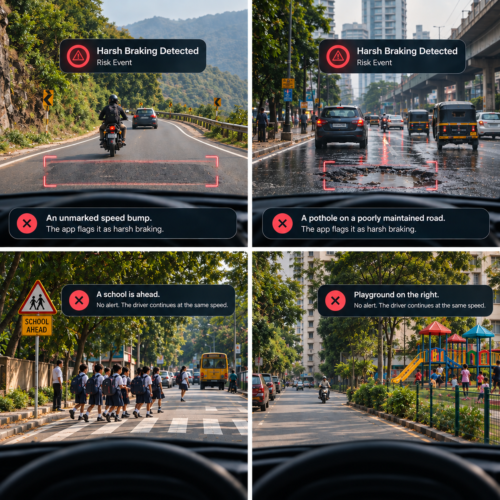
A driver score looks objective. A number goes up, a number goes down, and suddenly a complex behaviour like driving can be reduced to something that feels easy to understand. But there is a problem hidden behind that simplicity: a driving score is only as intelligent as its understanding of the road.
What counts as risky driving depends heavily on the environment in which it happens.
A sudden brake on a well-marked highway may suggest poor anticipation. On an Indian city road, the exact same brake could be the result of a pedestrian stepping into traffic, a motorcycle cutting across the road, an auto-rickshaw stopping unexpectedly, or a speed breaker appearing with barely any warning.
The vehicle does the same thing. The sensor records the same thing.
But the behaviour does not necessarily mean the same thing.
That distinction matters as telematics moves from simply tracking vehicles to understanding the people behind them. Over the last decade, companies such as Cambridge Mobile Telematics and Damoov have helped demonstrate what is possible when smartphones, GPS, sensors, machine learning and large behavioural datasets are used to analyse driving. These systems can identify patterns, assess risk, support insurance decisions and help fleets improve driver safety.
The technology has already established something important:
Driving behaviour can be measured at scale.
The next question is harder.
Can that behaviour be understood correctly across very different driving environments?
For India, that question matters enormously. Because Indian roads don’t simply present different conditions. They can change the meaning of the behaviour itself.
The Global Telematics Playbook
The evolution of telematics has been relatively straightforward.
Early systems focused primarily on the vehicle: where it was, how fast it was travelling, what route it took and how long it remained in a particular location.
As technology improved, the focus shifted from tracking vehicles to interpreting the person behind the wheel. Sudden acceleration, harsh braking, speeding, aggressive cornering and other signals could be detected and combined into a driver score. This created an entirely new layer of intelligence.
Large datasets allowed models to identify behavioural patterns across millions of journeys. Insurers could use those patterns to assess risk. Fleets could use them to monitor and coach drivers. Mobility platforms could use them to improve safety and operational performance.
The underlying idea was powerful: Don’t wait for an accident to happen. Identify behavioural signals that may indicate risk before an incident occurs.
That remains one of the most important advances in modern road-safety technology.
But there is a fundamental limitation to any behavioural model: It learns from the environment in which it observes behaviour.
A model can be sophisticated, well-trained and highly accurate within one environment, yet produce different results when the relationship between behaviour and context changes. And driving is particularly sensitive to that problem. Because driving is not just a person operating a vehicle. It is a person responding continuously to a road environment.
The Road Is Part of the Behaviour
Driving does not happen in a vacuum.
A driver is constantly responding to the road around them, which means the environment becomes part of the behaviour being measured. This is particularly important in India. Indian roads can involve cars, motorcycles, scooters, buses, auto-rickshaws, pedestrians, bicycles and animals sharing the same space.
Lane markings can be inconsistent or disappear altogether. Vehicles may move around obstacles rather than within clearly defined lanes. Road widths can change unexpectedly. Speed breakers can vary dramatically in size and visibility. Construction, roadside parking, encroachment and uneven surfaces can alter the driving environment within a matter of minutes. The result is a driving environment characterised by constant adaptation. Consider lane changes. In one market, frequent lane changes might be a strong indicator of aggressive driving. In a dense Indian city, repeatedly changing position may simply be how a driver navigates around slower traffic, parked vehicles, two-wheelers or an obstruction in the road. The same goes for braking. A high rate of hard braking could indicate poor anticipation, but it could also reflect the frequency of unexpected obstacles in the environment. The sensor captures the manoeuvre. It does not automatically understand why the manoeuvre happened. Context determines meaning.
Speed Is Perhaps the Clearest Example
Speed illustrates the problem particularly well.
A vehicle travelling at 65 km/h tells you almost nothing by itself.
Was it travelling at 65 km/h on a controlled highway?
On a 60 km/h arterial?
On a 50 km/h urban road?
On a narrow residential street?
Near a school?
Through a congested market?
The number is the same. The risk may not be. That is why simply asking whether a driver was speeding is less useful than asking whether their speed was appropriate for the road they were actually travelling on. This is the difference between a generic speed threshold and contextual speed discipline.
The road changes the meaning of the number. And that principle extends well beyond speed.
A hard brake needs context.
A rapid acceleration needs context.
A sharp corner needs context.
A lane change needs context.
Even a pattern that looks risky in isolation may have a different explanation when the surrounding environment is understood. The better the system understands the road, the better it can understand the driver.
India Isn’t Just Another Dataset
This is where the idea of localisation becomes important.
It might seem logical that a global telematics company could simply collect enough Indian driving data, add it to an existing dataset and retrain its model. More data certainly helps, but genuine localisation goes deeper than that.
A machine-learning model does not simply memorise individual driving events. It learns relationships between different signals and patterns. If those relationships change across environments, the model needs to understand those changes.
A driver accelerating quickly while merging into traffic is not necessarily behaving in the same way as a driver accelerating quickly on an empty road. A sudden lane change to avoid a parked vehicle does not carry the same meaning as an unnecessary lane change on a clear highway. A hard brake caused by an unexpected pedestrian is fundamentally different from a hard brake caused by late reaction to a predictable traffic situation. These distinctions require more than a global model with an Indian dataset added on top. They require local calibration and domain adaptation: understanding how the Indian driving environment changes the relationship between a physical driving event and the risk associated with it.
That is a much harder problem.
And potentially a much more valuable one.
AI Can Recognise Patterns. It Still Needs Context.
There is a broader lesson here for AI. Machine-learning models are exceptionally good at identifying patterns, but patterns are not automatically universal truths.
A model can perform extremely well within the environment it was trained on and still produce weaker or misleading conclusions when the underlying conditions change. Driver behaviour is particularly sensitive to this problem because driving is an interaction between a person, a vehicle and an environment.
The driver responds to the road. The road shapes the driver’s behaviour. That behaviour becomes data. The data then teaches the model what behaviour looks like. If the environment changes, the model needs to account for that change.
This is why a useful driver intelligence system should not simply ask, “How does this driver compare with the average driver?”
It should ask a more nuanced question: “How does this driver behave given the conditions in which they are actually driving?”
That distinction changes how the entire problem is approached. Instead of treating every harsh brake, acceleration or lane change as an isolated event, the system can begin looking for patterns across journeys and understanding how those patterns interact with the environment.
The objective isn’t simply to identify more events. It is to interpret them better.
From Events to Behaviour
A single driving event rarely tells the complete story.
One harsh brake could be a mistake. It could be good hazard avoidance.
One rapid acceleration could be aggressive driving. It could also be a necessary manoeuvre in heavy traffic.
One instance of speeding could be an isolated lapse.
Repeated inappropriate speeding across different roads and journeys tells a very different story.
The intelligence emerges when individual events are connected.
Event → Pattern → Context → Behaviour
And then another dimension becomes possible:
Behaviour → Change → Intervention
Is the driver’s braking becoming harsher?
Is speed discipline deteriorating?
Is aggressive acceleration concentrated around particular routes or times?
Is the behaviour consistent across vehicles?
Is it improving after intervention?
Those are much more meaningful questions than simply counting events. Because the goal of behavioural intelligence shouldn’t be to create a more sophisticated list of violations.
It should be to create a better understanding of the driver.
Where Attento Fits
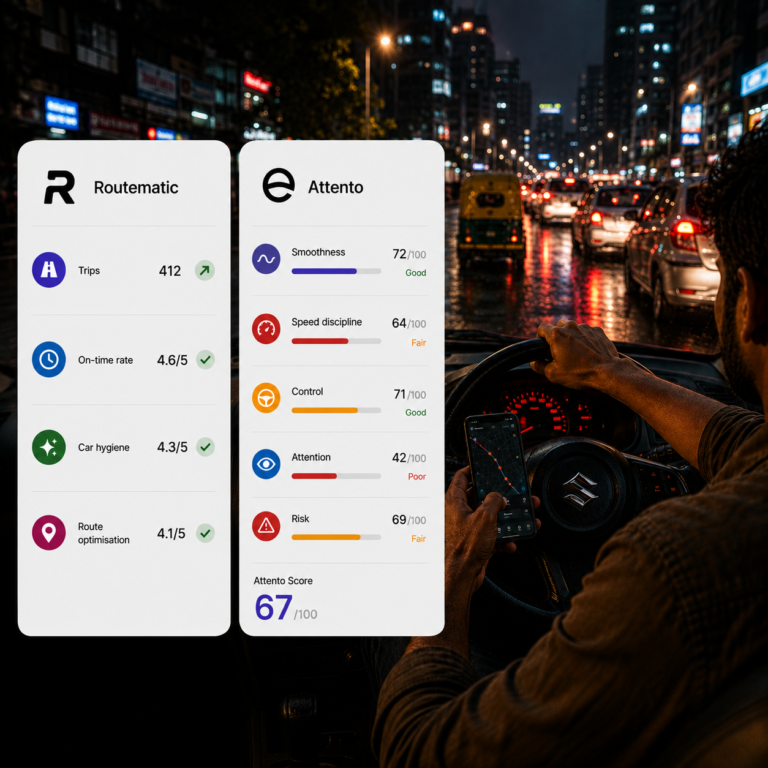
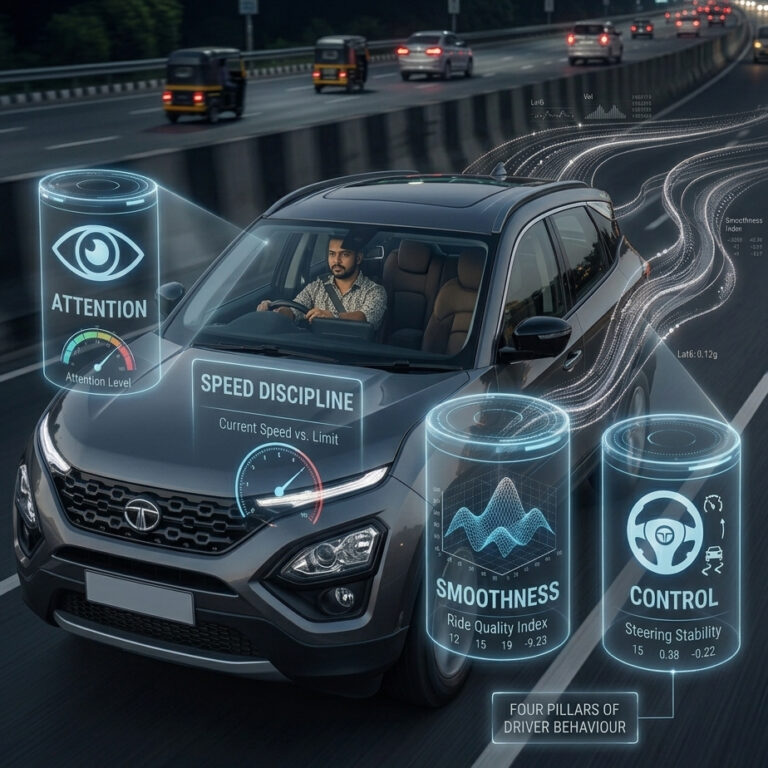
This is the opportunity Attento is built around. Rather than treating Indian driving as a variation of a global driving environment, Attento starts from the realities of how people actually drive in India. That means accounting for mixed traffic, two-wheelers, inconsistent infrastructure, unpredictable road users, speed breakers, dense urban environments and the informal behaviours that are simply part of everyday driving. The goal is not to make Indian drivers fit a global definition of safe driving. It is to build behavioural models that understand what safe and risky behaviour look like within the environments Indian drivers navigate every day. That distinction matters because localisation is not simply about geography. It is about context. And when the objective is to understand human behaviour, context is what turns a sensor reading into an insight.
From Measuring Driving to Understanding It
The next stage of telematics will not simply be about collecting more sensor data. Sensors can already tell us that a vehicle accelerated, braked, turned or changed speed. The harder and more valuable problem is understanding what those events mean.
A braking event is a signal. A speeding event is a signal. An acceleration event is a signal. What matters is how those signals appear together, how often they occur, under what conditions they occur and whether they form a consistent behavioural pattern over time.
That is the difference between measuring a journey and understanding a driver. Global telematics has already proven that driving behaviour can be turned into data. The next challenge is making that intelligence genuinely relevant to the people and environments being measured. For India, that means building from the road up rather than simply importing a model from somewhere else. Because the future of driver intelligence will not belong to systems that merely recognise what happened. It will belong to systems that understand why it happened. And that is where Attento sees its role: not as another generic driver-scoring platform, but as India-first behavioural intelligence built to understand the road before it judges the driver.
The End of Attento vs.
This is the final piece in the Attento vs. series.
Across the series, we’ve looked at ADAS, dashcams, insurance telematics, OEM driving scores, Driver Monitoring Systems, fleet management and now global telematics.
Each technology solves a legitimate problem.
ADAS can intervene when a crash is about to happen.
Dashcams can provide evidence when something has happened.
Insurance telematics can measure risk.
OEM systems can score recent driving.
DMS can monitor driver attention.
Fleet systems can track vehicles and operations.
Global telematics has demonstrated that behavioural driving data can be analysed at scale.
None of these approaches needs to be dismissed for another to be valuable.
The bigger opportunity is to understand how they fit together and what is still missing.
Because ultimately, road safety isn’t about whether we can collect more data about a driver.
It’s about whether we can turn that data into an understanding of how, why and where that driver behaves the way they do.
And for a country as diverse and complex as India, that understanding has to begin with the road itself.
The road changes. The context changes. The meaning of the behaviour changes.
The intelligence needs to change with it.
The Attento vs. series ends here. The work of understanding driving doesn’t.