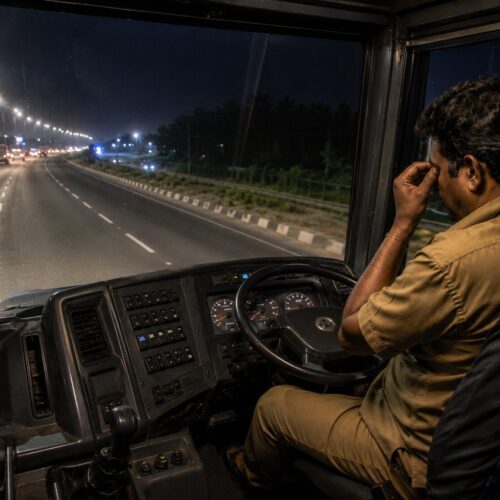
You book a sleeper bus from Mumbai to Bengaluru. The ticket costs Rs. 1,200. The journey is 982 kilometres on NH-48. The bus departs at 9 PM and is scheduled to arrive by 7 AM.
Somewhere around 3 AM, the driver has been at the wheel since before you boarded. The road is dark and straight. The passengers are asleep. You do not know how long he has been driving. The operator does not tell you. There is no law that requires them to.
At some point between one junction and the next, he stops being conscious. Not dramatically. Not with a jolt or a swerve. He simply ceases to be present. His eyes may still be open. The bus continues at speed.
This is not a freak accident. It is what the schedule demands.
Over 50 private bus operators run the Mumbai-Bengaluru overnight route daily. Private operators represent over 92% of India’s bus sector, according to a 2024 ITDP report. The rules governing how long their drivers can work are the same rules that governed them in 1961. The enforcement of those rules in 2025 is approximately the same as it was in 1961.
Part 1 of this series examined how algorithmic management reshapes risk for India’s gig drivers. This is Part 2: what happens when the human body’s need for sleep collides with the economics of overnight transport.
The Number Nobody Enforces
On the 165-kilometre Yamuna Expressway between Agra and Noida, a Right to Information query filed by road safety activist Kishan Chand Jain produced a finding that has not received the policy attention it deserves.
Between 2012 and 2023, there were 7,625 road accidents on the expressway. 3,364 of them ,44% were caused by drivers who dozed off at the wheel, claiming 522 lives.
Speeding caused 23% of crashes on the same stretch. Less than half the fatigue figure.
Speed cameras cannot detect a microsleep. Enforcement remains almost entirely focused on violations the camera can catch. The single largest cause of death on one of India’s most modern expressways is being systematically ignored because it does not register on a radar screen.
Did you know? India’s Motor Vehicles Act requires drivers of public service vehicles to not exceed eight hours of driving per day, and overnight journeys above a certain distance require a relief driver.
These rules have existed for decades. In practice, a significant share of private intercity buses run with a single driver on routes that take ten to fourteen hours. A second driver is a cost. A single driver on a double shift is a saving. The regulation and the economics point in opposite directions, and the economics win.
Two Sectors, Two Very Different Problems
Not all overnight drivers work under the same conditions. The difference between state transport corporations and private operators is significant, yet rarely discussed in India’s road safety debate.
Drivers employed by MSRTC, KSRTC, UPSRTC and other state transport corporations are government employees. They typically have union representation, structured duty rosters, and formal rest-hour regulations. On paper, safeguards exist. In reality, aging fleets, breakdowns, staffing shortages, festival rushes, and inconsistent enforcement often push drivers beyond planned schedules.
Private operators face a different reality. Most lack union protection, formal fatigue management systems, or strict oversight. On highly competitive routes, employing a second driver increases costs, creating pressure to maximize driving hours. In many cases, fatigue is managed informally, if at all.
The result is a stark contrast: state transport drivers operate within a system that does not always enforce its safeguards, while many private-sector drivers operate with few safeguards to begin with.
What a Microsleep Actually Is
The word drowsy driving understates the mechanism. The brain does not gradually dim. It cuts out.
A microsleep is an involuntary, unconscious gap in awareness lasting anywhere between a fraction of a second and fifteen seconds. The eyes may remain open. The driver may appear to be watching the road. The brain has stopped processing external information entirely. There is no awareness. No reaction.
The physics are precise and unforgiving:
- A three-second microsleep at 90 km/h covers 75 metres with no conscious control
- A four-second microsleep at 100 km/h covers 111 metres entirely without driver input
- A five-second microsleep at 110 km/h covers approximately 153 metres
What makes microsleep particularly dangerous is that the people experiencing it are almost always unaware it happened. Research consistently shows that sleep-deprived individuals significantly overestimate their own alertness. The driver who insists they are fine to continue is statistically the driver most likely to be wrong.
Did you know? In July 2019: a sleeper bus plunged into a 40-foot drain on the Yamuna Expressway killing 29 passengers after the driver fell asleep.
May 2023: a bus broke through a bridge railing in Khargone, Madhya Pradesh, killing 22 people, including three children, after the driver dozed off and fled the scene. These are not isolated events. They are the visible end of a pattern far more common than the headlines suggest.
The Biology the Schedule Ignores
Every human being has a biological window during which the body demands sleep most urgently. Sleep researchers call it the circadian trough. It falls between 2 AM and 5 AM. During this window:
- Core body temperature drops to its daily low point
- Melatonin production peaks
- Reaction times slow measurably
- The capacity to sustain attention deteriorates in ways that caffeine, cold air, and loud music cannot reliably reverse
This is not a matter of discipline or experience. It applies equally to a driver on their first overnight route and their five hundredth. The circadian trough does not respect tenure.
India’s busiest overnight routes operate straight through this window. The Bengaluru-Hyderabad corridor. Mumbai-Nagpur on the Samruddhi Expressway. Delhi-Lucknow. Chennai-Coimbatore. These arteries of India’s intercity travel economy are navigated by single drivers, on tight schedules, during the most biologically dangerous hours of the 24-hour cycle.
Caffeine delays the process. It does not prevent it. Once sleep debt reaches a critical threshold, stimulants borrow alertness from a depleted reserve. When the effect fades, sleep pressure returns with greater force. A coffee at 2 AM on hour twelve does not make a driver safe. It makes them confident. At highway speed, with forty passengers asleep behind them, that distinction is everything.
The Invisible Category
The overnight bus gets the headlines when crashes happen. The intercity cab driver is a category that barely registers in India’s road safety conversation, despite facing an almost identical risk profile with far less regulatory visibility.
Ola Intercity, Savaari, Yatra cabs, and thousands of individual operators running ad hoc intercity bookings form a massive, largely untracked network of overnight point-to-point travel. A cab booked from Bengaluru to Coimbatore at 10 PM, a journey of roughly 360 kilometres will arrive somewhere between 4 AM and 6 AM if the driver pushes through. There is no second driver. There is no rest stop requirement. There is no logbook.
The economics replicate the bus operator’s logic exactly. A cab operator who books an intercity overnight trip has a fixed revenue from that booking. A rest stop costs time. Time costs a return booking. The driver who completes the journey fastest maximises the operator’s utilisation. The biological cost of navigating 360 kilometres between midnight and 6 AM, straight through the circadian trough, is absorbed by the driver alone.
The customer adds a layer of pressure the bus passenger does not. A bus passenger cannot call the driver mid-route and ask why they have stopped for 20 minutes at a dhaba. A cab passenger can and frequently does. Intercity cab ratings on every platform are partly determined by arrival time. A driver who stops for a genuine 15-minute rest at 2 AM risks a lower rating, a complaint from the passenger, and a platform penalty. The incentive is to keep driving.
Unlike the Ola or Uber city driver examined in Part 1, the intercity cab driver receives almost no academic or policy attention. There are no studies on their fatigue exposure. There is no data on accident rates specific to intercity cab journeys. They exist in the gap between the gig economy literature and the commercial transport literature, belonging fully to neither, tracked by nobody.
Did you know? The circadian trough between 2 AM and 5 AM is the same biological window in which most long-distance intercity cab journeys are completing the bulk of their route. A cab that departs Bengaluru at 10 PM for a 360-kilometre journey to Coimbatore will be on the road between 1 AM and 4 AM, exactly the period when human alertness is at its physiological minimum. There is no platform policy, no operator requirement, and no regulatory mandate that addresses this.
In December 2025, IndiGo cancelled over 1,200 flights in two weeks after the Directorate General of Civil Aviation tightened its Flight Duty Time Limitation rules, requiring pilots to have longer rest intervals, stricter caps on night flying hours, and 48-hour weekly rest periods. IndiGo had not hired enough pilots to absorb the new rules. Ticket prices on competing routes crossed Rs. 1 lakh. The government ordered a high-level inquiry. The story was on the front page of every newspaper for a week.
India has 7,000 commercial pilots. Their duty hours and fatigue exposure are regulated by one of the most closely monitored frameworks in the country, with digital records and consequences when the rules are broken.
India has hundreds of thousands of commercial bus drivers. Their duty hours are recorded in a manual logbook. Filled in by the driver. Nobody checks it in real time.
A pilot falling asleep in a cockpit is a national emergency. A bus driver falling asleep on a highway is a statistic.
The gap between how India regulates fatigue for people carrying 200 passengers at 900 kilometres per hour and those carrying 40 passengers at 100 kilometres per hour is not a policy oversight. It is a statement about whose passengers are considered worth protecting.
The Signs Appear Early
Fatigue does not arrive without warning. It leaves a measurable signature long before a driver loses consciousness:
- Progressive speed inconsistency – oscillating between acceleration and braking without apparent cause
- Reduced steering micro-corrections – inputs becoming coarser, less frequent, and delayed
- Lane drift – corrections becoming less precise as sustained attention degrades
- Lengthening reaction windows – the gap between a visible hazard and response growing from fractions of a second to full seconds
At Attento, we track these signatures across commercial driving contexts: speed variance patterns, steering correction frequency, and braking initiation timing. Fatigue is visible in driving behaviour long before the driver recognises it in themselves. The gap between when the data shows impairment and when the driver acknowledges being tired can be hours.
That gap is where the risk lives.
The overnight transport problem will not be solved by asking drivers to rest more. Most of them know. The economics of the route do not allow it. The schedule does not permit it. The relief driver was never booked.
The body, however, does not negotiate with schedules.