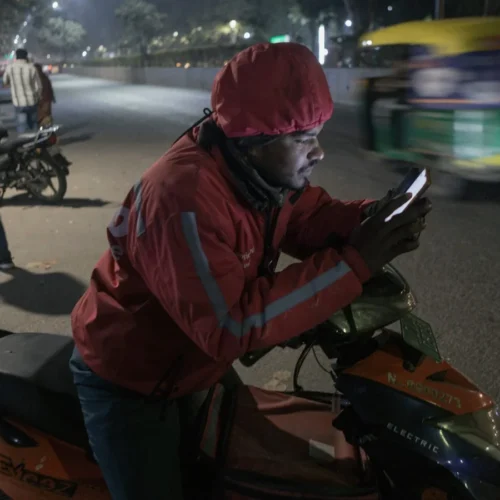
Imagine this.
You are on a two-wheeler in Bengaluru. It is 7:43 PM. You have been on the road since noon. Your phone shows two active apps. A third notification just arrived from a competing platform offering a surge bonus. The order timer is counting down. Four minutes left to reach a building in a lane your navigation has misidentified twice.
You are not distracted. You are doing exactly what the job requires.
That is the problem.
India’s commercial driving crisis is not one problem. It is five different systems producing five different kinds of unsafe behaviour. Over the next five pieces, Attento will examine each one.
- Part 1 – The Algorithm: How app-based platforms are managing drivers into danger
- Part 2 – Biology vs Schedule: Why overnight transport runs against human nature
- Part 3 – The Urgency Trap: The hidden pressures behind India’s trucking industry
- Part 4 – The Oversight Gap: Commercial drivers operating with no meaningful accountability
- Part 5 – The High-Stakes Run: What it means when one driver’s mistake affects fifty people
This is Part 1: the algorithmically managed driver, and why the app on their phone is the most dangerous thing about the job.
A System Designed to Keep Drivers Moving
India’s gig economy has produced a class of commercial driver unlike anything in the country’s labour history: the algorithmically managed worker. Roughly 7.7 million people worked in platform-based jobs in 2020-21, according to NITI Aayog. By 2029-30, that figure is projected to reach 23.5 million.
The algorithms decide which trips to offer. It tracks acceptance rates, enforces deadlines, scores every trip, and can deactivate an account without notice or explanation. No employer in India’s formal sector exercises this level of real-time behavioural control over a worker. And none do it while that worker is moving through traffic at 40 kilometres per hour.
The rating system is where the pressure becomes structural. Every trip is scored. Ratings below a threshold trigger warnings. Too many warnings and the account is suspended. A driver who takes a rest break is a driver whose acceptance rate falls. A driver whose acceptance rate falls is a driver whose income falls. The incentive architecture is designed to keep drivers moving at all times. The road safety consequences of that design are not factored in.
What compounds this further: a significant share of India’s platform drivers are not doing this as their only job. Small business owners starting their second shift at 7 PM. Workers driving weekends to cover a vehicle loan. The algorithm does not know any of this. It does not distinguish between a driver at the start of their day and one who is eight hours deep into another job. It simply measures whether they accepted the last order.
The Fairwork India Ratings 2024, produced by Oxford University and the International Institute of Information Technology Bangalore, scored Ola, Uber and Porter at zero out of ten for working conditions. Not low. Zero. No grievance mechanisms. No worker representation. No fair management practices of any kind documented.
The Economics That Make It Worse
Because a single platform does not pay enough, drivers run multiple apps simultaneously. Uber and Ola side by side. Swiggy and Zomato. Rapido layered on top. A Human-Computer Interaction study of Indian platform workers confirmed that app-switching is treated as a basic survival strategy. A single platform does not generate sufficient income. Running two or three does.
The numbers explain why. Zomato’s chief executive Deepinder Goyal disclosed in January 2026 that the average delivery partner earned Rs. 102 per hour in 2025. Delhi’s official minimum wage for unskilled workers is more than three times that figure. To approach a liveable income, a rider must maximise every hour, accept every viable order, and move as fast as the roads allow.
The 10-minute delivery promise accelerates this pressure. On New Year’s Eve 2025, over two lakh delivery workers from Zepto, Zomato, Blinkit, Swiggy, and others walked off the job in a nationwide strike. Their demands were not complicated: an end to 10-minute targets, mandatory rest breaks, and basic accident insurance. The platforms mostly kept running. In January 2026, India’s central government asked quick commerce platforms to drop the model. The request was not legally binding. The 10-minute race continues. Blinkit, Zepto, Swiggy Instamart, and Bigbasket even now continue to compete on speed. Platforms insist riders face no penalties for late delivery. Unions have consistently disputed this, pointing to rating systems that function as indirect enforcement mechanisms, invisible below the level of any formal policy.
The 10-minute promise was not designed by the rider. It was designed by product teams competing for market share. The rider is simply the person the timer controls.
Did you know? Two-wheeler rider deaths in India nearly doubled between 2014 and 2023, rising from five deaths per hour to nine per hour, according to an IndiaSpend analysis of Ministry of Road Transport and Highways data.
Every other road user category saw fewer deaths over the same period and the sharp rise in two-wheeler fatalities has occurred during the same period that app-based delivery work expanded dramatically across India.
The Science of What Happens Next
Every app switch, every notification, every voice navigation prompt generates what researchers call cognitive load. And here is what the platforms do not tell you about that load: it does not end when the interaction ends. For a rider managing multiple apps in city traffic, this isn’t a minor inconvenience. It is a compounding hazard with every notification.
A study by the University of Utah, cited in Scientific American, found that cognitive distraction depletes a driver’s attention for at least 27 to 30 seconds after the distraction ends. The American Automobile Association (AAA) Foundation for Traffic Safety confirmed this, and added that voice-based tasks, including navigation input and customer calls, create cognitive distraction equivalent to a blood alcohol level of 0.08%, the legal drunk-driving threshold in most countries.
At 40 kilometres per hour, a rider covers 300 metres in those 27 seconds. That is three cricket pitches. More importantly, that could be busy junction, a school gate, and a pedestrian crossing.
The riskiest moment for a platform driver is not when they are on the app. It is the half-minute immediately after, when they believe their attention is back on the road but their brain has not finished processing the previous interaction. A delivery notification received at a busy junction does not end when the rider pockets their phone. It ends 30 seconds later.
On an Indian road, that is a very long time.
What the Platforms Have Decided Not to See
The platforms know what they measure. Here is the full picture:
What platforms track:
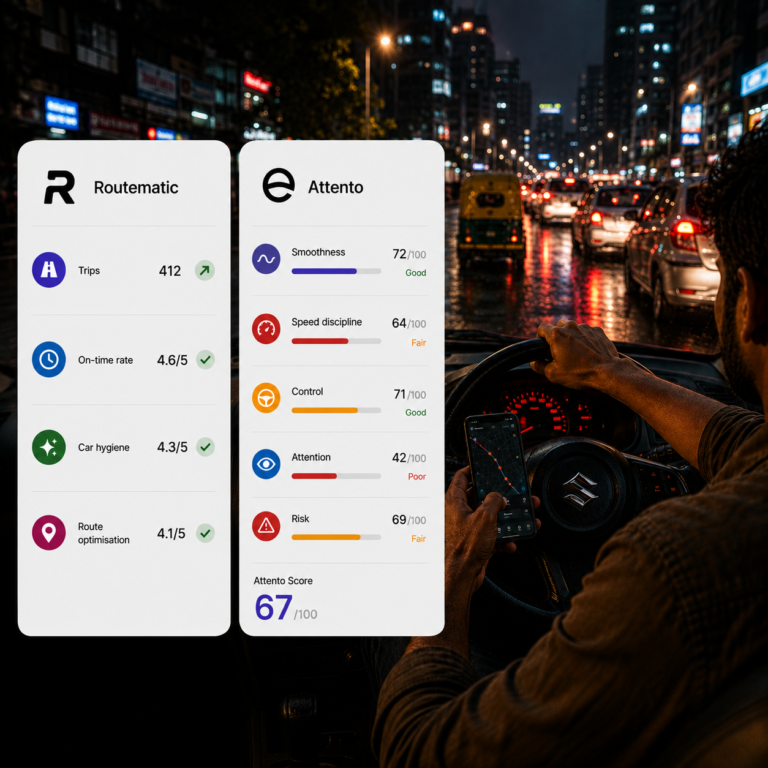
- Acceptance rate
- Delivery time
- Customer rating
- Cancellation frequency
- GPS location and utilisation
What platforms do not track:
- Braking consistency
- Speed variance
- Distraction patterns
- Fatigue accumulation across a shift
- Risk exposure per kilometre driven
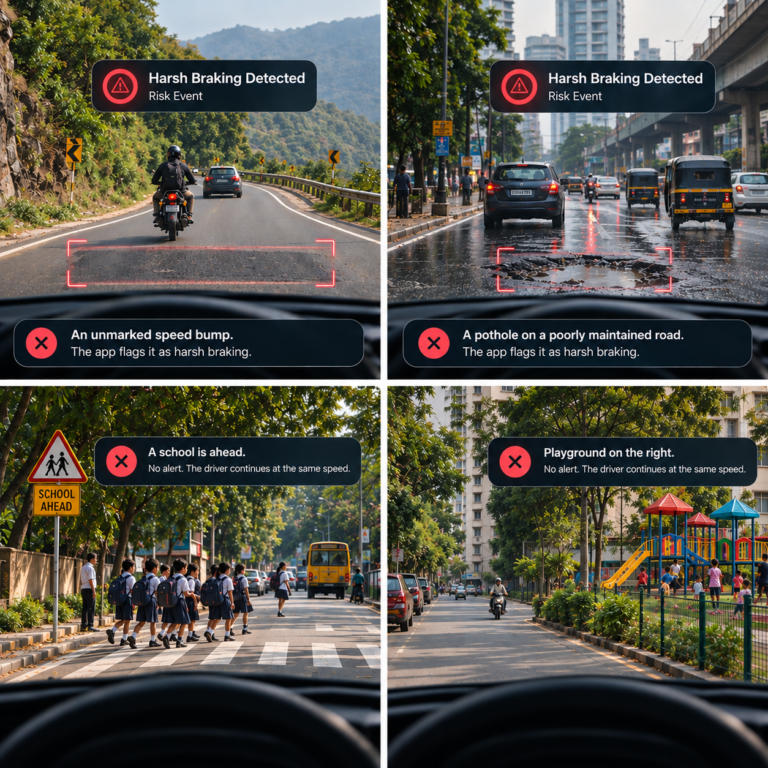
A rider can speed, tailgate, brake aggressively, and run amber lights, and still be considered a high-performing driver by every metric the platform uses. Meanwhile, a cautious driver who maintains safe following distances and refuses trips at the edge of fatigue may score lower, earn less, and be deprioritised. The platform’s definition of a good driver and road safety’s definition of a good driver are not just different. They are sometimes opposites.
Zomato and Swiggy, when asked by IndiaSpend about driver safety, confirmed that riders complete a mandatory road safety module before onboarding. Neither platform disclosed what the module contains or whether it has any measurable effect. A module completed once, before a driver has experienced a single shift, is not a safety system. It is a liability disclaimer.
And this risk does not stay with the driver. Every food delivery, grocery order, and ride-hailing trip depends on a commercial driver making hundreds of decisions in traffic. When platforms optimise for speed and utilisation, that risk spills onto every pedestrian at a junction, every two-wheeler in the next lane, every family sharing the road with someone on their fourteenth hour of a double shift. The road safety implications of how this workforce is structured are not a driver welfare issue. They are a public safety issue that affects anyone who steps outside.
The platform optimizes for efficiency. The road pays for the externalities.
The Reputation That Should Travel With the Driver
An Uber driver rating stays on Uber. A Swiggy delivery agent rating stays on Swiggy. A rider moving platforms starts from zero, regardless of how safely they drove before.
Imagine if CIBIL worked that way. Every time you changed banks, your credit history disappeared. That would be absurd. Yet that is exactly how commercial driver reputation works in India today.
What commercial driving needs is a reputation system that is fair, explainable, and portable, one built from actual driving behaviour, not delivery speed.
At Attento, we believe safe drivers should be able to prove they are safe through a portable record that travels with the driver and means something across the industry. Just as CIBIL made creditworthiness portable, the next decade of mobility may require driving trust to become portable too.
One pattern with driving behaviour, though, remains consistent. Risk does not arrive suddenly. It accumulates gradually, across hundreds of trips, and it is measurable long before it produces an incident.
The platforms have decided to measure delivery times instead.