Every generation believes it is witnessing the safest cars ever built.
For the first time in automotive history, that belief is objectively true.
Modern vehicles can automatically brake before a collision, keep themselves centred within a lane, detect vehicles hidden in blind spots, warn drivers of fatigue, adjust their speed to maintain safe following distances, and increasingly, make split-second decisions that once depended entirely on human reflexes. Technologies that belonged to research laboratories two decades ago are now finding their way into family sedans and sport utility vehicles.
Road safety has spent the better part of fifty years making the vehicle smarter.
Yet one statistic has remained stubbornly resistant to that progress.
Every year, approximately 1.7 lakh people lose their lives on Indian roads.
Those two facts are not contradictory. They describe two entirely different problems.
The first is an engineering problem, and the automotive industry has made extraordinary progress in solving it. The second is a behavioural problem, and despite decades of innovation, it remains largely unmeasured.
Advanced Driver Assistance Systems, better known as ADAS, sit precisely at the intersection of these two realities. They are among the most significant advances in vehicle safety in modern history, and simultaneously among the most misunderstood.
Not because they do not work. They do. But because what they were designed to solve is fundamentally different from what India’s road safety challenge increasingly demands.
This article is the first in Attento vs., an eight-part series examining the technologies, systems and assumptions shaping modern road safety. Each article begins from a simple premise: every technology solves a real problem exceptionally well. The more interesting question is not whether it works, but what problem it was never designed to solve.
ADAS is the obvious place to begin. Not because it is insufficient. But because it perfectly illustrates how engineering excellence and behavioural understanding solve different parts of the same journey.
The Decision That Happened Thirty Seconds Earlier
Imagine a vehicle travelling at 90 kilometres per hour on a national highway. The driver glances down to read a notification. For two seconds, nothing appears to happen. The vehicle continues moving smoothly. The lane remains straight. The speed hardly changes.
By the time the driver’s attention returns to the road, traffic ahead has slowed sharply.
Automatic Emergency Braking detects the closing gap. The brakes engage. The collision is avoided. From the vehicle’s perspective, the story began when the closing speed exceeded a critical threshold. From the driver’s perspective, it began when their eyes left the road.
From a behavioural perspective, however, it began much earlier.
Perhaps this was the tenth time the driver had checked their phone during the journey. Perhaps they had been sleeping poorly for several nights. Perhaps they had gradually become comfortable following vehicles more closely because previous journeys had ended without consequence. The emergency braking event was not the beginning of the problem. It was its final expression.
That distinction matters because it reveals something fundamental about how road safety technologies work. Most systems intervene at the moment a situation becomes dangerous. Very few understand how that situation was created. Every technology in modern road safety occupies a different point along the same causal chain.
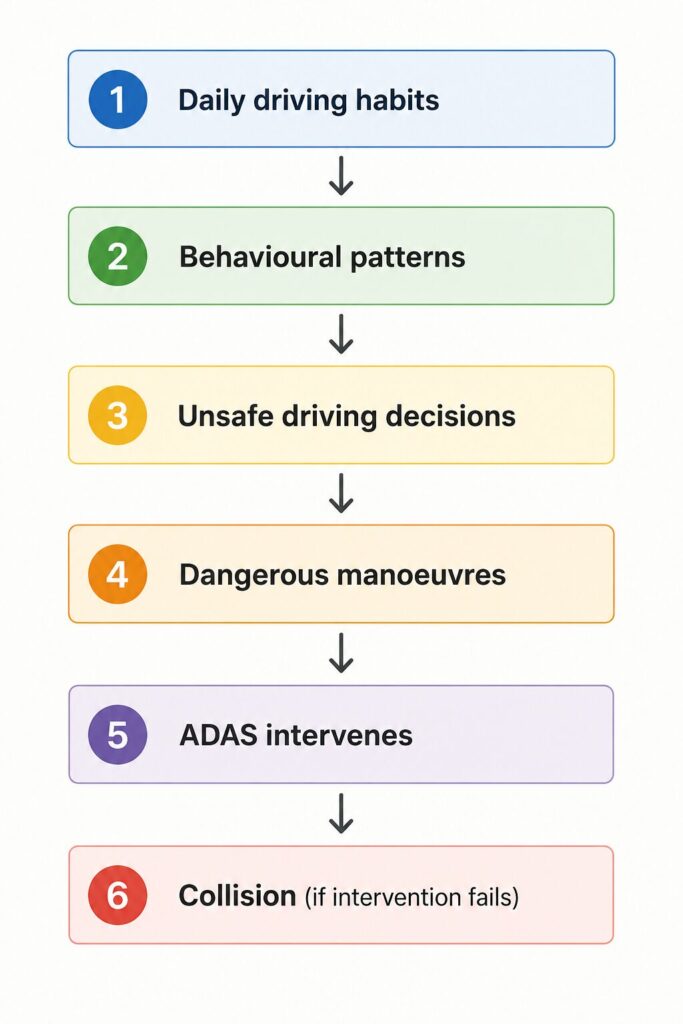
Understanding where a technology sits within this chain tells you almost everything about what it can—and cannot—do.
ADAS operates near the end of the sequence.
Its purpose is to prevent an unsafe situation from becoming an irreversible one.
Attento begins much earlier.
Rather than asking “Can the vehicle avoid this collision?”, it asks a different question.
“Why did this driver repeatedly create situations where emergency intervention became necessary?”
The distinction is subtle. Its implications are profound.
Because reducing the consequences of mistakes and reducing how often those mistakes occur are not the same problem.
What ADAS Actually Is
Despite the way it is often marketed, ADAS is not a single technology.
It is an ecosystem of independent systems, each designed to solve a specific driving problem.
- The Anti-lock Braking System (ABS), mandatory on all new passenger vehicles sold in India, prevents wheels from locking during hard braking, allowing drivers to retain steering control even under maximum braking force.
- Electronic Stability Control (ESC) monitors wheel speed, steering angle and vehicle yaw to detect the onset of a skid, selectively braking individual wheels to restore stability before the driver may even realise control is being lost.
- Automatic Emergency Braking (AEB) uses cameras, radar, LiDAR—or increasingly, a combination of all three—to detect imminent collisions. If the driver fails to respond in time, the system automatically applies the brakes to either avoid the collision altogether or significantly reduce its severity. Recognising its effectiveness, India has mandated AEB for passenger vehicles carrying more than eight occupants from April 2026.
- Lane Departure Warning (LDW) monitors road markings and alerts drivers when the vehicle unintentionally drifts from its lane. Lane Keeping Assist (LKA) goes one step further by gently correcting the steering to guide the vehicle back towards the centre of the lane.
- Adaptive Cruise Control automatically adjusts vehicle speed to maintain a safe following distance from traffic ahead.
- Blind Spot Monitoring identifies vehicles approaching areas that mirrors cannot easily reveal, warning drivers before they change lanes.
Individually, each of these technologies addresses a specific risk. Collectively, they represent one of the greatest advances in occupant safety since the widespread adoption of seatbelts and airbags.
The European New Car Assessment Programme estimates that Automatic Emergency Braking alone can reduce rear-end collisions by roughly fifty percent under the conditions for which it was designed.
That final qualification is doing considerably more work than it first appears.
Because the effectiveness of ADAS depends not only on the sophistication of its algorithms, but also on the assumptions those algorithms were built upon.
The Assumption ADAS Was Built On
Every technology reflects the environment in which it was created.
ADAS is no exception.
Its underlying assumption is surprisingly straightforward.
A reasonably attentive and broadly competent driver, travelling through a structured road environment with clearly marked lanes, predictable traffic behaviour and consistent infrastructure, makes a momentary mistake.
The vehicle detects that mistake. The vehicle intervenes. That description fits a significant proportion of crashes across Europe, Japan and North America. It is also why ADAS performs remarkably well during standardised testing.
Road markings are clearly visible. Traffic behaves predictably. Vehicles travel in defined lanes. Pedestrians cross at expected locations. The system identifies a deviation from normal behaviour and responds within milliseconds. Engineering does exactly what it was designed to do. India presents a very different operating environment.
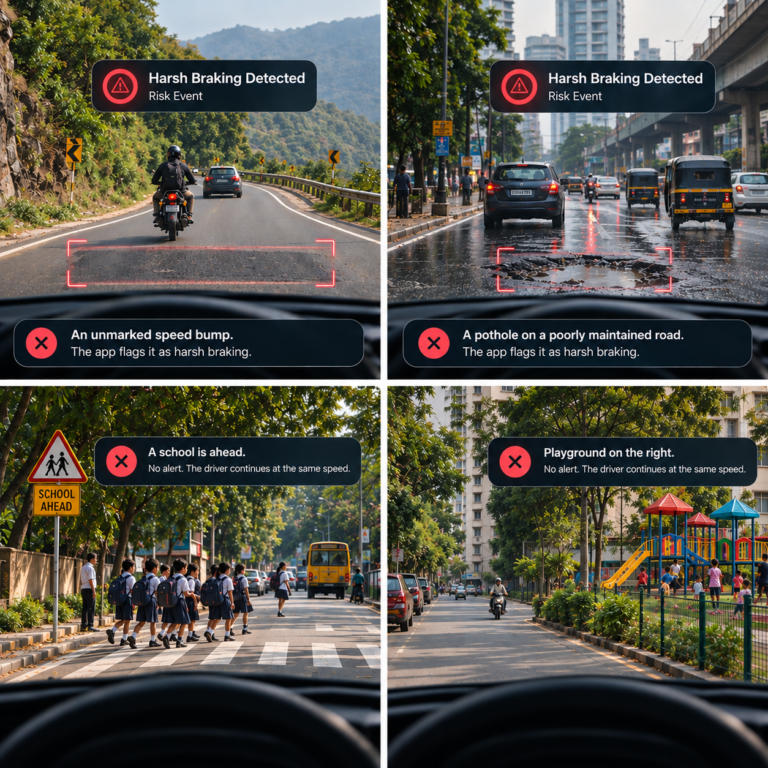
A single urban journey may include faded lane markings, two-wheelers filtering between lanes, autorickshaws making unexpected manoeuvres, pedestrians crossing outside designated areas, livestock wandering onto carriageways, temporary road diversions, unmarked speed breakers and construction zones—all within a matter of minutes.
The challenge is not merely that Indian roads are more complex. It is that they demand a fundamentally different kind of attention.
A German motorway rewards consistency. Maintain your lane. Maintain your speed. Maintain your following distance.
An Indian highway rewards continuous judgement.
Drivers are constantly negotiating with imperfect infrastructure, unpredictable traffic, informal road behaviour and rapidly changing environments. This is not simply more difficult driving. It is behaviourally richer driving. That distinction has practical consequences.
A January 2026 report by Indian ADAS company Starkenn found that many commercial drivers were actively disabling assistance systems—not because they rejected safety technology, but because repeated false alerts had become disruptive.
Lane Departure Warnings triggered on roads where lane markings barely existed. Collision alerts responded inconsistently to unmarked speed breakers. Systems trained primarily on orderly traffic struggled to interpret India’s uniquely heterogeneous roads.
Eventually, drivers stopped listening.
A safety system that cries wolf consistently enough ceases to be a safety system. But there is an even deeper behavioural consequence that receives far less attention. The moment a safety technology is given a reassuring name, it begins influencing behaviour in ways its engineers never intended.
- Autopilot.
- ProPilot.
- Drive Assist.
- Safety Shield.
Each name communicates certainty. The engineering delivers assistance. Drivers adapt not only to what the vehicle does, but to what they believe the vehicle is capable of doing. That gap between engineering reality and human perception is not a software problem. It is a behavioural one.
And it sits entirely outside the design scope of ADAS.
Where ADAS Stops
Every technology has boundaries. The most successful technologies are often the ones with the clearest understanding of where those boundaries lie.
ADAS was never designed to monitor a driver’s habits. It was never intended to understand whether someone had spent the past week driving while fatigued, whether they consistently followed vehicles too closely, or whether they had gradually become comfortable checking their phone every few minutes. Its purpose is much narrower—and precisely because it is narrower, it performs remarkably well.
Automatic Emergency Braking activates when a collision becomes imminent. Lane Keeping Assist intervenes after the vehicle begins drifting out of its lane. Blind Spot Monitoring alerts the driver when another vehicle has already entered a blind zone. Drowsiness alerts activate only after the system detects signs of fatigue.
Every intervention occurs at, or immediately before, the moment of risk. That is not a design limitation. It is the design. The mistake many conversations about ADAS make is assuming that if a technology prevents a crash, it must also have understood what caused it. Those are two entirely different questions. Imagine two drivers.
The first follows traffic at a safe distance for six months before one unexpected distraction causes a near collision. The second tailgates every vehicle they encounter, brakes aggressively at every signal, exceeds speed limits on familiar roads, and routinely checks their phone while driving. By coincidence, they have not yet been involved in a serious incident.
An ADAS-equipped vehicle may intervene in exactly the same way for both drivers. From the perspective of the vehicle, both situations look identical. From the perspective of road safety, they could not be more different. One driver made an isolated mistake. The other has developed a behavioural pattern.
ADAS responds to the moment. It does not distinguish the journey that led to it.
That distinction is the beginning of behavioural intelligence.
Every Emergency Has a History
Crashes have a peculiar way of appearing sudden. News reports describe a collision as though it emerged from nowhere: a driver lost control, a pedestrian was struck, two vehicles collided. But road safety researchers have long understood that serious crashes are rarely isolated events. They are usually the visible outcome of dozens—or even hundreds—of smaller behavioural decisions accumulating over time. The collision itself is often the final link in a much longer chain.
A driver who repeatedly follows too closely eventually encounters a situation where the available stopping distance is no longer enough. A driver who gradually becomes comfortable looking away from the road for “just two seconds” eventually glances down at precisely the wrong moment. A driver who repeatedly drives while fatigued eventually experiences the microsleep that they do not remember having.
The emergency is visible. The behaviour that produced it usually is not.
This is where Attento begins looking at the problem differently.
Instead of asking, “Can this collision be prevented?”, Attento asks, “What behavioural patterns made this collision increasingly likely long before it happened?”
That difference may sound subtle. Operationally, it changes everything.
ADAS acts in moments. Behaviour measures the patterns that lead up to those moments.
The objective is no longer simply preventing one emergency braking event. It is reducing how many emergency braking events become necessary in the first place.
When Safety Changes Behaviour
There is another reason why understanding behaviour matters. Humans rarely respond to increased safety by simply becoming safer.
In 1975, economist Sam Peltzman proposed an idea that has since become one of the most influential concepts in behavioural economics. When people perceive themselves to be better protected, they often compensate by accepting greater levels of risk.
Drivers wearing seatbelts may drive slightly faster. Cyclists wearing helmets may take marginally greater chances. Investors protected against losses may become less cautious.
Safety changes behaviour. Driving is no exception. ADAS has dramatically improved vehicle safety. It has also changed what many drivers believe the vehicle is capable of doing.
Research increasingly suggests that some drivers become less attentive when assistance systems are active. The confidence created by lane-centering, adaptive cruise control or automatic braking can subtly reduce the perceived need for continuous vigilance.
These behavioural shifts are rarely dramatic. They are incremental. A driver glances at a navigation screen for an extra second. They delay braking because they subconsciously expect the vehicle to help. They check mirrors slightly less often because blind spot monitoring feels reassuring. Each decision is almost invisible. Collectively, they become measurable.
This does not mean ADAS makes drivers worse. Far from it. The technology still delivers substantial safety benefits. It simply means that engineering and psychology interact in ways engineering alone cannot fully predict.
A 2024 paper published in the Journal of Law and Economics reached a similar conclusion. While ADAS significantly reduced crash probability, part of its safety benefit was offset by changes in driver behaviour. The engineering worked. Human behaviour adapted. Road safety has always been a partnership between people and machines. The better our machines become, the more important it becomes to understand how people respond to them.
The Missing Layer in Road Safety
For decades, conversations about road safety have focused on two questions.
- How do we build safer roads?
- How do we build safer vehicles?
Those remain essential questions. Infrastructure saves lives. Engineering saves lives.
But they are only two layers of a much larger system. Every journey is also shaped by the human being behind the steering wheel. That behavioural layer has historically been the hardest to measure. Crash investigations tell us what happened.
Vehicle telematics often tell us where it happened. Traffic cameras tell us when it happened. Few systems explain why similar situations keep recurring across weeks, months and years of driving. That is the gap Attento was built to address.
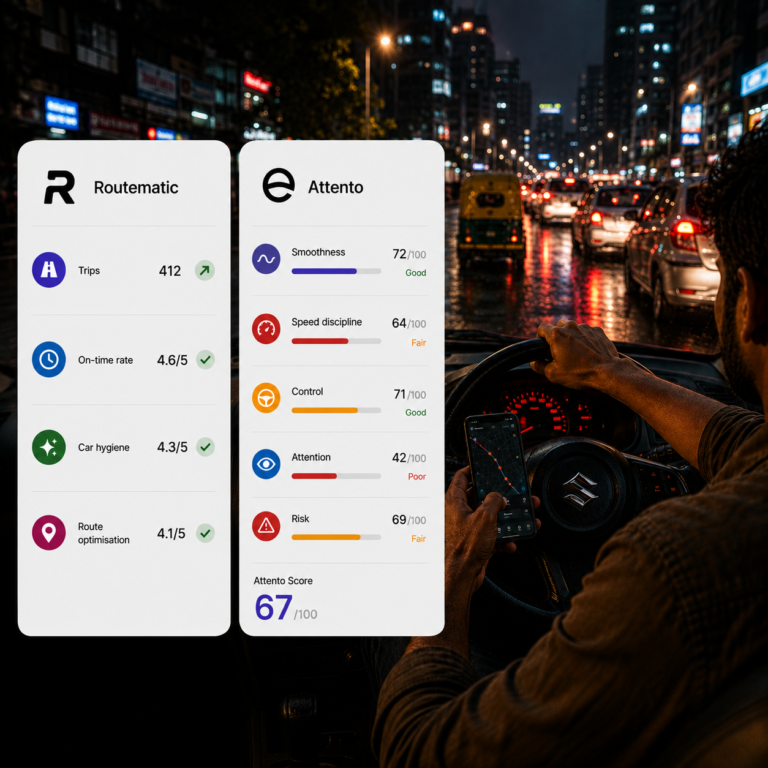
Rather than measuring isolated events, Attento measures behavioural trends. Rather than assigning meaning to a single harsh braking event, it looks at whether harsh braking is becoming more frequent. Rather than treating every journey as an independent trip, it recognises that every journey contributes to a behavioural profile that evolves over time.
The distinction is important. A single instance of speeding tells us very little. A gradual increase in speeding across fifty journeys tells us considerably more. One late braking event is an incident. A pattern of late braking is behaviour. One distracted glance is human. Repeated distracted driving is risk. Behaviour becomes visible only when measured longitudinally.
That is why Attento does not see itself as an alternative to ADAS.
The two systems answer fundamentally different questions.
ADAS asks: “What should the vehicle do right now?”
Attento asks: “What is this driver’s behaviour becoming?”
Those are complementary questions. Not competing ones.
Beyond Intervention
The safest journey is not the one in which Automatic Emergency Braking successfully prevents a collision. The safest journey is the one in which emergency braking never becomes necessary. That idea sounds almost obvious.
Yet much of modern vehicle technology has understandably concentrated on improving interventions rather than reducing the frequency with which those interventions are required. Preventing one dangerous moment is valuable. Reducing the number of dangerous moments a driver creates over an entire year is transformative.
That is why the behavioural layer matters. Not because it replaces engineering. Because it extends it. Road safety does not begin when a sensor detects danger. It begins much earlier, when habits are still forming, attention is still drifting, confidence is still growing, and behaviours are still changing. By the time a vehicle needs to intervene, the behavioural story has often been unfolding for weeks.
ADAS sees the consequence. Behaviour reveals the cause.
A Different Way to Think About Road Safety
The future of road safety is unlikely to be defined by one breakthrough technology. It will be defined by how intelligently multiple layers work together. Infrastructure will continue becoming smarter. Vehicles will continue becoming safer.
Artificial intelligence will continue making assistance systems more capable. The missing opportunity lies in connecting those advances to a deeper understanding of the person operating the vehicle. That is where Attento sees its role.
Not as a replacement for ADAS. Not as a competitor to vehicle manufacturers. Not as another safety feature. But as the behavioural layer that sits upstream of every intervention, helping drivers recognise patterns before those patterns become emergencies.
ADAS protects drivers during critical moments. Attento measures the patterns that lead up to those moments. Together, they answer two different questions that every modern road safety system must eventually address. Can the vehicle prevent this mistake?
And perhaps the more important one: Why does this mistake keep happening?
India’s roads are becoming better engineered. India’s vehicles are becoming better equipped. The next frontier is making our understanding of drivers equally sophisticated.
ADAS saw the beep. Attento saw the pattern.
The future of road safety will require both.