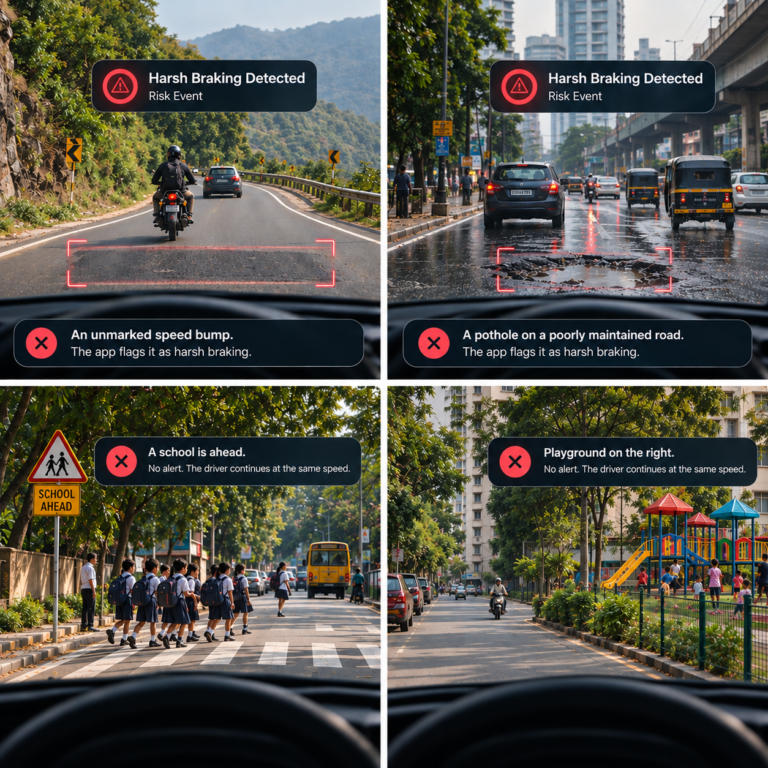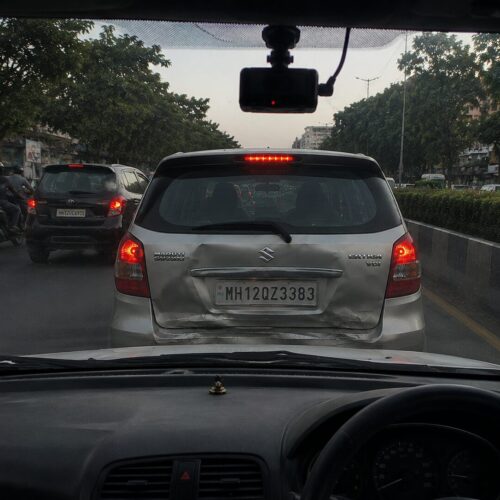
Somewhere on the Mumbai–Pune Expressway, the Delhi–Jaipur corridor, or a Bengaluru delivery route, a dashcam is recording a near-miss that nobody will ever watch.
Not because it wasn’t important. Because no one could.
A fleet of just 300 buses can generate around 2,400 hours of video every day. No safety team reviews that volume of footage manually. Most recordings are never seen again unless a collision, insurance claim or customer complaint forces someone to retrieve them. The driver does not report it. No fleet manager receives an alert. The footage remains on a memory card until it is eventually overwritten.
The event was real. The behaviour that produced it was real. The warning it contained disappears without consequence.
Dashcams have become one of the fastest-growing vehicle technologies in India. Fleet operators, logistics companies, ride-hailing platforms and individual motorists are all investing in them for the same reason: they provide an objective account of what happened.
That accountability has real value. Dashcams help resolve insurance disputes, establish liability, reduce fraud and strengthen investigations. In many cases, a single disputed claim successfully resolved through video evidence can justify the cost of deployment. Dashcams solve real problems. The more interesting question is whether recording what happened is the same as understanding what it means.
Because evidence and prevention are not the same thing. Every safety system produces information. The question is what kind.
Raw video becomes evidence. Evidence becomes events. Events become patterns. Patterns reveal behaviour.
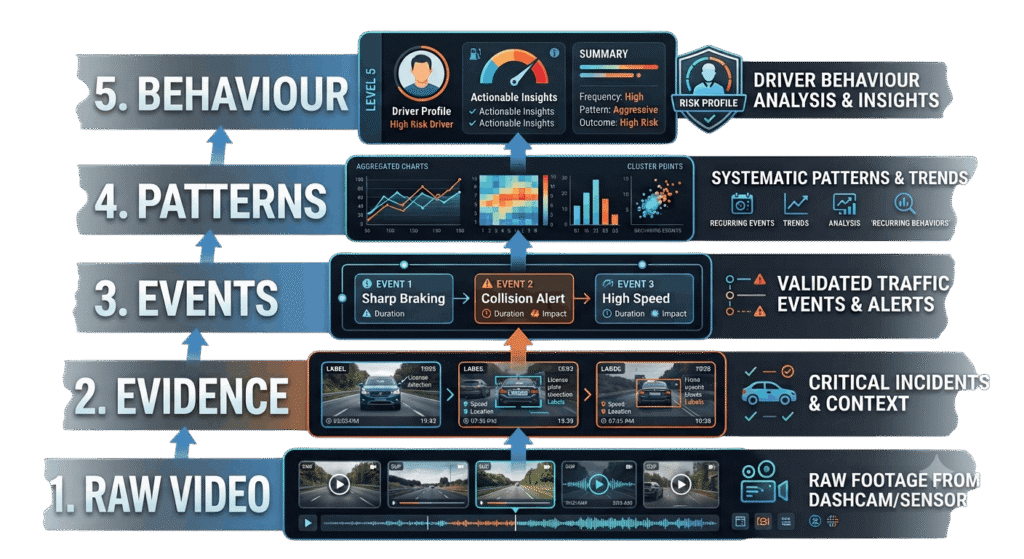
The further up that chain we move, the closer we get to understanding risk before it becomes visible. A fleet manager investigating a collision needs evidence. A fleet manager trying to prevent the next collision needs something else entirely.
The Near-Miss That Never Happened
Imagine a delivery vehicle approaching a busy junction late in the evening. The driver has already completed dozens of stops. Traffic is unpredictable. Fatigue is beginning to accumulate. As the vehicle enters the junction, a motorcyclist appears unexpectedly from the left. The driver brakes sharply. The motorcyclist swerves.
Nothing happens. No collision. No injury. No insurance claim. The journey continues.
To most organisations, the event effectively never existed. Yet from a road safety perspective, this moment may be more valuable than a collision itself. A collision tells us a risk materialised. A near-miss tells us a risk was developing and still had time to be addressed.
The dashcam captured the event perfectly. The footage contains evidence of what happened, how quickly the driver reacted, the traffic conditions and the behaviour of everyone involved. What it does not automatically provide is an understanding of whether this was an isolated incident or part of a broader pattern. That distinction matters because road safety problems rarely emerge suddenly. They accumulate through repeated decisions, repeated habits and repeated exposures to risk, often long before a serious incident forces anyone to pay attention.
This is where the traditional role of the dashcam begins to show its limits. Not because the technology is ineffective, but because it was designed to answer a different question.
From Witness to Observer
At their core, dashcams are witnesses. Their purpose is straightforward: record events accurately and preserve them for later review. In this role they are remarkably effective. When an accident occurs, footage can establish liability in seconds. It can reveal whether a driver ran a signal, crossed a lane unexpectedly or braked aggressively. For insurance providers, legal teams and fleet operators, this capability is enormously valuable because it removes ambiguity from situations that would otherwise depend on conflicting accounts and incomplete recollections.
Most technologies become successful because they solve one problem repeatedly and reliably. The dashcam’s success comes from the fact that it answers a very specific question exceptionally well:
What happened?
But road safety increasingly depends on a second question:
What keeps happening?
Because a collision is rarely the product of a single moment. It is often the result of a pattern that has been repeating long before anyone notices it.
For years, that was enough. Fleet operators needed evidence. Insurers needed clarity. Drivers needed protection against fraudulent claims. The dashcam delivered all three.
The category, however, has evolved. Modern AI-powered dashcam systems can automatically identify harsh braking, distraction, fatigue indicators, tailgating and unsafe manoeuvres. Instead of requiring managers to review hours of footage manually, algorithms surface events that deserve attention and increasingly provide coaching recommendations linked to those events.
The traditional dashcam acted as a witness. Modern AI dashcams increasingly act as observers. They no longer simply record events. They identify distraction, detect fatigue, classify unsafe manoeuvres, generate driver scores and surface coaching opportunities.
Yet even these systems typically begin with an observable event. A distraction alert exists because distraction occurred. A fatigue alert exists because fatigue became visible. The system becomes aware when behaviour produces a signal.
This is a meaningful advancement. For fleets operating dozens or hundreds of vehicles, reviewing every hour of footage is practically impossible. AI dramatically reduces that burden by highlighting moments that matter. Safety managers can spend less time searching for incidents and more time responding to them.
Yet there remains an important distinction between recognising an event and understanding behaviour.
Every Warning Has a History
Every safety technology reflects the problem it was designed to solve, and AI dashcams are no exception. Their underlying assumption is that identifying unsafe events will help organisations reduce future risk. In many cases, that assumption is entirely correct. A driver repeatedly using a mobile phone while driving should be identified. A fatigue event should be surfaced. A harsh braking incident should be reviewed.
The challenge is that events and behaviour are not necessarily the same thing.
Imagine two drivers. The first experiences a single harsh braking event after six months of otherwise safe driving. The second experiences increasing harsh braking frequency every week for two months. A camera can detect both events. A fleet manager reviewing footage can observe both events.
From a behavioural perspective, however, they are fundamentally different stories.
One is an isolated incident. The other is a developing trend.
This is the difference between information and insight.
A video clip is information. A detected event is information. A trend that persists across dozens of journeys is insight.
Recording behaviour is not the same as understanding behaviour.
The distinction is subtle, but it sits at the centre of modern road safety because serious collisions rarely emerge from isolated moments. They emerge from patterns.
Road safety researchers have long understood that major incidents are often preceded by countless smaller signals: near-misses, distraction events, late braking, aggressive acceleration, inconsistent speeds and poor following distances. Each event may appear insignificant on its own. Together, however, they create a trajectory.
A driver who consistently follows vehicles too closely eventually encounters a situation where stopping distance is no longer enough. A driver who repeatedly checks their phone eventually looks away at exactly the wrong moment. A driver who grows comfortable taking small risks gradually normalises behaviour that would once have felt dangerous.
By the time a serious incident occurs, the behaviour that produced it has often been developing for weeks, months or even years.
The emergency is visible. The pattern that created it often is not.
This is where many safety technologies reach the edge of their design scope. Dashcams record the warning. AI dashcams identify the warning. Neither was originally designed to understand how that warning evolved across hundreds of journeys and thousands of kilometres.
The Missing Layer in Road Safety
In Part 1 of this series, we looked at where ADAS sits within the road-safety chain. ADAS operates near the point of crisis. It intervenes when risk has already become visible. Dashcams operate slightly further upstream. They capture incidents, near-misses and unsafe events, helping organisations understand what occurred and why.
Yet there is still another level in the hierarchy. Behaviour.
Not behaviour as a single action, but behaviour as a pattern that persists over time.
For decades, conversations about road safety have focused on two questions: how do we build safer roads, and how do we build safer vehicles? Those remain essential questions. Infrastructure saves lives. Engineering saves lives. Yet every journey is also shaped by a third factor: the behaviour of the person behind the wheel.
Historically, that behavioural layer has been the hardest to measure.
Crash reports tell us what happened. Dashcams tell us what happened. AI dashcams increasingly tell us when it happened and how often similar events occur. What remains more difficult to understand is how risk evolves before those events become visible at all.
When does distraction become a habit rather than a momentary lapse? When does confidence become overconfidence? When does occasional late braking become a consistent behavioural trend? When does a driver’s risk profile begin shifting long before any collision occurs?
Those questions sit further upstream than most vehicle technologies were designed to look, but they are often where future incidents begin.
As fleets move from reactive safety management towards predictive safety management, those questions become increasingly important. Investigating incidents after they occur will always matter. The greater opportunity lies in recognising behavioural shifts before they produce incidents in the first place.
Where Attento Fits
This is where Attento enters the conversation.
Not as a replacement for dashcams. Not as a competitor to AI video telematics. But as a different layer within the same safety ecosystem.
Dashcams provide evidence. AI dashcams provide event intelligence. Attento provides behavioural intelligence.
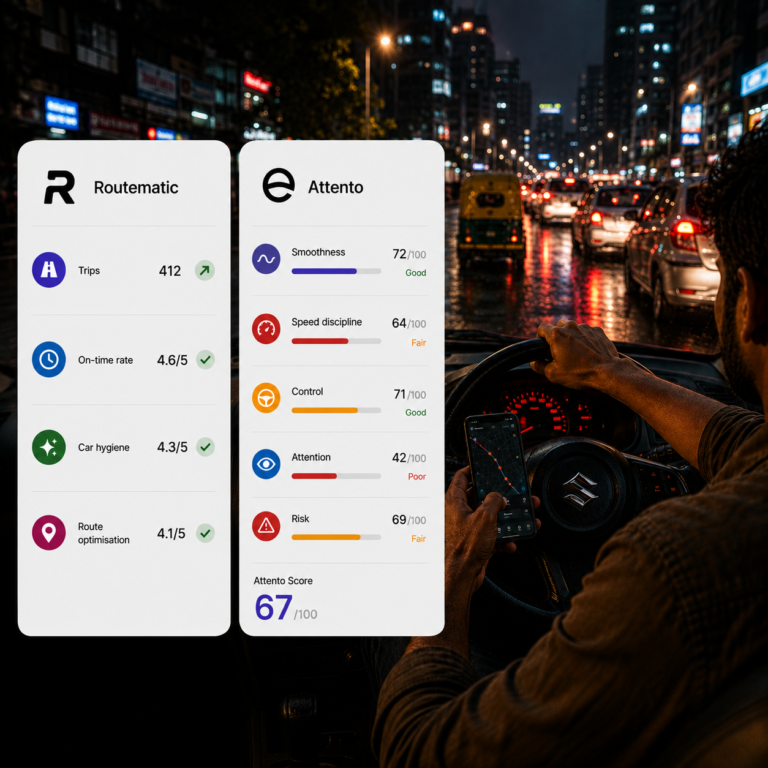
Rather than treating each trip as an isolated event, Attento looks across journeys, weeks and months to understand how driving behaviour changes over time. A single harsh braking event tells us very little. A steady increase in harsh braking frequency across fifty journeys tells us considerably more. One distracted glance is human. A growing pattern of distraction is risk.
Behaviour only becomes visible when measured longitudinally. That is why Attento ultimately asks a different question from the technologies around it.
The dashcam asks:
What did this driver do?
Attento asks:
What is this driver becoming?
The two questions are not competing. They are complementary. Because the safest journey is not the one where footage helps explain a collision afterwards. It is the one where the behavioural pattern that would have produced the collision was recognised early enough that the collision never occurred. No camera can record a trend. It can only record individual moments. Trends emerge only when those moments are connected across time.
The dashcam recorded the moment.
AI identified the event.
Behaviour revealed the trajectory.
Because what happened matters.
What keeps happening matters more.
And what a driver is becoming may matter most of all.