A Mahindra XUV rolls down a public road somewhere in India. Inside, a couple is dancing. Both hands off the wheel. Music playing. The car is moving.
The video went viral because it looks insane. But here is the uncomfortable truth: it is not random stupidity. It is a predictable consequence of something that has been documented in road safety research for fifty years.
The car they are in has six airbags, Electronic Stability Control, and one of the highest safety ratings available in the Indian market. And somewhere, beneath the music and the movement, that knowledge is part of what made this feel acceptable.
This is called the Peltzman Effect, and it is playing out on Indian roads every single day.
Just randomly happened to come across a reel !!
— Xroaders (@Xroaders_001) March 11, 2023
Trust,me you would not see such a bizarre & moronic stuff related to Automobile stuff !!
Unreal just for reel @anandmahindra @MahindraXUV700
it’s a travesty that we have to share roads with people like these
This is just insane… pic.twitter.com/jZhkX6YKIO
In 1975, economist Sam Peltzman published a paper that infuriated the car safety industry. After studying the impact of sweeping new vehicle safety mandates in the United States (seat belts, padded dashboards, reinforced steering columns), he found something nobody wanted to hear.
Driver fatalities stayed roughly flat, but pedestrian and motorcyclist deaths increased.
His explanation was simple and devastating: when the cost of an accident falls, people drive more intensely. Feeling protected, they take risks they would not otherwise take. The safety benefit gets consumed by riskier behaviour rather than translated into saved lives.
This became known as the Peltzman Effect. Fifty years later, it is one of the most important ideas in automotive safety that almost nobody in India is talking about.
The Experiment That Proved It
In the early 1980s, a Munich taxi company fitted half its fleet with Anti-lock Braking Systems (ABS). Objective, superior technology. The expectation was straightforward: fewer accidents.
Over three years, accident rates between the two halves were nearly identical.
What changed was the behaviour. Expert observers, hired in a double-blind setup, found that drivers of Anti-lock Braking System-equipped taxis tailgated more, cornered faster, and switched lanes more aggressively. They had unconsciously absorbed the safety advantage and spent it on risk.
The brakes were better. The driving was worse. The outcomes were the same.
Did you know? Research examining NASCAR after mandatory head and neck restraints found accident frequency increased even as injury severity dropped
A Safety Upgrade Landing in the Wrong Culture
Sport Utility Vehicles (SUVs) crossed 65% of all passenger vehicle sales in India in Financial Year2024-25 up from roughly one in four cars just five years earlier. These vehicles arrive loaded with features once reserved for premium European cars: six airbags, Anti-lock Braking Systems (ABS), Electronic Stability Control, Lane Departure Warnings, and Automatic Emergency Braking.
Bharat New Car Assessment Programme launched in 2023. Five-star ratings are now marketing currency. Safety has, for the first time, become a genuine purchase criterion in the Indian car market.
This is genuinely good. A five-star car protects its occupants better than a zero-star one.
But a five-star car is still driven by a person. And in India, that person is increasingly likely to have acquired their licence without ever proving they can drive.
But here is what the conversation is missing entirely.
India simultaneously has one of the weakest driver training ecosystems in the world. A 2018 survey by road safety organisation SaveLife Foundation found that 59% of driving licence holders in India had never taken a driving test.Former Union Minister Nitin Gadkari himself acknowledged that approximately 30% of India’s driving licences are bogus. Touts outside Regional Transport Offices would appear in tests on behalf of applicants for as little as Rs. 3,000.
This means a significant share of India’s roads are navigated by people who acquired a licence without ever demonstrating the ability to drive. And now, many of them are getting into vehicles packed with safety technology they have never been trained to understand, let alone rely on correctly.
The Peltzman Effect warns us that safety features nudge even trained, experienced drivers toward riskier behaviour. In a country where formal driver training is the exception rather than the rule, that nudge lands harder.
Several studies globally have observed that drivers of larger vehicles often report feeling safer and more in control than drivers of smaller cars. Researchers have long debated whether that perception influences risk-taking behaviour behind the wheel.
Did you know? A West Virginia University study, in 2008, found that Sport Utility Vehicle drivers were 2.7 times more likely to cause a fatal crash than passenger car drivers, partly attributed to the elevated risk tolerance that comes with perceived invincibility behind the wheel.
The Overspeeding Numbers Tell the Story
Overspeeding caused 68.4% of all road accident deaths in India in 2023, according to the Ministry of Road Transport and Highways. Thirteen people died every hour due to overspeeding alone. India recorded 1.75 lakh road deaths that year, and the number continues to rise despite more crash-tested cars entering the fleet than ever before.
These two trends – safer cars and rising fatalities driven by speeding, are not obviously coincidental. They are consistent with what the Peltzman Effect predicts, even if direct causation is difficult to isolate
A driver who buys a car with six airbags and Electronic Stability Control has objectively reduced the physical cost of an accident to themselves. The question is what they do with that reduction:
- Bank it as pure safety and the technology works as intended
- Spend it on faster driving, shorter following distances, and reduced attentiveness, and the safety gains are quietly eroded
The car gets safer. The driving gets more aggressive. The death toll does not fall.
To be clear, overspeeding has many causes and the Peltzman Effect alone cannot explain India’s fatality numbers. But it offers one possible explanation for why safer vehicles do not automatically translate into safer roads.
The People Who Cannot Benefit From Any of This
The most troubling dimension of the Peltzman Effect is not what it does to the person feeling protected. It is what it does to everyone around them.
Peltzman’s original data showed the transfer clearly: occupant deaths stayed flat after safety mandates, but pedestrian and motorcyclist deaths increased. The safety devices protected people inside the car while encouraging driving behaviour that endangered those outside it.
In India, 64% of all road fatalities in 2024 were two-wheeler riders and pedestrians, according to National Crime Records Bureau data. These are the road users with no airbags, no crumple zones, no Electronic Stability Control. They have no five-star rating.
As India’s car-owning population upgrades to better-equipped vehicles, the pedestrian and two-wheeler population absorbs the risk those drivers are no longer taking for themselves. The safety rating on a showroom floor does not extend to the person crossing the road outside.
The five-star era has coincided with India’s worst road fatality numbers in recorded history.
Did you know? National Highways constitute only 2.1% of India’s total road network but account for nearly 30% of all road accidents. These are the stretches where faster, better-equipped vehicles travel at their highest speeds, and where the gap between what a car can survive and what a two-wheeler rider can survive is widest.
Passive Safety Protects You. Active Safety Protects Everyone.
This distinction matters more than most people realise.
Passive safety features (airbags, crumple zones, seat belts) activate after a crash has already begun. They are exceptional at reducing how badly a crash injures the occupant. They do nothing to prevent the crash from happening.
Active safety is the behaviour that prevents the crash in the first place: appropriate speed, maintained following distances, attentiveness at junctions, braking for pedestrians.
The Peltzman Effect operates almost entirely on the passive side. When passive safety improves, drivers unconsciously reduce their active safety. The airbag fires perfectly. The driver was never paying enough attention to begin with.
Bharat NCAP measures what happens during a crash.
- It does not measure whether the driver speeds.
- It does not measure whether the driver follows too closely.
- It does not measure whether the driver yields to pedestrians.
Nor is it designed to.
A five-star rating is a measure of crash survivability, not driving behaviour. Yet much of India’s public discussion treats the two as interchangeable.
What We See at Attento
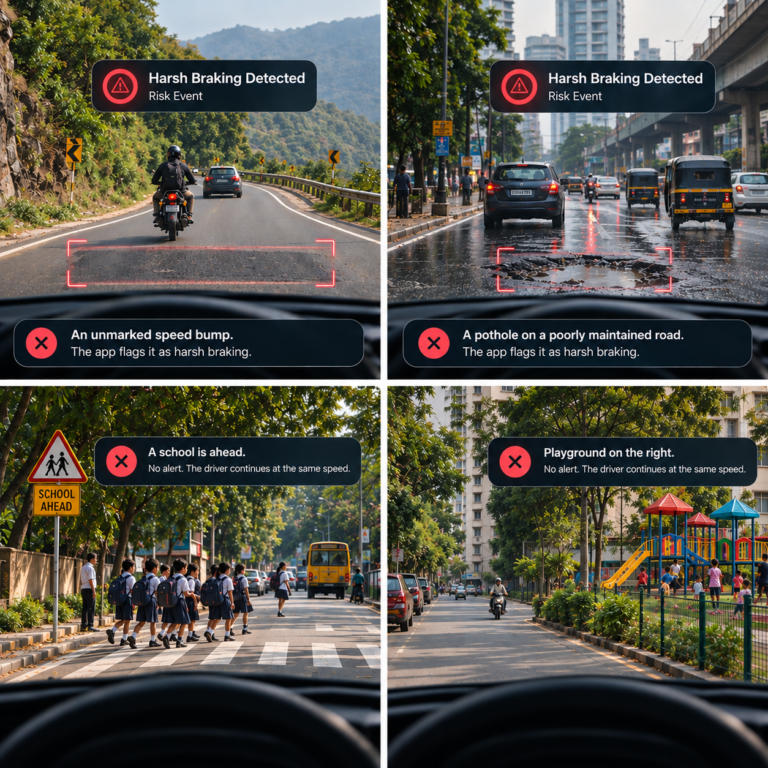
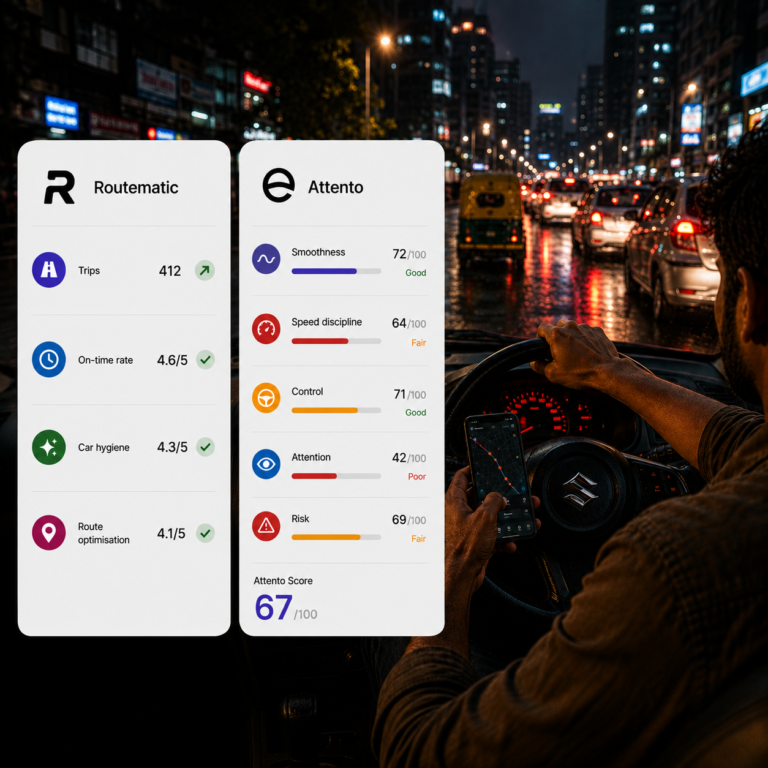
At Attento, we track driver behaviour across real-world conditions: braking patterns, acceleration profiles, speed variance on different road types, and response times near pedestrians and junctions.
The Peltzman dynamic is not theoretical for us. It appears consistently in the data. We frequently observe patterns consistent with what risk-compensation theory would predict: higher cruising speeds, later braking initiation, and reduced following distances among drivers who appear highly confident in their vehicles’ capabilities.
Nobody consciously decides to drive recklessly because they have an airbag. But the cumulative effect of small, unconscious adjustments, a slightly later brake, a slightly shorter gap, a slightly faster approach to a junction, adds up to something measurable.
The Rating Does Not Drive the Car
The five stars do not know you are doing 110 kilometres per hour on a stretch limited to 80. The Automatic Emergency Braking does not know you checked your phone for four seconds on a national highway. The airbags do not know that the person you just overtook was a two-wheeler rider who has nothing.
India’s Sport Utility Vehicle boom and Bharat New Car Assessment Programme are real progress. But the Peltzman Effect is a reminder that a safety rating describes a controlled laboratory scenario at 64 kilometres per hour against a fixed barrier. It says nothing about the road you are actually driving on.
The most dangerous idea in Indian road safety right now is not speed.
It is the belief that buying a safer car is the same thing as being a safer driver.
At Attento, we track the difference between those two things, every single day.