Insurance telematics may be the most sophisticated driving data system available to Indian consumers today.
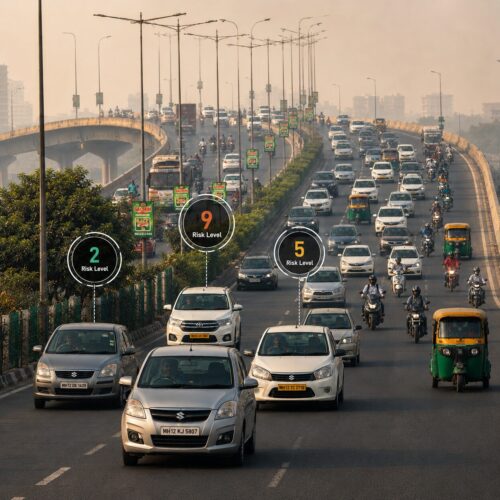
It monitors your speed. Your braking. Your acceleration. Your cornering. The time of day you drive. How consistently your behaviour holds across dozens of trips. It processes all of this continuously, generates a risk profile specific to you as an individual, and adjusts the price you pay for motor insurance accordingly.
It is, by almost any technical measure, an impressive piece of infrastructure. And its primary output is a more accurate premium. Not a safer driver.
That sentence is not a criticism of insurance telematics. It is a description of what it was designed to do. Pricing risk accurately and reducing risk are two different problems. Solving one does not automatically solve the other. As usage-based insurance matures, the opportunity to connect the two becomes increasingly compelling.
In this article, we explore the most important thing about insurance telematics is understanding which problem(s) it was built to solve. And which one it was not.
What Insurance Telematics Actually Is
Insurance telematics is the use of real-time driving data to price motor insurance policies. Instead of calculating premiums based on demographic proxies such as age, location, vehicle type, or previous claims history, telematics-enabled insurers use actual driving behaviour as the primary variable.
The Indian market has moved quickly. In 2023, Zuno General Insurance launched the Zuno Driving Quotient, monitoring sudden braking, overspeeding, and distracted driving while offering premium discounts to drivers who score well. By August 2024, they had introduced a Pay How You Drive add-on linking premiums directly to real-time behaviour. Shriram General Insurance followed with AI-driven risk profiling. The Insurance Regulatory and Development Authority of India approved usage-based car insurance in 2022. The market reached USD 151.2 million in 2024 and is projected to reach USD 1,022.1 million by 2033.
What these systems typically monitor is consistent across providers:
- Overspeeding
- Harsh braking
- Sudden acceleration
- Cornering forces
These are meaningful signals. The data pipeline is real. The monitoring is continuous. The risk assessment it enables is more accurate than traditional actuarial methods that never observed a driver at all.
Insurance telematics solves a genuine problem in insurance economics. Road safety benefits from that progress. But its primary optimisation target remains accurate risk assessment rather than long-term behaviour change.
Two Very Different Problems
Somewhere on the Delhi–Jaipur highway, a driver receives a notification from their insurer’s telematics app. Their driving score this month is 71. They drive carefully for the next three days.
The score improves. Whether the underlying behaviour improves is a different question.
That distinction between appearing safer and becoming safer sits at the centre of what insurance telematics can and cannot do.
The insurer’s problem is pricing. How do we accurately assess the risk this specific driver presents and set a premium that reflects it? Before telematics, insurers estimated risk using proxy variables. A 22-year-old male driver in Mumbai paid more than a 45-year-old female driver in Pune, not because anyone had observed either driving, but because statistical models suggested one group filed more claims.
Telematics replaces the proxy with the real thing. It is a fairer, more accurate system for pricing risk. The driver’s problem is different. How do we change the behaviour that creates the risk in the first place?
These are related problems. They are not the same problem. The product designed to solve the first one is not automatically designed to solve the second.
An insurer with perfect telematics data has everything they need to price premiums precisely. They do not necessarily have everything they need to make a driver safer. Pricing is backward-looking. It assesses the risk a driver has demonstrated. Behaviour change is forward-looking. It requires understanding why a pattern exists, how to interrupt it, and what feedback would actually shift the underlying habit.
Insurance telematics is excellent at the first.
It was never primarily designed for the second.
The Feedback Gap
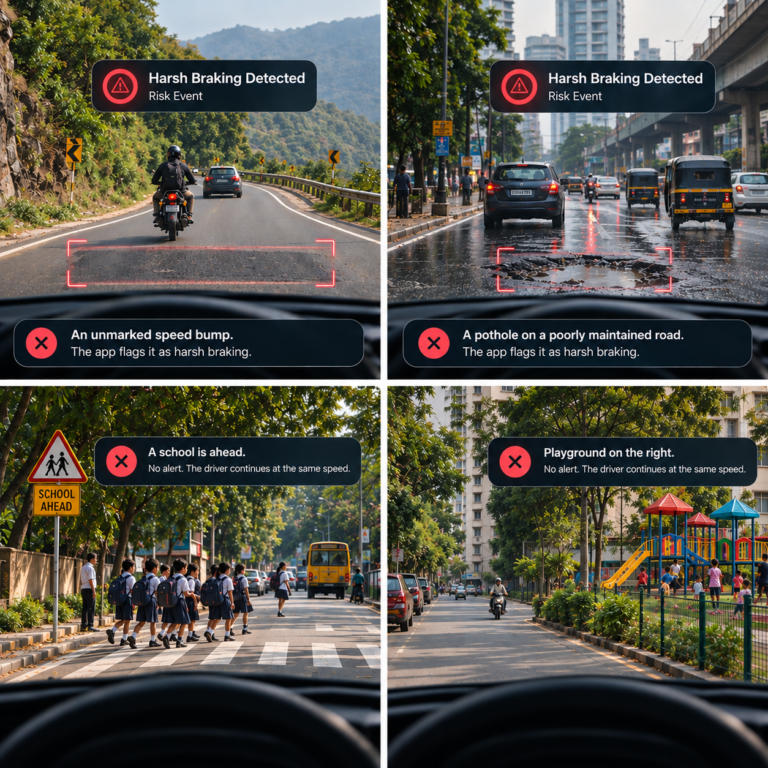
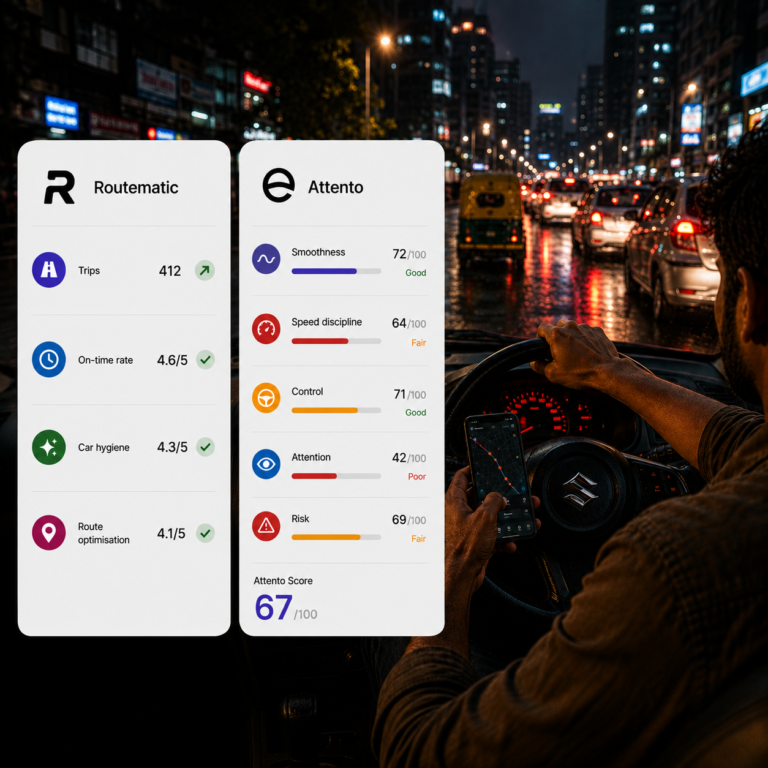
Consider what a driver with a Pay How You Drive policy actually receives when they score poorly. They see a number. They see the categories where they lost points. They may receive a discount notification or a premium warning. They may decide to drive more carefully for the next scoring period. What they do not receive is an analysis.
They are not told that their harsh braking events cluster at three specific junctions on their morning commute, suggesting a following-distance problem on that route rather than a general braking issue.
They are not told that their aggressive acceleration correlates with late departures, and that when they leave home twelve minutes late, their driving quality deteriorates significantly.
They are not told that their score has been declining for eight consecutive weeks even though any individual week appears acceptable.
The patterns within the events, the contextual information that would make feedback genuinely useful, are not necessary for the pricing function and are therefore not surfaced.
The driver knows they scored 71 this month. They do not know why 71 is becoming their ceiling rather than their floor.
The insurer does not need a behavioural explanation to price a premium accurately. It needs a reliable assessment of risk. Behavioural explanations become valuable when the goal shifts from measuring risk to reducing it.
The Incentive Problem
There is a deeper structural issue worth naming.
Insurance telematics creates a financial incentive for drivers to appear safe rather than to become safe.
These are not always the same thing.
A driver who understands how their scoring system works can optimise for the score. Drive carefully when the monitoring window is assumed to be open. Drive differently when it is not.
Research on incentive structures in monitoring programmes consistently finds that when people know they are being scored, their behaviour improves on the metric, not necessarily in the underlying habit the metric was designed to capture.
Premium adjustment follows behaviour. But the insurer’s ideal outcome is not a higher premium, it is a driver who never files a claim. Pricing risk accurately and reducing it are complementary goals. They require complementary tools, The insurer is protected either way.
Road safety is not.
A driver who has learned to score well on their telematics app without genuinely improving their following distance, junction behaviour, or fatigue management is a driver whose risk has been priced. Not reduced.
What Insurance Telematics Gets Right
To be precise, telematics does move the needle on behaviour.
Studies have shown that real-time feedback and financial incentives can reduce high-risk behaviour and improve long-term driving habits for a meaningful segment of drivers. The financial incentive is real.
India’s road safety challenge is large enough that any intervention that reduces risk for any segment of drivers matters.
Insurance telematics is a positive development for both the Indian insurance market and road safety.
The question is not whether it helps. It does. The question is what it was designed to optimise for, and what falls outside that optimisation.
Insurance telematics was designed to optimise premium accuracy. Behaviour change is a beneficial side effect in cases where financial incentives are sufficient to shift habits.
For drivers for whom the financial incentive is not enough, or for commercial drivers whose insurance is carried by a fleet operator rather than individually, the mechanism is absent entirely.
What Insurers Stand to Gain From Behavioural Intelligence
Insurance telematics has already transformed underwriting. The next frontier is loss prevention.
An insurer who can identify that a driver’s harsh braking frequency has been climbing for eight consecutive weeks — before a claim occurs — has something more valuable than accurate pricing. They have an intervention opportunity.
A coaching nudge at week four costs almost nothing. A claim settlement costs significantly more.
The insurer’s ideal customer is not a high-risk driver paying a high premium. It is a safe driver who never files a claim, renews annually, and recommends the product. Insurance telematics identifies which customers are which. Behavioural intelligence creates the conditions for more customers to move in the right direction.
Those are complementary functions. One prices the present risk. The other helps reduce tomorrow’s.
For insurers already invested in telematics infrastructure, behavioural analytics is not a competing product. It is the layer that makes the existing investment more valuable.
The Question Insurance Telematics Cannot Ask
In Part 1 of this series, ADAS was shown to operate near the end of the safety chain, at the moment of crisis.
In Part 2, dashcams were shown to operate slightly further upstream, capturing events after they occur and helping organisations understand what happened.
Insurance telematics operates further upstream still. It monitors patterns across trips and creates a financial signal that can, for some drivers, shift behaviour before it produces dangerous decisions.
That is genuinely valuable positioning.
But the design goal shapes everything it can see and everything it cannot.
The insurer is asking one question, consistently and well:
What has this driver’s behaviour cost so far?
That question is backward-looking by necessity. It requires evidence of what has already happened.
It does not require, and therefore does not produce, an understanding of where behaviour is going before it gets there.
That is the question left unanswered.
The Data Acquisition Problem
One of the least discussed challenges in insurance telematics is not the scoring model. It is collecting the data consistently enough for the scoring model to matter.
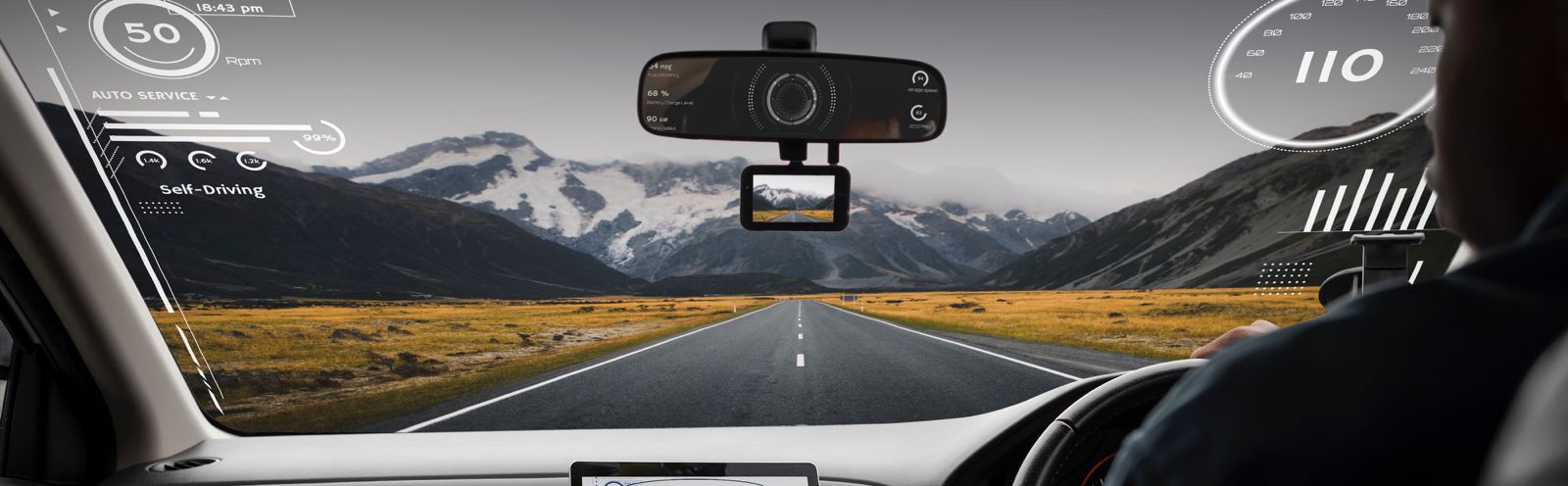
Many usage-based insurance programmes, particularly in international markets, rely on an On-Board Diagnostics (OBD-II) device plugged into the vehicle. Others use smartphone apps that require drivers to grant continuous location access, disable battery optimisation and keep the application running throughout every journey.
Both approaches introduce friction.
For private vehicle owners, installing a hardware device is an additional step after purchasing insurance. Smartphone-based systems avoid the hardware but depend on sustained user engagement, permissions and background operation over months rather than days.
None of these challenges make insurance telematics ineffective. They simply highlight that measuring driving behaviour at scale is as much a user adoption problem as it is a data science problem.
That distinction matters because the value of any behavioural model ultimately depends on the consistency of the data flowing into it.
Where Attento Fits
Insurance telematics and behavioural intelligence are not competing layers of the mobility stack. They are sequential ones. Attento and insurance telematics are not rivals.
They are different answers to different questions.
Insurance telematics asks: What is the risk this driver represents, and how should it be priced?
Attento asks: Why is this driver’s behaviour changing, and what can be done before that change becomes tomorrow’s risk?
A driver with a good insurance telematics score may still have deteriorating behaviour that has not yet crossed the threshold for premium adjustment. A driver’s overall telematics score may remain stable even as subtle behavioural patterns begin to shift. Recognising why those patterns are emerging, and intervening before they become significant, requires a different kind of behavioural analysis. Attento is designed to see the deterioration before the claims data exists. That is not a better version of what insurance telematics does.
It is a different function, operating at a different point in the safety chain, answering a different question.
Insurance telematics measures risk remarkably well. Behavioural intelligence builds on that foundation by helping reduce it.
One helps determine today’s premium. The other helps shape tomorrow’s outcome.
For insurers already building telematics infrastructure, that gap represents both a challenge and an opportunity. The data already exists. The behavioural intelligence layer that converts risk measurement into risk reduction is the logical next investment, one that benefits the insurer’s loss ratio as directly as it benefits the driver’s safety.
This is one reason independent behavioural platforms may become increasingly valuable. Drivers engage with them for reasons beyond insurance alone viz. safer driving, coaching, rewards and behavioural feedback. If that engagement produces richer longitudinal behavioural data, insurers do not necessarily need to build a second behavioural relationship with the same driver. They can instead integrate behavioural intelligence into the underwriting and coaching workflows they already excel at.