Your car already knows how you drive.
It knows you braked hard twice on Tuesday. It knows you took that corner on the highway ramp faster than it would recommend. It knows you accelerated aggressively pulling out of the toll plaza. It has been watching every journey since the day you drove it off the forecourt, scoring each one, building a picture of your behaviour behind the wheel.
Now ask a different question: Who does that picture belong to?
Not you. It belongs to the manufacturer’s platform. It lives inside the app that came bundled with your vehicle, behind a subscription you may or may not have renewed, in a format no insurer can access, no fleet operator can verify, and no future employer can see. When you sell the car, the picture disappears. When you buy a different brand, you start again as a stranger.
Somewhere across the city, a driver with two years of harsh braking, late-night speeding, and aggressive cornering just bought a new vehicle. His new car’s connected platform has no memory of him either. Clean slate.
The score existed. It measured something real. It meant nothing beyond the platform that generated it.
The irony is that society remembers almost everything about a driver except how safely they drive. We remember driving licences, vehicle registrations, insurance claims, traffic violations, tax payments and service histories. But consistent safe driving has no portable institutional memory.
That is the problem this article is about.
What OEM Driving Scores Actually Measure
Nearly every connected vehicle sold in India today generates some form of driving score. By 2024, approximately 37% of passenger vehicles sold in India had embedded cellular connectivity, according to Counterpoint Research. Hyundai Bluelink, Tata iRA, Mahindra Adrenox, MG iSMART, Kia UVO each platform monitors driver behaviour and distils it into a number.
What they measure is largely consistent across platforms:
- Harsh braking events
- Sudden acceleration
- Cornering forces
- Speeding above set thresholds
- Trip distance and duration
- Time of day driven
These are genuine safety-relevant signals. A driver who scores poorly on harsh braking is, statistically, a driver who is following too closely, reacting late, or both. A driver who consistently accelerates aggressively is a driver whose speed management has safety implications. The data being collected is real and the inferences it supports are legitimate.
The Driving Score is not a gimmick. It is a meaningful measurement of something that matters.
The question is what happens to that measurement once it is made.
The Identity Problem
A credit score is useful precisely because it travels. When you walk into a new bank, your CIBIL score walks in with you. The bank does not need to extend you credit blindly and wait years to discover whether you repay. The history is already there.
Before CIBIL, this did not exist. A borrower’s repayment history stayed with their current bank. Change banks, and you started from zero. Imagine if every time you changed banks, your credit history disappeared—every mortgage application, every car loan, every credit card. You would spend your entire financial life proving yourself again.
That is exactly how driving works today. OEM driving scores resemble India’s pre-CIBIL credit market: every platform remembers your history, but only for as long as you stay within it.
Your Hyundai Bluelink Driving Score stays on Hyundai’s platform. Your Tata iRA score stays on Tata’s platform. Your MG iSMART score stays on MG’s platform. A driver who has accumulated two years of safe driving data on one OEM’s platform and then purchases a vehicle from a different manufacturer loses that history entirely. A fleet operator hiring a driver cannot access the score generated by the driver’s personal vehicle. An insurer cannot price a policy based on OEM driving data they do not have access to. The data exists. The reputation does not.
There is a second dimension to this identity problem that receives even less attention. OEM scores are vehicle-bound, not driver-bound. A household with two drivers sharing one car generates a composite score that reflects neither driver accurately. A vehicle driven primarily by a careful spouse on school runs and occasionally by an aggressive second driver will produce a blended score that accurately represents neither person’s risk profile.
Hyundai is not building a driver identity system. Tata isn’t either. Neither should they. They are building better ownership experiences for their own customers. Driver identity, however, only becomes valuable when it exists independently of every manufacturer.
The score reflects the vehicle’s history. It does not represent the driver’s long-term behavioural profile.
What the Score Does Not Measure
Even within the vehicle that generates it, the OEM Driving Score has structural blind spots worth understanding.
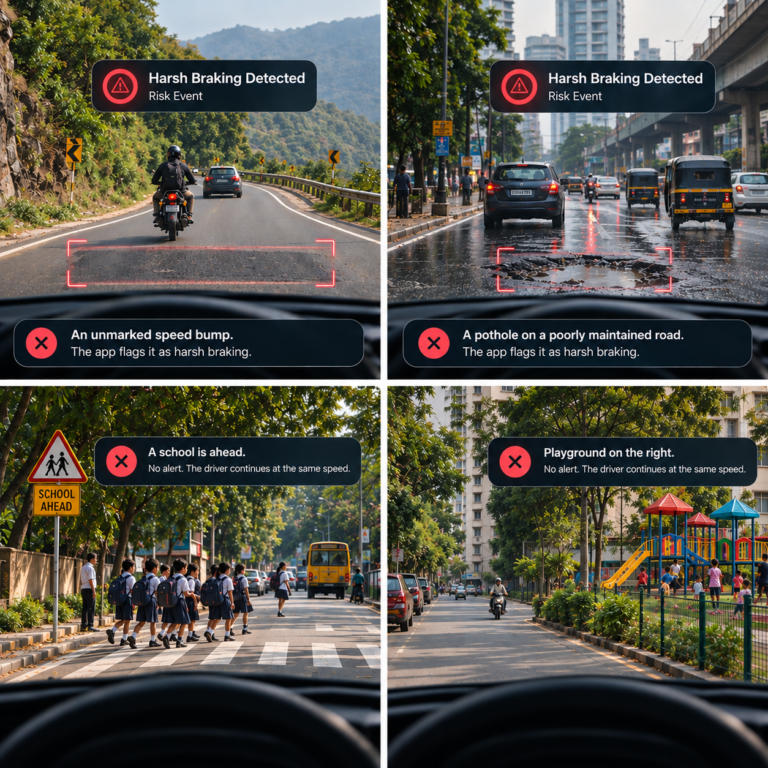
Context is absent. A harsh braking event on a clear motorway and a harsh braking event at a junction where a child stepped into the road look identical in the data. The score penalises both equally. A driver who brakes hard to avoid a collision is indistinguishable from a driver who brakes hard because they were following too closely. The measurement captures the event. It does not capture what caused it.
Time horizon is short. Most OEM driving scores are calculated on a rolling basis — recent trips weighted more heavily than older ones. A driver who had six months of deteriorating behaviour followed by two careful weeks will present a score that looks encouraging. The trend that preceded it is invisible.
Coaching is minimal. The Hyundai Bluelink app will tell you your score. It will flag the categories where you lost points. It will not tell you that your harsh braking events cluster specifically on the route you drive at 8 AM, or that your acceleration behaviour is significantly more aggressive after 9 PM, or that your following distance has been declining consistently over the past three months. The data to generate these insights exists. The product is not designed to surface them.
Primary objective is ecosystem engagement. OEM driving scores are designed primarily to enhance the ownership experience within a manufacturer’s ecosystem. A driver engaged with their vehicle’s connected ecosystem is a driver who renews their subscription, visits the dealership, and buys the next model. Coaching and long-term behavioural development are secondary objectives.
The Score Is Not the Reputation
Here is the distinction worth making precise.
A driving score is like a semester exam. It reflects performance over a defined recent period, on a defined vehicle, within a defined platform. It is useful. It is also, by design, temporary and bounded.
A driving reputation is like your academic transcript. It is a longitudinal record of who you’ve consistently been across time, vehicles, employers, and contexts. One tells you how you performed recently; the other tells the world who you are.
No OEM platform in India — or globally — produces a driving reputation. The limitation isn’t the quality of the score. It’s that every score ends where its platform ends.
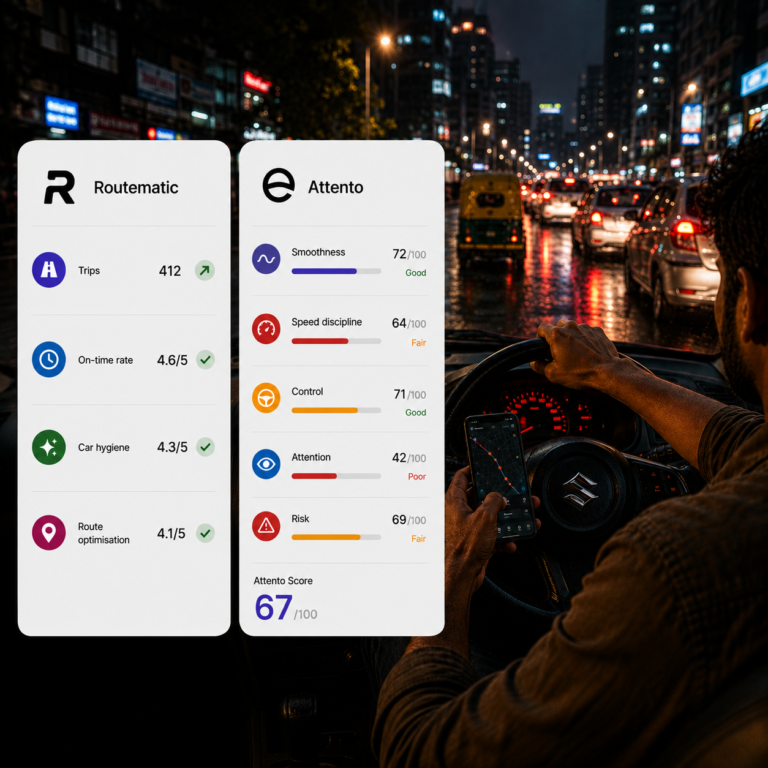
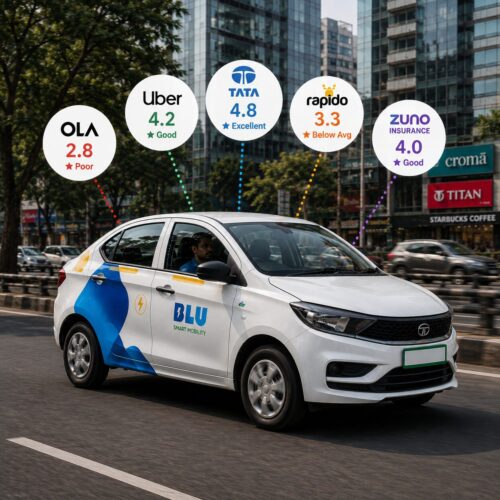
OEM driving scores are only one example of a broader problem. Drivers already accumulate scores from manufacturers, insurers, ride-hailing platforms, and fleet operators. Each measures something useful. None belong to the driver. Imagine if your credit score was split across five banks, your tax record lived with your employer, and your passport history stayed with the airline you flew most often. Every institution would know something about you, but none would know enough to trust you. That is the state of driver reputation today.
Where Attento Fits
Attento does not replace OEM driving scores. It occupies a different position in the architecture. Attento starts from a different assumption: driving behaviour belongs to the driver, not to the platform that happened to measure it.
Where OEM scores measure what happened on recent trips within a single platform, Attento builds a longitudinal behavioural profile that is independent of the vehicle, the manufacturer, and the platform. It tracks how behaviour evolves over weeks and months. It identifies patterns that short-term scores obscure: a gradual increase in following-too-closely, a shift in harsh braking frequency that correlates with time of day, a decline in speed management quality that precedes incidents.
And it is portable. A driver whose behavioural profile Attento has built does not lose that history when they change vehicles, change employers, or change platforms.
A score belongs to the platform that calculated it.
A reputation belongs to the person who earned it.
That distinction may become one of the defining pieces of mobility infrastructure over the next decade.