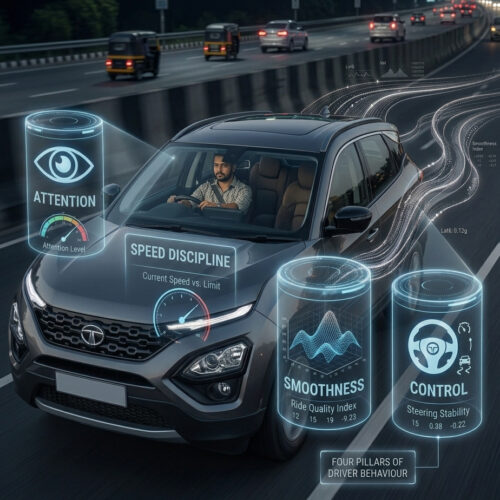
Open the spec sheet of a growing number of new cars launched in the last two years and you’ll find a small, increasingly familiar addition to the safety features list: a Driver Monitoring System, or DMS.
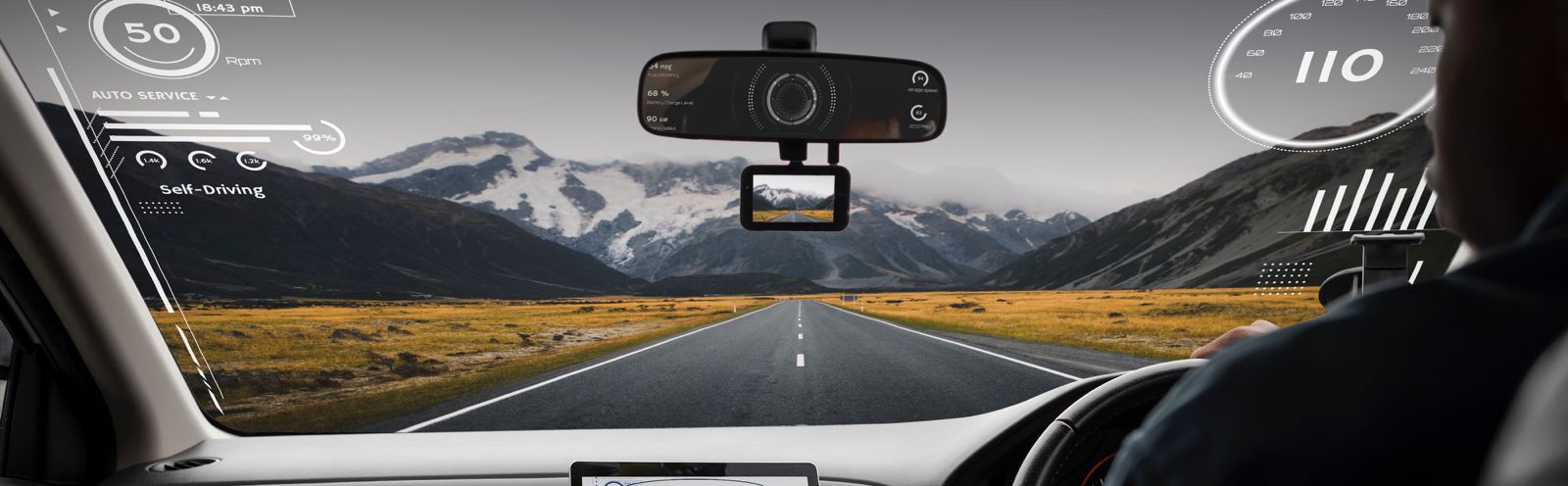
A camera, sometimes tucked behind the steering column, sometimes integrated into the instrument cluster or steering column, watches the driver’s face in real time, tracking things such as eyelid closure, head pose and gaze direction. It is becoming an increasingly important category in automotive safety, and for good reason.
But DMS and behavioural telematics solve different problems. DMS watches one dimension of driving: the driver’s attention and state. Attento looks at driving behaviour as a whole.
The Rise of Driver Monitoring
DMS didn’t emerge from nowhere. It’s the product of a decade-long shift in how safety regulators think about crash prevention, moving upstream from “protect the occupant on impact” to “catch the driver before the mistake happens.”
That shift is now written into law. Euro NCAP’s 2026 protocol gives driver monitoring a much more prominent role within its new “Safe Driving” assessment, evaluating technologies that monitor driver attention and engagement in real time. Higher scores can also be earned by systems capable of identifying signs of drug or alcohol impairment and safely bringing the vehicle to a halt if the driver becomes unresponsive. The EU’s General Safety Regulation is following the same direction, with advanced driver distraction warning becoming mandatory for new vehicles from July 2026, building on systems that detect signs of driver distraction and drowsiness.
India is following the same trajectory on its own timeline. AIS-184 mandates DDAW for buses and trucks starting October 2027, and Bharat NCAP 2.0 has introduced a “Safe Driving” scoring category carrying 10% weight toward a car’s overall rating, rewarding vehicles that can detect eye closure and phone use. Domestic OEMs are already responding: camera-based DMS is showing up in flagship SUVs ahead of enforcement, and commercial fleets are adopting aftermarket DMS voluntarily, independent of any government deadline.
The technology stack is now familiar: infrared cameras, eye-tracking algorithms, yawn and blink-rate detection, head-pose estimation. Cheaper sensors, better computer vision, and regulatory pressure have converged to make DMS close to a default feature rather than a premium one.
What DMS Gets Right
It’s worth being honest about why DMS has spread so fast: it solves a real, narrow, urgent problem well.
Immediate intervention. A DMS doesn’t need to understand a driver’s history to be useful. If eyes close for two seconds at highway speed, the system can alert, vibrate the seat, or tighten the belt, right now, before the car drifts.
In-cabin safety, not just crash safety. Unlike much of ADAS, which reacts to what’s happening outside the vehicle, DMS looks inward. It’s one of the few safety systems built specifically around the state of the human being behind the wheel.
Regulatory compliance. For OEMs, DMS is increasingly not optional. It’s becoming a checkbox for market entry, required for a five-star rating in Europe, incentivized in India, and mandated outright for commercial vehicles in multiple geographies. That alone guarantees its place in every new vehicle platform going forward.
These are genuine strengths. A driver who’s seconds from a microsleep needs an alert, not a monthly behavioural report. DMS is built for exactly that moment.
What DMS Measures
But there’s an important distinction in what DMS is actually designed to measure.
DMS can ask: Is the driver looking at the road?
It can identify drowsiness, distraction, changes in gaze, head position and, increasingly, other indicators of driver state.
But it doesn’t necessarily answer:
Is this driver consistently overspeeding?
Is their braking becoming harsher?
Is their acceleration becoming more aggressive?
Is their speed control deteriorating?
Is their driving becoming less smooth over time?
That’s because attention is only one dimension of safe driving.
A driver can be completely attentive and still drive too fast. They can watch the road and still brake late. They can be alert and still accelerate aggressively, follow inconsistently or take corners too quickly.
Being attentive is a prerequisite for safe driving. It isn’t a complete definition of safe driving.
DMS vs. Attento: Two Different Views of the Driver
The distinction becomes clearer when you put the two systems side by side.
| DMS | Attento | |
| Primary focus | Monitors driver state and attention | Measures driving behaviour |
| What it looks at | Eyes, gaze, head pose, drowsiness, distraction | Speed, braking, acceleration, cornering, consistency, attention and more |
| Time horizon | Primarily real-time | Longitudinal |
| Hardware | Usually vehicle-integrated | Smartphone-based |
| Availability | Available only where the vehicle has the required hardware | Works across existing vehicles |
| Safety response | Can intervene immediately | Can identify behavioural trajectories over time |
| Data relationship | Potentially high privacy sensitivity | Driver-controlled behavioural record |
| Role in the bigger picture | One source of behavioural information | Potentially integrates multiple sources |
The most important point is that these systems don’t have to remain separate.
DMS doesn’t need to be replaced by Attento. In fact, as driver monitoring becomes increasingly common, it could eventually become one of Attento’s sources of truth for the attention dimension of driving.
Attento can combine that with the broader context of how the vehicle is being driven, across trips and over time. That creates a fundamentally different picture.
A driver can be attentive and still overspeed. They can be alert and still brake harshly. They can be looking directly at the road and still have a pattern of aggressive acceleration or inconsistent cornering. In fact, some of the most dangerous driving behaviours require no lapse in attention at all.
Attention is one dimension of safe driving. Behaviour is the bigger picture.
Events vs. Patterns
This is where the distinction becomes even more important: an event is not the same as a pattern, and safety, over the long run, is determined far more by patterns than by any single event.
A DMS might flag a moment of distraction or drowsiness in real time. But understanding whether that moment represents an isolated incident or part of a recurring behavioural pattern requires context beyond that individual event.
Consider the difference between one yawn and chronic fatigue. A DMS can identify the yawn as it happens. But a driver who yawns once on a long haul is having a normal human moment. A driver who shows signs of fatigue repeatedly, across trips and over weeks, represents a very different risk profile.
The same gap shows up with distraction. One instance of phone use during a trip might be an anomaly, a call from a spouse, a five-second glance at a map. Recurring distraction across weeks of driving is a behavioural pattern, and a much more serious risk indicator.
Behaviour accumulates. It’s shaped by fatigue built up over a week of night shifts, by stress from a specific route, by habits formed over months of driving a particular vehicle. Some of that becomes visible only when individual events are connected over time and read as a trend.
The Installed-Base Problem
There’s another important difference, particularly in a market like India.
DMS is fundamentally vehicle-dependent. If a vehicle wasn’t manufactured with the required camera and hardware, there is no DMS to activate.
And that’s important because road safety cannot wait for India’s entire vehicle fleet to be replaced. A smartphone-based approach can therefore operate across a much larger existing vehicle population, rather than waiting for DMS-equipped vehicles to enter the fleet.
As DMS becomes increasingly common in new vehicles, it will become a valuable source of attention and driver-state data. But millions of existing vehicles will continue to operate without factory-installed DMS for years to come.
Smartphone-based telematics approaches the problem differently. It can bring behavioural intelligence to vehicles that were never designed with a driver-monitoring camera in the first place.
That doesn’t make one technology a replacement for the other. It means they can serve fundamentally different roles across the vehicle ecosystem.
Where Attento Fits
Attento isn’t a replacement for DMS, and it isn’t trying to compete on the same axis. DMS should keep doing exactly what it does best: monitoring driver attention and state in real time, in the cabin. That’s a safety function no fleet or driver should go without, and increasingly, regulation won’t let them.
Attento looks at the bigger behavioural picture.
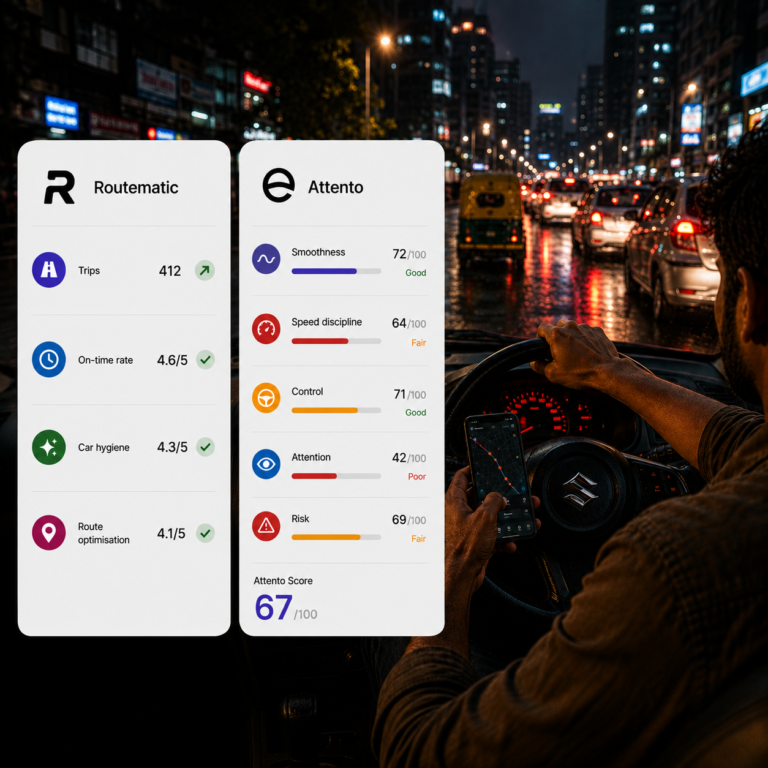
It measures driving behaviour across dimensions such as speed, braking, acceleration, cornering, consistency and attention, then builds longitudinal context around those behaviours.
If DMS asks: “Are you paying attention?”
Attento asks: “How are you driving?”
And over time: “Is the way you’re driving changing?”
That’s where the two can eventually become complementary rather than competitive.
If DMS becomes ubiquitous, Attento doesn’t need to replace it. It can become one of the sources of truth for one dimension of driving: attention and driver state.
But attention is only one dimension. Attento’s job is to connect that signal with the rest of the behavioural picture viz. speed, braking, acceleration, cornering, consistency and how all of those behaviours change over time.
Is this driver’s fatigue getting worse over the past month? Is this distraction pattern new, or has it always been there? Is their braking becoming harsher? Is their speed control deteriorating? Is this a bad day, or a bad habit?
DMS provides one piece of that picture. Attento’s role is to connect the pieces.
The Data Relationship
There’s also a fundamental difference in how the two systems interact with the driver.
DMS needs to observe the driver to perform its function. A camera pointed at the driver’s face can capture highly sensitive information about gaze, facial behaviour and attention, which naturally raises questions around storage, access and data use.
Attento’s proposition is different: to build a driver-centric behavioural record based on how the vehicle is being driven.
The distinction isn’t that one system has privacy concerns and the other doesn’t. It’s that they collect different kinds of information for different purposes. For some drivers, that difference may influence whether they are comfortable using the technology at all.
A technology that depends on continuous in-cabin observation may face a different adoption barrier from one that measures vehicle dynamics through a device the driver already owns and controls. The goal is not simply to watch the driver. It’s to give the driver a better understanding of their own behaviour.
Watching vs. Understanding
That’s ultimately the distinction between DMS and behavioural telematics.
DMS is valuable because it can identify an immediate problem with one specific dimension of driving: the driver’s attention or state.
Attento looks beyond that single dimension and asks how the driver actually behaves behind the wheel, how that behaviour changes over time, and what those changes might mean.
DMS tells you whether the driver is paying attention.
Attento tells you how they drive.
And over time, the driving tells a story.