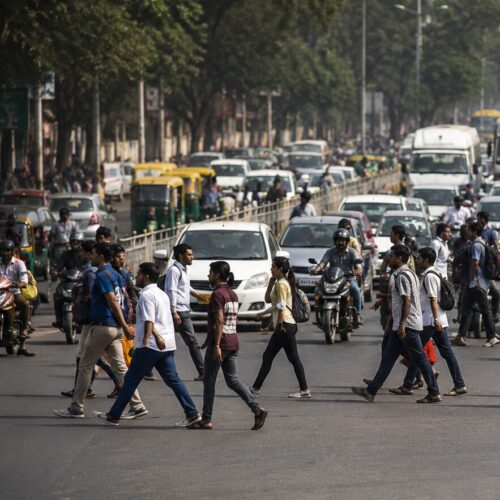
India has more pedestrians than almost any country on earth. It also has some of the world’s deadliest roads for them. The two facts are not a coincidence. They are a policy choice.
Picture the most ordinary thing you did today.
You stepped out of a building. You crossed a road. Maybe you didn’t even think about it.
Now consider that in India, that act kills over 70 people every single day. Not drivers who ran a red light. Not riders without helmets. People who were simply on foot, trying to get from one side of a road to the other.
In 2024, India recorded 25,769 pedestrian fatalities, according to the National Crime Records Bureau (NCRB). And buried in that data is a number that should stop policymakers cold: for the first time, the share of pedestrians killed has surpassed that of car occupants. The person walking is now more likely to die on an Indian road than the person inside a vehicle.
This is not a statistic born from recklessness. It is the predictable outcome of a road system that was never really designed for the people using it most.
A country’s relationship with its pedestrians reveals everything about how it thinks about public space, mobility, and who the road actually belongs to. India’s answer, right now, is uncomfortable.
The Country That Walks, But Doesn’t Plan for Walking
28% of India’s urban population moves primarily on foot, according to a study commissioned by the Ministry of Housing and Urban Affairs. Walking is not a fringe activity. It is the primary mode of transport for daily wage workers, schoolchildren, the elderly, and street vendors. The people who walk the most are also the people with the fewest alternatives.
And yet, the infrastructure they depend on barely exists.
In Pune, out of a 2,000 km road network, only 800 km have footpaths, and most of those are encroached upon or unsafe, per the city’s own walking survey. A PMC audit found 863 encroachments on footpaths across just 457 km of road. Across Indian cities, footpaths are interrupted by electricity poles, open drains, transformer boxes, parked two-wheelers, and informal vendors. They narrow without warning and disappear entirely on stretches where a pedestrian is most exposed.
Did you know? A Central Road Research Institute survey found that 9 out of 10 pedestrians felt unsafe while crossing roads in Indian cities. That is not a statistic about pedestrian indiscipline. It is a statement about infrastructure failure.
Jaywalking Is The Wrong Diagnosis
Jaywalking is treated as a behavioural problem in India. Police periodically run “awareness drives” fining pedestrians Rs. 10 to Rs. 50 in cities like Kolkata and Bengaluru. The conversation is usually framed around pedestrian carelessness.
But here is the structural problem with that framing.
India has no universal law criminalising jaywalking. Unlike the United States, Singapore, Australia, or New Zealand, India’s legal framework has no standalone provision prohibiting pedestrians from crossing where they choose. The Motor Vehicles Act, 1988 and the Rules of the Road Regulations, 1989 focus overwhelmingly on driver obligations. The pedestrian’s obligations are barely addressed
In fact, Section 122 of the MV Act places the burden of care on drivers when pedestrians are present. Rule 190 of the Central Motor Vehicle Rules requires drivers to slow down and, if necessary, stop when pedestrians are crossing.
In other words: Indian law already assumes pedestrians have right of way. The enforcement gap is absolute.
A study of urban pedestrian behaviour in India found that 46% of pedestrians violate traffic signals to save time and for convenience. But the data also consistently shows that crossing mid-block is rarely reckless. It is a response to absent zebra crossings, infrequent pedestrian signal phases, and crossings placed so far apart that finding one would add hundreds of metres to a journey.
When the legal response to a design failure is to fine the person navigating that failure, the system is working backwards.
Did you know? Research shows pedestrians are unwilling to walk more than 100 metres out of their way to reach a designated crossing. In many Indian cities, crossings are spaced 500 metres apart on major roads. The infrastructure has effectively guaranteed jaywalking by design.
This does not mean every unsafe crossing behaviour is rational. But the overwhelming pattern is infrastructure forcing unsafe decisions.
The Stop & Wait Behaviour That Broke Western Traffic Models
One finding from Bosch’s landmark pedestrian safety study, the first of its kind for India, based on over 6,300 RASSI cases, deserves to be far more widely discussed.
In the western world, when a pedestrian steps onto a road, the expectation is that the driver will stop.
In India, it is the pedestrian who stops.
Bosch found that nearly 12% of pedestrians cross halfway and pause in the middle of the road, allowing the vehicle to pass before completing the crossing. This behaviour is so distinct from global norms that it presents a specific technical challenge: existing Autonomous Emergency Braking (AEB) systems are calibrated to detect moving objects. A pedestrian who stops mid-crossing registers as a stationary obstacle rather than a crossing person. The safety systems designed to prevent pedestrian deaths were not built for the way Indian pedestrians actually behave.
This means that pedestrian survival behaviour in India is the product of adapting to an environment where drivers will not stop. And that same adaptation, pausing mid-road, is itself a source of risk when traffic approaches from the other direction before the crossing is complete.
Did you know? India’s 2021 pedestrian fatalities of 29,200 exceeded the combined road fatalities of the entire European Union and Japan, according to the Bosch study.
The Rural Paradox
Most discourse on pedestrian safety focuses on cities. The data points somewhere else.
According to the Bosch study, 56% of pedestrian accidents in India occur on rural roads. Rural roads are faster, lighting is absent, and emergency response times can exceed one hour. Trucks and heavy vehicles travel at speed on stretches with no median barriers, no shoulders, and no pedestrian markings.
The urban-rural gap also reflects a healthcare gap. In cities, a critically injured pedestrian has some chance of reaching trauma care within the golden hour. In rural India, where the nearest trauma centre may be 40 km away, survivable injuries become fatal.
This is why Bihar and West Bengal tell the more alarming story. Bihar records 39% of its road deaths among pedestrians. West Bengal reaches 48.5%. Delhi, despite being the most cited city for pedestrian danger, is not representative of where the crisis is deepest. For two-wheeler deaths specifically, Tamil Nadu reported the highest toll at 11,786, followed by Uttar Pradesh at 8,575, reflecting how state-level road culture and enforcement capacity shape who dies and where.
When Exactly People Are Dying
The narrative around pedestrian safety implies nighttime danger: poor visibility, drunk drivers, empty speeding roads. The Bosch study challenges this.
In India, 52% of pedestrian accidents occur during the daytime. Daytime deaths happen on busy roads where truck and two-wheeler volumes are highest, often involving pedestrians crossing highways to reach markets or bus stops with no formal crossing nearby.
But the highest-risk window is narrower. Research corroborated by Indian hospital studies identifies 4 PM to 8 PM as the most lethal period overall. Peak vehicle density, driver fatigue, and the transition from day to dusk combine at exactly the moment when pedestrian volumes also spike, as people return from work. It is not darkness that kills. It is the period when the road transitions faster than the lighting infrastructure can compensate.
Did you know? India’s growing SUV market is improving occupant safety while degrading pedestrian safety. Research published in ScienceDirect found that pedestrians struck by SUVs are significantly more likely to die than those struck by smaller passenger cars, due to the height of the front end and the physics of impact.
A pedestrian hit at 30 km/h has a high chance of survival. At 50 km/h, the probability of death rises dramatically. This is why countries serious about pedestrian safety do not just build crossings. They slow vehicles down where people are expected to walk.
India’s roads often attempt the opposite: moving maximum traffic volume through mixed-use urban spaces at maximum possible speed.
The result is predictable.
What Other Countries Do Differently
Netherlands: 30 km/h speed limits in all residential areas, physical barriers protecting pedestrians, strict liability law (driver presumed at fault in ped crashes)
Japan: Elevated crossings standard in urban areas, pedestrian priority encoded in driver training, narrow lanes that force slower speeds
Vision Zero cities (Oslo, Helsinki): Redesigned streets to eliminate high-speed pedestrian conflicts, near-zero pedestrian deaths in some years
These aren’t richer countries with magic solutions. They’re places that decided pedestrian lives matter more than vehicle speed.
What Would Actually Help
The countries that have reduced pedestrian fatalities most effectively share a common philosophy. The road is not designed around the fastest possible movement of vehicles. It is designed around the survival of the most vulnerable user.
This translates into concrete decisions that India’s IRC has already codified but rarely enforced:
Continuous footpaths. The IRC mandates a minimum width of 1.8 metres for roads wider than 18 metres. The gap between that standard and street-level reality is enormous and largely unenforced.
Raised crossings. A raised zebra crossing is a physical speed-calming measure. In cities where driver compliance at crossings is near zero, painted lines accomplish nothing. Physical geometry is the only reliable enforcement.
Traffic calming measures in residential areas. Cities need to implement speed tables, chicanes, and deliberately narrowed lane widths that physically force vehicles to slow down. Establish mandatory 30 km/h zones near schools, markets, and residential colonies where pedestrian density is highest.
Enforcement technology that actually works. Deploy automated detection systems at zebra crossings to catch violations without requiring constant police presence. More importantly, India needs a fine structure that actually deters dangerous behavior, the current Rs 500-1,000 penalty is meaningless to most drivers and does nothing to change behavior.
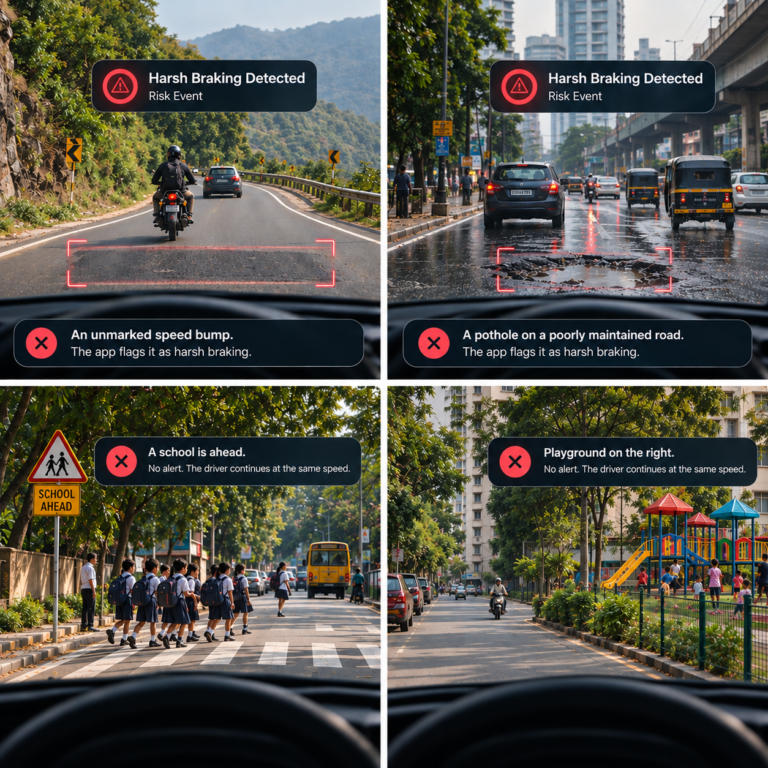
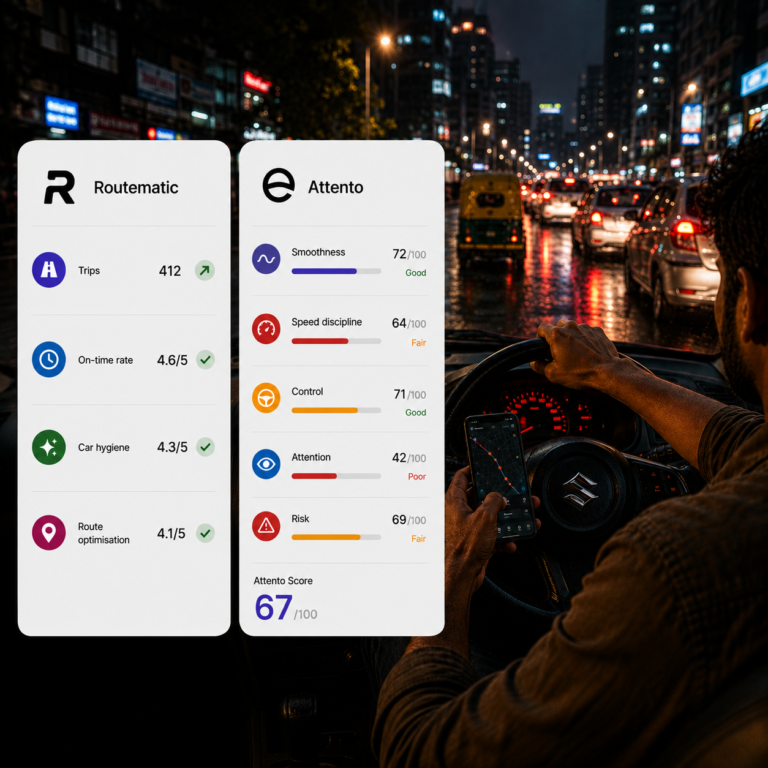
At Attento, we track driver behavior at a granular level. When we analyze zebra crossing approach patterns, the data is stark.
- Speed reduction at marked crossings: minimal to none in cities without active enforcement.
- Braking response time when pedestrians are visible: consistently delayed compared to vehicle-to-vehicle braking.
- Yielding compliance: near zero in most urban contexts we monitor.
These aren’t anecdotes. They’re patterns across thousands of trips.
Pedestrian safety can’t be solved without changing driver behavior. And driver behavior won’t change without measurement, feedback, and accountability.
The Bosch finding, that Indian pedestrians stop mid-road to let vehicles pass, is a behavioural artefact of drivers who do not yield. Every time a vehicle fails to slow at a zebra crossing, it reinforces the learned behaviour of a pedestrian who waits mid-road and completes the crossing in a second gap. Over millions of daily interactions, this shapes a road culture.
The Final Crossing
The question of pedestrian safety in India is often posed as a behavioural problem. Why don’t pedestrians use crossings? Why do they jaywalk?
The more honest question is a different one.
Why have we built roads where over 70 people die walking every single day, and still describe the problem as a failure of individual discipline?
The pedestrian is the original road user. The road existed before the vehicle. The footpath was not an addition to the street. It was what the street was.
India has 1.4 billion people. Hundreds of millions of them walk. They are not the problem.
They are the people the road was supposed to protect.