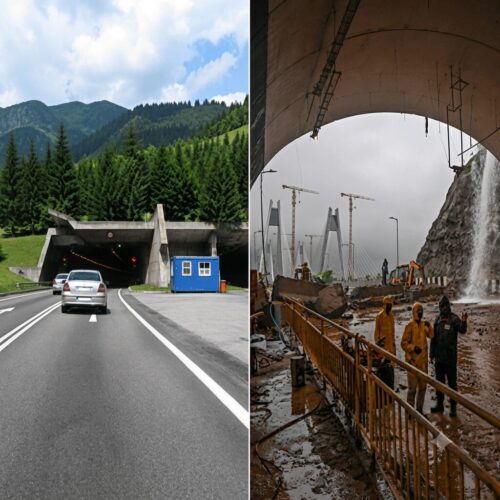
On 1 May 2026, Maharashtra Chief Minister Devendra Fadnavis stood at the inauguration of the Mumbai-Pune Expressway Missing Link and described it as Maharashtra’s new “connecting link.” The project had taken nearly three decades from conception to completion. It cost Rs 7,000 crore. Its 8.9-kilometre main tunnel, bored 180 metres below Lonavala Lake using the New Austrian Tunnelling Method, is among the widest road tunnels in the world. Its cable-stayed bridge soars above Tiger Valley. The press releases promised it would make Mumbai-Pune travel “quicker and more reliable” by eliminating one of India’s most accident-prone road sections.
Nine weeks later, on 6 July 2026, a landslide near the Khandala exit of Tunnel 2 blocked the Pune-to-Mumbai carriageway and shut the Missing Link to traffic. Debris cascaded from the hillside above the tunnel exit. Water gushed through the tunnel. The stretch closed for 19 hours. Commuters were sent back to the accident-prone Khandala ghat section the Missing Link was specifically built to replace.
The Maharashtra State Road Development Corporation called it an “act of God.”
The monsoon comes every year. It has always come every year. The Western Ghats are among the most landslide-prone formations in India. Everyone who built this road knew this. The question that “act of God” does not answer is: why was a Rs 7,000-crore infrastructure project inaugurated nine weeks before its first monsoon test without completing the slope stabilisation work that its terrain demanded?
That question connects to a larger one. India is currently building tunnels at an unprecedented pace, through some of the most geologically challenging terrain on earth. In the same week the Missing Link failed its first monsoon test, a landslide at an active tunnel construction site in Wayanad, Kerala (separate from the July 2024 disaster) killed at least three workers. Less than three years before that, 41 workers were trapped for 17 days in the Silkyara Bend-Barkot Tunnel in Uttarakhand after a collapse that investigators found had no escape shaft, despite government guidelines requiring one.
These are not separate incidents. They are expressions of the same underlying problem: a tunnel safety culture that treats the mountain as a deadline variable rather than a fixed constraint.
What Switzerland Learned the Hard Way
Switzerland has been building tunnels through hostile Alpine geology since 1882. The Gotthard Road Tunnel, opened in 1980 at 16.9 kilometres, was the world’s longest road tunnel at the time. On 24 October 2001, a truck collision inside the tunnel ignited a fire that within minutes exceeded 1,000°C. Eleven people died. The tunnel’s ventilation system did not extract the smoke. It spread it along the tunnel, cutting off visibility and oxygen faster than people could escape.
The Swiss response was not a press release about extraordinary circumstances. It was a systematic, mandatory reform of tunnel safety standards across the country’s entire 1,800-kilometre road network. The Federal Roads Office, known by its German acronym ASTRA, mandated changes that went far beyond the Gotthard:
- Ventilation systems redesigned to control smoke direction rather than circulate air
- Emergency phones every 125 metres throughout every major tunnel
- Emergency exits every 250 metres
- Fire-resistant materials made standard across all tunnels
- Emergency response teams stationed at both portals of major tunnels
- A comprehensive rehabilitation programme from 2010 to 2020 retrofitting existing tunnels to the new standard
The 2001 Gotthard fire fundamentally changed how the country designed, operated, and regulated tunnels. The lesson wasn’t that disasters could be prevented. It was that every disaster should permanently raise the standard.
When Switzerland built the 57-kilometre Gotthard Base Tunnel (the world’s longest), the safety architecture was designed entirely around failure scenarios. Twin tubes connected by sealed evacuation passages every 325 metres. Full emergency stations. A legally required series of full-scale evacuation exercises before operating licences were granted. Completing an 800-passenger evacuation within 90 minutes was not a target. It was a condition.
Before the Swiss Ministry of Transport granted an operating licence, six full-scale evacuation exercises were legally required. The final exercise evacuated 800 passengers following a simulated fire alarm: passengers walked 1.5 kilometres through emergency passages to another tube, boarded a rescue train, and were moved to safety. Completing this within 90 minutes was a condition of operating. Not a target. A legal requirement.
Did you know? The Gotthard Road Tunnel has emergency exits every 250 metres. The Silkyara tunnel, at 4.5 kilometres, had none at all. Switzerland mandates what India only recommends.
The Pattern the Missing Link Exposes
The Mumbai-Pune Missing Link failure is not simply a monsoon story. It is a story about when and why infrastructure gets declared ready.
The project was conceived in 1995, approved by Maharashtra Cabinet in 2017, and began construction in 2019. It was delayed by Covid-19, difficult geology, and the engineering complexity of tunnelling through the Western Ghats. Infrastructure observers have raised questions about whether the project was inaugurated before slope stabilisation was complete, and whether political timing contributed to that decision.
MSRDC’s response (“act of God”) is a framing that does significant work. It places the event outside the domain of engineering accountability. A landslide on a known landslide-prone hillside above a new tunnel, nine weeks after inauguration, is not an act of God. It is a predictable consequence of the Western Ghats meeting a monsoon. The question is whether the project was designed and completed to withstand that consequence, not whether the consequence was foreseeable.
In Switzerland, this question has a structured answer. A project cannot be inaugurated until it demonstrates compliance with safety standards under the conditions it will actually face. The mountain is not a variable. It is a fixed constraint that the engineering must accommodate.
In India, the inauguration is frequently the finish line. What happens in the first monsoon is discovered afterward.
Silkyara: The Same Pattern, Higher Stakes
The tunnel had been built across a known geological fault. The geology report submitted before construction began had explicitly flagged weak rock conditions. Residents of a nearby village had written to the district magistrate four years before the collapse, alleging construction in “utter disregard” for established norms. Government guidelines required an escape shaft for tunnels over 1.5 kilometres in length. The 4.5-kilometre Silkyara tunnel had none.
When the collapse occurred, 41 workers were trapped for 17 days. The rescue required intervention from the National Disaster Response Force, army engineers, international tunnelling experts, and ultimately rat-hole miners working manually through the debris. The operation lasted longer than the escape shaft that could have resolved it in hours would have taken to build.
The Ministry of Road Transport and Highways responded with comprehensive new guidelines: mandatory Geotechnical Baseline Reports, formal Risk Registers, real-time geological monitoring during construction, and an explicit statement that Detailed Project Reports must be “serious technical documents and not mere formalities.” These guidelines are substantively correct. They align with international best practice. The question, as always in India, is the gap between the guideline and the construction site.
India currently has 57 tunnels covering nearly 94 kilometres under active construction on national highways alone, the majority through Himalayan terrain. This number will grow. The monsoon arrives between June and September every year. The Himalayas are a young fold mountain system with highly variable geology, active fault lines, and groundwater ingress that conventional surveys struggle to fully characterise.
India’s operational tunnel safety framework under IRC:SP:91 guidelines specifies requirements for ventilation, emergency lighting, emergency exits, and fire suppression in tunnels above a certain length. The Missing Link’s main tunnel at 8.9 kilometres falls well within those provisions. Whether those systems were fully operational at inauguration on 1 May 2026 has not been publicly confirmed by MSRDC. That silence is itself informative.
Did you know? As of December 2024, India has 57 tunnels under active construction on national highways, concentrated in the Himalayas and Western Ghats, the two most geologically unstable and monsoon-affected terrains in the country.
Where India Has Got It Right
This piece should not leave the impression that India always fails. It does not.
The Banihal Qazigund Road Tunnel in Jammu and Kashmir, at 8.45 kilometres, has operated since 2017 with a safety record that reflects serious engineering investment. The Chenani-Nashri Tunnel in the same state, at 9 kilometres the longest in India at its opening, includes ventilation systems, emergency exits, and cross-passages designed to standards comparable to international benchmarks. The Zoji La Tunnel, currently under construction at 14.2 kilometres, is being built with escape passages and emergency infrastructure specified from the outset.
These projects prove the capability exists. Indian engineers know how to build tunnels safely. The knowledge is not the variable. The institutional consistency, the willingness to apply the same standard on a political deadline as on a project with time to spare, is the variable. The Missing Link and Silkyara are not evidence that India cannot build safe tunnels. They are evidence that India does not yet build them safely every time.
The “Act of God” Problem
When infrastructure fails, the language used to describe the failure tells you how the institution understands its own responsibility.
“Act of God” is a specific legal and institutional claim. It means the event was unforeseeable, outside human control, and therefore outside the domain of engineering accountability. It is a phrase designed to close questions rather than answer them.
A landslide in the Western Ghats during the monsoon is not unforeseeable. It is the baseline risk profile of the terrain. A tunnel fire in a confined underground space is not unforeseeable. It is among the first failure scenarios any tunnel engineer must plan for. A collapse in Himalayan geology is not unforeseeable. It is why Swiss and European tunnel safety standards require Geotechnical Baseline Reports, Risk Registers, and staged geological monitoring throughout construction.
What “act of God” actually means, when used in these contexts, is: we did not build for this, and we do not want to be accountable for not having built for it.
Switzerland’s response to the 2001 Gotthard fire was the opposite of this. It accepted that the failure was the system’s failure, not the mountain’s, and rebuilt the system. India’s response to the Missing Link closure and the Silkyara collapse has been, so far, better than denial but still short of the institutional reform that Switzerland’s 2001 fire produced.
Safety Doesn’t End When Construction Does
Road safety discussions about tunnels almost always focus on the construction and engineering phases. The operational phase carries its own risk profile that receives far less attention.
A driver entering a long tunnel through the Western Ghats or the Himalayas is entering an environment with specific behavioural risks that open road driving does not produce:
Speed misperception. Enclosed spaces reduce the visual cues that help drivers gauge speed. Drivers in tunnels consistently travel faster than they perceive themselves to be travelling, particularly when the tunnel is well-lit and straight. The 8.9-kilometre main tunnel of the Missing Link, with its wide bore and high-speed design, is precisely the kind of environment where this effect is most pronounced.
Following distance compression. Drivers follow more closely in tunnels than on open roads, partly because the absence of peripheral reference points reduces perceived risk, and partly because the enclosed geometry creates pressure to maintain pace with the vehicle ahead.
Exit adjustment. Exiting a dark tunnel into bright daylight produces a temporary reduction in visual acuity that can last several seconds. At 100 kilometres per hour, several seconds is 280 metres. The area immediately outside a tunnel exit is statistically one of the highest-risk zones on any mountain road.
Tunnel monotony. A long, straight, well-lit tunnel removes the peripheral visual cues that keep drivers alert on open roads. The absence of variation, no curves, no roadside trees, no changing landscape, creates the same conditions that produce highway hypnosis on straight national highways. At 8.9 kilometres, the Missing Link’s main tunnel is long enough for this effect to manifest before the driver even sees the exit. A driver who entered alert may exit having been cognitively absent for the final two kilometres without realising it.
At Attento, we track exactly these behavioural signatures: approach speed, following distance variation, and braking patterns at tunnel exits. A well-designed tunnel manages these risks through lighting transitions, speed enforcement, and physical geometry. An infrastructure project inaugurated before slope stabilisation is complete has not yet answered the question of what the operational risk profile looks like in year one, let alone year ten.
The Standard India Needs to Hold Itself To
Switzerland did not build the world’s safest tunnel network because it had easier geology or unlimited money. The Alps are among the most geologically challenging environments in the world. Switzerland built its tunnel safety record because, after the 2001 Gotthard fire, it decided that treating infrastructure failure as a natural event was unacceptable, and it enforced a new standard with legal mechanisms and real consequences.
India’s tunnel-building programme is the most ambitious in its history. The Missing Link failure nine weeks after inauguration, the Silkyara collapse that required 17 days of international rescue effort, and the Kerala construction landslide that killed workers last week are not isolated events in an otherwise well-managed programme. They are signals from a system where the inauguration is still treated as the finish line, and the mountain is still being treated as a variable.
The Geotechnical Baseline Report mandated by MoRTH’s post-Silkyara guidelines is the right tool. The Risk Register is the right tool. Mandatory escape shafts and real-time geological monitoring are the right tools. What converts them from guidelines into outcomes is enforcement culture: an institutional willingness to delay an inauguration when the slope stabilisation is not complete, to halt construction when monitoring reveals unexpected ground behaviour, and to call a failure a failure rather than an act of God.
The mountain does not negotiate with ribbon-cutting ceremonies.