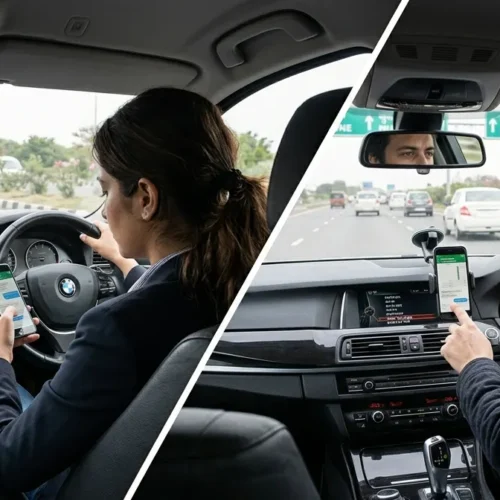

We all use our phones while driving. Some of us just don’t realise how much.
The question isn’t whether you do it. It’s which type of phone user you are, and whether you’re ready to admit it.
Because here’s the thing. According to the US National Highway Traffic Safety Administration, distracted driving killed 3,275 people in 2022. In India, where more than 170,000 people die in road accidents annually, your “quick glance” might be someone’s last moment.
But lectures don’t work. Shame doesn’t work. What works is recognizing your pattern.
Let’s look at some common types that we have identified in our work at Attento.
Type 1: The “Just a Quick Glance” Driver

If you’ve ever told yourself “just one second” while reaching for your phone at a signal, this is you.
What they do
Check notifications briefly — usually 1 to 2 seconds at a time, often at signals, in slow traffic, or on “empty” roads.
Their mantra
“It’s just a second, I’m still in control.”
Why it feels harmless
It doesn’t feel like real phone use. You’re not scrolling. Just checking.
The reality
At 60 km/h, a 2-second glance means driving 33 metres blind — the length of a cricket pitch.
And it’s not just one glance. It’s multiple micro-interruptions. Each one fragments attention.
Did you know? Even a 1-second distraction significantly doubles crash risk. Duration doesn’t equal safety.
Type 2: The Navigation Tweaker
If you’ve ever zoomed into Google Maps right before a turn “just to be sure,” this is you.

What they do
Constantly adjust navigation — zooming, rechecking routes, tracking ETAs. The phone is mounted, so it “doesn’t count.”
Their mantra
“I’m just navigating, not using my phone.”
Why it feels necessary
On Indian roads, navigation isn’t optional. Missing signs, last-minute diversions, unfamiliar routes — GPS becomes essential.
The reality
These interactions happen at the worst moments — turns, merges, junctions.
Each tap pulls your attention away exactly when you need it most.
Late lane changes.
Sudden braking.
Missed turns corrected at the last second.
Did you know? Google Maps recalculates routes approximately every 30 seconds in heavy traffic. Checking each update? That’s 120 distractions in a one-hour commute.
Type 3: The Red-Light Scroller
If your instinct at a red light is to reach for your phone, this is you.

What they do
Use the phone only when stopped — quick replies, social media, email checks. Phone goes down when the light turns green.
Their mantra
“I only use my phone when stopped, so it’s safe.”
Why it feels justified
The car isn’t moving. It feels like free time.
The reality
Your car may be stationary. Your brain isn’t.
When the light turns green, your attention lags. You’re still processing what you just saw.
You miss pedestrians.
You miss cross-traffic.
You react late — then accelerate harder to compensate.
That delay doesn’t just affect you. It affects everyone behind you.
Did you know?Your brain takes several seconds to fully re-engage after a distraction. Traffic doesn’t wait for that reset.
Type 4: The Work-Life Multitasker
If “I have to take this call” is part of your regular drive, this is you.

What they do
Frequent calls — work, family, logistics. Often hands-free, often emotionally engaged.
Gig workers:
Constant app interaction — ride requests, deliveries, navigation, customer calls. Often on two-wheelers.
Their mantra
“Hands-free is legal, so it’s safe.”
— or —
“I don’t have a choice. This is my job.”
Why it feels unavoidable
Life doesn’t pause for your commute. And for India’s 7.7 million gig workers, the phone is the job.
The reality
Hands-free isn’t distraction-free.
Your brain can’t fully process a conversation and the road at the same time.
Add stress — a work call, an angry customer — and attention drops further.
For gig workers, it’s worse:
Navigation + calls + app interaction
On two wheels
In unpredictable traffic
That’s maximum exposure with minimal protection.
Did you know? Talking to a passenger is less distracting than a phone call. Passengers adapt to traffic. Your phone doesn’t.
Type 5: The “I Can Handle It” Power User
If you’ve ever texted at speed and thought “I’ve got this,” this is you.

What they do
Texting, voice notes, emails — even videos — while driving. Often at speed. Usually with one hand on the wheel.
Their mantra
“I’m experienced. I know what I’m doing.”
Why it feels justified
You know the roads. You’ve done this drive hundreds of times. And you haven’t crashed.
The reality
Reading a message for 5 seconds at 80 km/h means covering 111 metres — longer than a football field — without looking.
Skill doesn’t change physics.
Experience doesn’t reduce reaction time under distraction.
And “I’ve never crashed” isn’t proof of safety.
It just means the right mistake hasn’t met the right moment.
Did you know? Experienced drivers often take more risks with phones — not because they’re worse drivers, but because they’re more confident.
What All 5 Types Have in Common
Recognize yourself? Most of us are multiple types depending on the day.
We all underestimate how often we actually use our phones while driving. We overestimate our control while doing it. We believe our specific use case is “different.” And we think “I’ll just be more careful” is a plan.
The most dangerous belief? “Phone use is risky — except when I do it.”
Phone Usage And What It Means To Us At Attento
At Attento, these behaviours don’t show up as “phone use.”
They show up as patterns:
• Late braking
• Speed inconsistency
• Missed reactions at predictable points
When we isolate phone-related behaviour, distinct patterns emerge for each of the above types:
The Quick Glancer: Clusters of brief attention lapses, especially at predicted stop points (signals, toll plazas).
The Navigation Tweaker: Phone interaction spikes correlated with turns, junctions, and route decision points.
The Red-Light Scroller: Delayed acceleration at signals, followed by rapid speed increase (compensating for the delay).
The Multitasker: Sustained periods of reduced attention quality, often during longer highway stretches.
The Power User: High-risk phone use during high-speed segments, often with sudden hard braking events.
Each pattern shows measurable impact on driving safety, even when the driver believes they’re in control.
Final Thoughts
Beyond phone use, distraction on Indian roads takes many forms music, conversations, fatigue, even overconfidence. At Attento, we’re breaking these down one by one through our ongoing blog series, from how your driving playlist affects your driving to the everyday habits that quietly increase risk.
Because the question isn’t whether you use your phone while driving. It’s whether you still believe your reason is the exception. On Indian roads, the margin for error is already thin. And most of us don’t lose attention for minutes. Just seconds. That’s enough.
If this felt familiar, there’s a good chance other patterns will too. Explore more from the series and start noticing what your own driving really looks like.