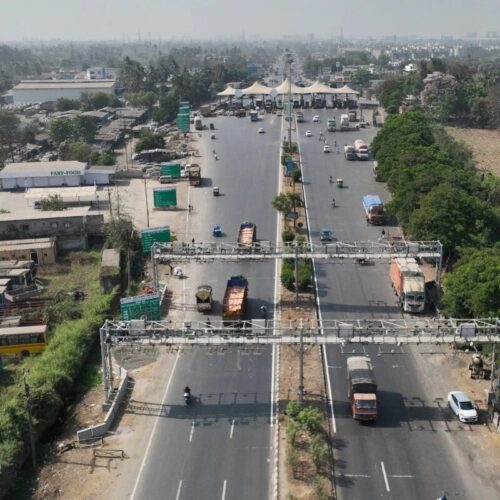
Picture this. You are a truck driver hauling perishables from Surat to Delhi. You have 1,400 kilometres ahead of you. Your cargo has a shelf life. And somewhere along the way, you will pull up behind a queue at a toll plaza and sit there, engine running, losing time you cannot recover.
This is not an edge case. This is Tuesday.
Multiply this by 1,150 toll plazas. By millions of vehicles daily. By every delivery, every shipment, every urgent cargo racing against a clock.
Toll plazas on India’s national highway network acted as a mandatory stop, a bottleneck, a small tax on the movement of everything that moves in this country. FASTag reduced average waiting times from roughly 714 seconds per vehicle to under a minute. But reduced is not eliminated. The barrier is still there. The queue still forms.
On 11 May 2026, India’s second fully barrier-free toll plaza went live at Mundka-Bakkarwala in Delhi-NCR, following the Choryasi Toll Plaza on the Surat-Bharuch section of NH-48 in Gujarat, which opened on 1 May 2026. No boom barriers. No stopping. Vehicles pass through at highway speed and the toll is deducted automatically.
India has been talking about this for years. Now it is actually happening.
What FASTag Did and Didn’t Do
FASTag, launched in 2014 and made mandatory by February 2021, was a genuine leap from the cash-and-card era. Before FASTag, every toll transaction involved a physical cash exchange or card swipe, human operators, change-making delays, and the inevitable corruption that comes with cash handling. It automated toll payments and reduced average waiting times from roughly 714 seconds per vehicle to under a minute.
But FASTag’s limitation was structural. It sped up the transaction while leaving the infrastructure unchanged. The boom barrier still had to lift. Vehicles still processed one lane at a time. At peak hours, queues simply re-formed faster.
Multi-Lane Free Flow (MLFF) removes the stop-start model entirely. Vehicles pass through gantries at full speed.
How It Actually Works
The MLFF system uses three technologies working in concert:
Layer 1: RFID (FASTag) Primary identification. Your existing FASTag is read as you pass under the gantry at highway speed. Account debited automatically.
Layer 2: ANPR (Automatic Number Plate Recognition) Backup system. AI-powered cameras capture front and rear number plates using OCR. Identifies and bills vehicles without valid FASTags or when RFID read fails.
Layer 3: LiDAR (Light Detection and Ranging) Vehicle classification. Builds real-time 3D profile to determine toll category: car, two-axle truck, multi-axle commercial. No human judgment required.
All three feed into a backend integrated with VAHAN, India’s national vehicle registry, for validation and billing. This is why NHAI, in April 2026, urgently directed all FASTag-issuing banks to verify and correct the Vehicle Registration Numbers linked to their tags. A mismatch can cause the system to miss a violator or wrongly penalise a compliant driver. Cleaning up that data is not administrative housekeeping. It is the foundation on which MLFF enforcement rests.
The Number That Explains the Urgency
India’s logistics cost stood at 7.97% of GDP in FY 2023-24, per the DPIIT-NCAER assessment, down from the 13-14% cited for years. It is India’s first scientifically derived estimate. In absolute terms, that is Rs. 24.01 lakh crore spent on moving goods annually.
Even at the revised figure, India sits above global benchmarks.
Indian trucks cover an average of only 300 km per day, against a global benchmark of 500-800 km. Every minute a truck idles at a toll is fuel burned, cargo time lost, and fleet utilisation wasted.
The government estimates MLFF could save nearly 250 crore litres of fuel annually by eliminating the deceleration, idling, and re-acceleration cycle at every toll point.
The Enforcement Problem Nobody Is Talking About
The physical barrier, for all its inefficiency, enforced payment perfectly. If your FASTag was invalid, the gate simply did not open. MLFF removes that hard stop entirely. Enforcement now depends on digital notices, accurate vehicle databases, and penalties that actually get collected.
That is where the real challenge begins.
India’s e-challan recovery rates remain below 30% in many states. Notices go to outdated addresses. Phone numbers change. Penalties accumulate without consequence. Taiwan’s MLFF system works because enforcement is nearly airtight: vehicle records are accurate, notices reach owners quickly, and unpaid dues affect registration renewals and insurance.
India’s April 2026 directive asking banks to urgently correct FASTag-linked vehicle registration data suggests NHAI understands the scale of the problem.
Did you know? NHAI plans to roll out MLFF at around 25 national highway plazas in the current financial year.
What It Means for How We Drive
The shift to MLFF is not just an infrastructure story. It is a driver behaviour story. For decades, Indian drivers have been conditioned to slow at toll plazas. The barrier forced lane discipline, speed reduction, and a predictable interruption in highway flow. MLFF removes that pause entirely.
At Attento, we will be watching how drivers adapt:
- Speed patterns approaching gantries
- Lane discipline without physical barriers
- Tailgating risk in high-speed toll corridors
- How quickly drivers stop treating toll zones as slow points
The toll booth is disappearing. The question is whether the driving habits it created disappear with it or whether we’re trading one set of risks for another. For decades, Indian drivers have been conditioned to treat toll plazas as mandatory interruption points. They slow down, reorient, look around, adjust lanes, reset attention. MLFF removes that pause entirely. That improves flow. But it also removes one of the few predictable slow-speed zones on long highway stretches. The behavioural consequences of that shift are still largely unknown.
It also raises a new set of questions for Indian roads:
- Will drivers overspeed through toll corridors?
- Will lane cutting worsen near gantries?
- How quickly will fake plates and unpaid toll accumulation emerge as enforcement gaps?
- Will fleets begin exploiting weak enforcement?
The technology is the easy part. Making compliance work without a physical barrier is the real test.
The Direction Is Set
Alongside MLFF, NHAI is developing a GNSS-based tolling framework where vehicles are charged based on the actual distance travelled, with no fixed infrastructure at all. Germany, Belgium, and several other European countries already run their commercial vehicle tolling this way. India is watching, and preparing.
Distance-based charging would change the equity of the system entirely. Today, a vehicle pays the same toll whether it joins a highway for 5 kilometres or 500 kilometres. Satellite-based charging aligns cost with actual use, and opens the door to dynamic pricing as a genuine traffic management tool.
The boom barrier at Mundka-Bakkarwala came down in May 2026, and it is not going back up. For everyone who has ever sat in a toll queue at 11 PM on a highway that was otherwise empty, that is not a small thing.
The FASTag was a fix. The MLFF system is a rethink. And the difference matters more than most people realise.