Picture this.
A brand-new road is laid smooth, dark, flawless. Politicians inaugurate it with garlands and speeches. It gleams under the sun, promises convenience, and for a moment, feels like a glimpse of the India we aspire to be.
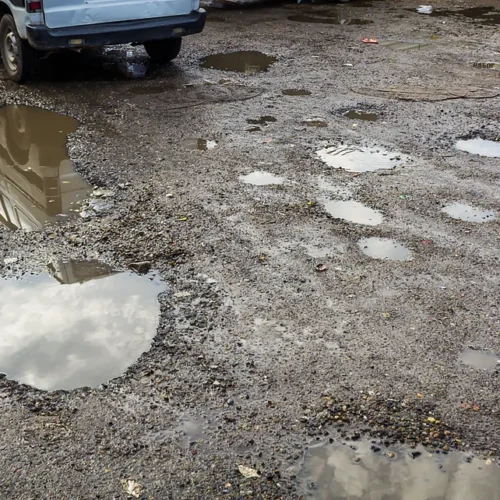
But just three months later, after one monsoon, a few overloaded trucks, and some routine neglect, the same road looks like it has survived a minor war craters, loose gravel, broken shoulders, traffic slowing to a crawl, and sometimes the road doesn’t just break, it disappears.
In Bihar, a 1.5 km road was literally stolen rolled up and taken away like a carpet. Overnight, scrap mafias dug out the bitumen and gravel and sold the materials for profit. By morning, villagers found only an uneven dirt track.
It sounds absurd. But it reveals a deeper truth: Indian roads don’t fail because of weather.They fail because of weak engineering discipline, poor oversight, perverse incentives and outright theft, both literal and metaphorical.
Before we dive deeper, it helps to look at how the world compares. The chart below, based on World Economic Forum rankings, shows which countries have the best roads in terms of quality and connectivity. The leaders aren’t just wealthy nations, they’re places where engineering discipline, drainage design, axle-load enforcement, and accountability are non-negotiable. And when you compare these global benchmarks with India’s lived reality, the gap becomes impossible to ignore.
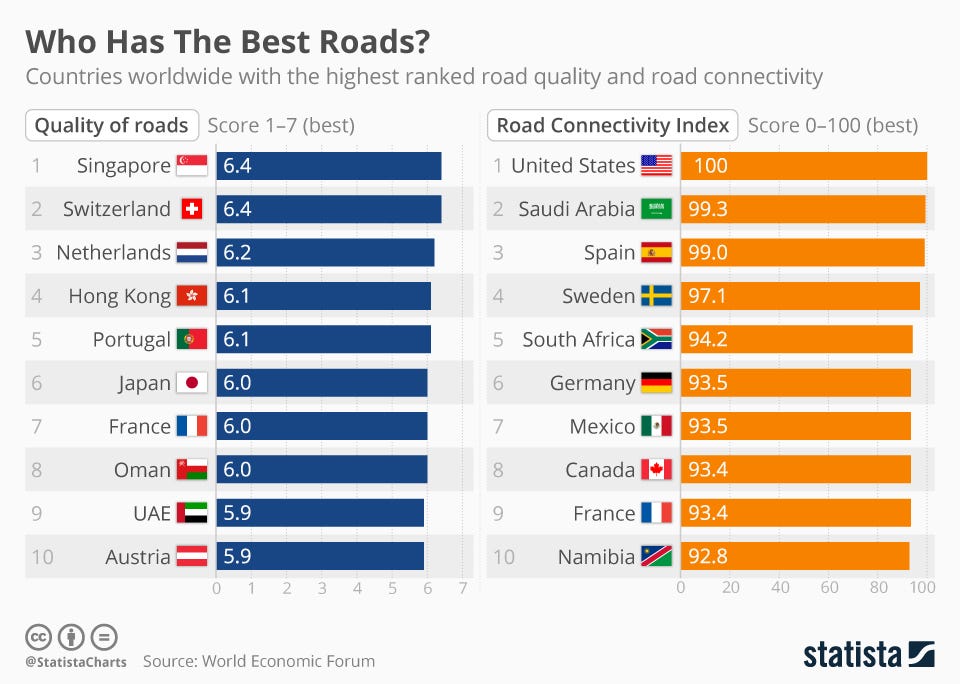
Let’s break down how roads crumble long before they should, and why countries with far harsher conditions,Norway’s freeze-thaw cycles, Canada’s blizzards, Japan’s typhoons,still manage roads that last years, not seasons.
Water Goes Where It Shouldn’t, Because We Don’t Let It Flow Out
Drainage failure is the number one reason Indian roads collapse.
When drains are missing, clogged, or built at the wrong gradient, water pools on the surface. Once water seeps through microcracks, it weakens the subgrade and the pavement loses strength with every axle load. According to the Central Road Research Institute (CRRI), standing water can reduce pavement life by up to 40 percent.
Did you know? The Netherlands designs drainage before designing the pavement layers. Many Dutch municipal standards require runoff to clear within 15 minutes of peak rainfall.
In India, drainage is often postponed to a later phase that rarely arrives.
Overloaded Trucks Aren’t Just Heavy, They Multiply Damage
Highway engineers rely on the fourth power rule from the American Association of State Highway and Transportation Officials. It states that pavement damage increases with the fourth power of axle load.
This means a truck overloaded by even 20 percent can inflict more than double the damage. CRRI estimates that severe overloading on Indian highways can accelerate failure by 10 to 20 times. That is why rutting appears first in truck lanes, then channels rainwater into those ruts, deepening the failure.
Many European countries use weigh in motion systems at toll plazas. India has them too, but enforcement varies widely by state and corridor.
Infrastructure failure isn’t only about what we build. It’s also about how we drive on what’s built. Speeding, aggressive lane changes, hard braking, and overload tolerance all amplify pavement stress and crash risk. Interestingly, even something as personal as what we listen to while driving can influence these behaviours.
We explored this human side of road safety in another piece: How Music Shapes the Way You Drive.
Construction Shortcuts Build Failure Into the Road
compaction passes, and ignoring temperature windows all create weak interfaces that unravel during the first monsoon.
An IRC audit of urban roads in 2021 found frequent non-compliance in binder content, aggregate grading, and density. The issue is not the standards. It is that contractors often self certify their work, and independent quality checks are inconsistent.
In 2019, a quality review of Mumbai’s civic roads found that one in three newly built stretches failed basic core-cut tests for density and binder content.
Uncoordinated Utility Work Turns New Roads Into Patchwork
A road may be resurfaced today and cut open next month for water, power, or fiber. Each department backfills differently, often with loose soil and a thin asphalt topping. These patches settle unevenly and become initiation points for potholes.
Cities like Singapore require that anyone digging a road must rebuild the full structural layer, not just lay a cosmetic patch. Tokyo maintains a utility corridor under many major streets to avoid repeated surface cuts.
Indian cities rarely coordinate utilities before paving, so new roads quickly become stitched surfaces.
Corruption Makes Durability a Liability
Did you know? Pune’s JM Road is still invoked as a parable. A contractor is said to have built it so well that it barely needed repairs. The rumour claims he struggled to win new tenders afterward. The story endures because everyone recognises the incentives: durable work is rarely rewarded.
Why does this happen?
- Low bids decide most contracts.
- Repairs generate steady revenue.
- Inspections often miss or ignore corner cutting.
- Materials can quietly leak out of the supply chain.
And Bihar shows what this looks like on the ground. In June 2025 a two kilometre road in Banka district reportedly vanished after encroachers dug it up and replaced it with wheat crops. Earlier, a 60 foot iron bridge and a two kilometre railway track were dismantled and stolen in separate incidents. Videos have also shown villagers breaking concrete off newly laid roads, sometimes out of anger over poor construction rather than for resale.
These cases differ in scale and motive, but they point to a deeper problem. When oversight is weak and accountability fragmented, public infrastructure becomes vulnerable not only to decay but to literal disappearance. At that point, a road can fail long before the first vehicle ever drives on it.
The Standards Exist, The Implementation Doesn’t
India’s Indian Road Congress (IRC) codes are solid and in many cases match global practice. Yet field execution often falls short. Common issues include lower bitumen content than specified, poor aggregate quality, incomplete compaction, incorrect layer thickness, and unsealed joints in concrete roads.
By contrast, the United States and Japan routinely use polymer modified binders, continuous density monitoring, and mandatory third party audits. Their typical urban road lasts eight to twelve years. Municipal roads in India often last six to eighteen months.
India does not need new technology to fix its roads. It needs discipline. The countries that build durable pavements do three things well. They keep water away from the structure. They enforce axle loads without exception. They separate the builders from the checkers.
If Indian cities adopt even two of these three practices, the monsoon will stop being an annual demolition cycle and start being just another design input. The question is not whether we can build better roads. It is whether we are willing to align incentives so that durability becomes the norm instead of an accident.