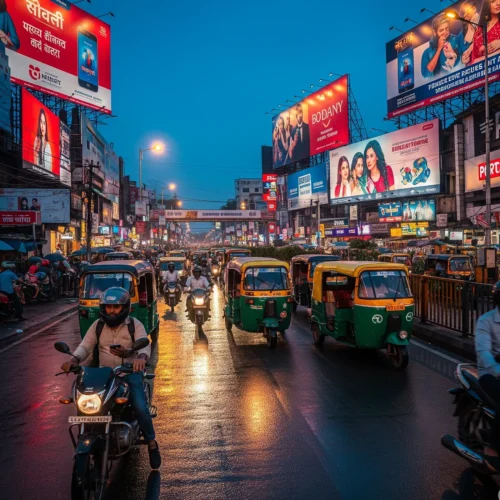
In India’s bustling cities and chaotic highways, there’s an ever-present visual companion — the billboard. Some are static. Some blink with LED intensity. And some tower above traffic signals with sleek, high-resolution motion graphics. But as India races forward with infrastructure growth and advertising innovation, a difficult question emerges: Are we underestimating the danger these roadside distractions pose to everyday commuters?
It turns out billboards may be playing a bigger, and riskier role in India’s road safety crisis than we think.
India’s Love Affair with Outdoor Ads
India’s Out-of-Home (OOH) advertising industry is booming. Valued at ₹3,500 crore in FY 2023 (FICCI-EY Report), it’s growing at double-digit rates, with expansion concentrated in Tier-1 and Tier-2 cities. From Bhopal to Bengaluru, urban local bodies are raking in revenue by licensing more hoardings than ever. The Brihanmumbai Municipal Corporation (BMC) alone collected ₹180+ crore in hoarding license fees in 2023.
While this may seem like a harmless monetisation of public space, the proliferation of billboards — especially unregulated and oversized ones,is creating an increasingly cluttered and risky environment for drivers and pedestrians alike.
The Real Risks: How Billboards Compromise Road Safety
1. Visual Distraction That Costs Lives
Modern billboards are engineered to capture attention: bright colours, fast-moving visuals, animations, transitions. But that attention has to come from somewhere usually, the road.
According to cognitive psychology research, glancing away from the road for just 2 seconds while driving at 60 km/h means you’ve travelled nearly 33 meters without actively observing your surroundings. In India’s unpredictable road conditions, this can be deadly.
A study from the Indian Institute of Science (IISc), Bengaluru, found that external distractions — including digital billboards — can reduce driver response times by up to 25%, increasing the likelihood of accidents in high-density traffic zones.
International studies reinforce this:
- A 2009 Tel Aviv University study reported a 35% increase in rear-end collisions near digital billboards compared to areas without them.
- The U.S. Federal Highway Administration (FHWA) found crash rates up to 29% higher on road segments containing digital, rotating, or brightly lit billboards.
2. Strategic (Mis)Placement
In Indian cities, billboards are frequently placed:
- Directly above or beside traffic signals
- Near intersections or flyovers
- On blind curves
This placement not only distracts but often obstructs visibility altogether. In 2023, the Pune Traffic Police flagged over 300 hoardings that partially blocked signals or directional signs, contributing to wrong turns, sudden braking, and even collisions.
The Delhi High Court, in a 2019 judgment, ordered the removal of over 500 hoardings that interfered with signal visibility or compromised road safety. Yet enforcement remains weak and ad revenue continues to take precedence.
3. Night-Time Glare and Glitches
Digital billboards often emit intense glare at night, especially in under-lit areas. Sudden exposure to high-intensity LED light can cause temporary blindness, disrupting a driver’s focus and visual adaptation a phenomenon known to contribute to night-time crashes.
A study from the National Institute of Design (Ahmedabad) found that LED hoardings with brightness above 300 nits (a common benchmark) can overwhelm the human eye, particularly when surrounded by low ambient light, such as on highways and elevated corridors.
Poorly calibrated light transitions — such as sudden flashes, jerky animations, or rapid image changes — make this worse, particularly in foggy or rainy conditions.
4. Cognitive Overload
India’s roads are among the most cognitively demanding in the world. Drivers must simultaneously process honking vehicles, erratic lane changes, jaywalking pedestrians, potholes, and minimal lane discipline,a cognitive load that’s already near maximum.
Billboards add another layer: unrelated, high-saturation visuals competing for attention. This increases the risk of inattentional blindness, where drivers literally fail to see obvious hazards in front of them because their brains are overloaded.
Cognitive neuroscience studies show that such “overload” reduces situational awareness — and that the human brain, under multitasking pressure, often prioritises novel stimuli (like a flashing billboard) over relevant ones (like a merging vehicle).
When Distraction Turns Deadly: Real-World Cases
Ghatkopar Billboard Collapse (May 2024)
A massive 120 x 120 ft billboard collapsed during a dust storm in Mumbai, killing 16 people and injuring dozens more. Investigations revealed that the hoarding was four times the legal size, lacked structural clearance, and violated municipal safety norms.
Delhi High Court Order (2019)
Following a petition citing billboard-induced visual obstruction at signals, the Delhi High Court ordered the removal of 500+ hoardings across the capital. (Source: Bar & Bench, Hindustan Times)
Pune’s Billboard Problem (2023)
The Pune Traffic Police submitted a report flagging 300+ billboards for obstructing road signs and traffic lights. Several near-miss accidents and signal violations were directly attributed to them. (Source: Times of India)
Why the Problem Persists
Despite the risks, regulation remains fragmented and ineffective:
- No Uniform National Guidelines: While MoRTH has issued advisories discouraging billboard placement within 100 meters of traffic signals or intersections, they are non-binding and rarely enforced.
- Municipal Loopholes: Urban Local Bodies often have their own rules, and many rely on hoardings as a primary source of non-tax revenue — leading to conflicts of interest.
- Lack of Road Safety Audits: Unlike in countries such as Sweden or Germany, billboards in India are not subject to mandatory road safety assessments before installation.
Final Thought
We’re used to seeing billboards as part of the urban landscape — passive, even decorative. But they’re not just scenery. They’re a stimulus — and on Indian roads, every distraction competes with survival.
In a country where over 1.5 lakh people die in road crashes every year (MoRTH Annual Report, 2023), even small, normalised risks like billboards deserve scrutiny. When distraction is built into the road environment, safety is compromised before the driver even turns the ignition.