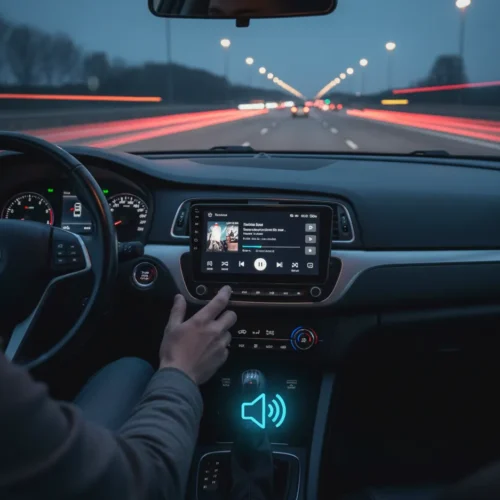
The speedometer reads 95 km/h on a late-night highway drive. The driver does not realise the speed has increased until a slower song begins to play. Within half a minute, the needle drops to 80 km/h.
No conscious decision.
No enforcement intervention.
Only a change in soundtrack.
Your Playlist Is Making Driving Decisions
In discussions on road safety in India, the focus is usually on drunk driving, lane violations, overspeeding or mobile phone use. However, an underexamined behavioural factor influences millions of drivers every day: in-vehicle audio.
A growing body of research demonstrates that music can alter speed choice, reaction time, lane maintenance, and hazard perception.
A 2019 study from the South China University of Technology found that high and medium volume music significantly increased average driving speed and acceleration relative to low-volume conditions (Ding et al., 2019). This supports earlier laboratory and simulator studies, such as Brodsky (2001), who reported that drivers exposed to fast-tempo music increased speed and made more traffic violations.
A frequently cited experiment at Ben-Gurion University (Brodsky & Slor, 2013) asked young drivers to complete a 40-minute simulated route with different genres. When exposed to high-tempo Balkan folk and metal tracks, drivers exhibited greater speed variability and more lane deviations. The original 60 km/h reference in this line of research is often misunderstood. It does not imply that 60 km/h is a high absolute speed, but that drivers repeatedly exceeded the required safe urban range. The significance lies in the deviation from intended limits, not the number itself. This behavioural drift toward overshooting posted speeds is consistently observed across music-tempo studies.
The mechanism is well-documented in cognitive psychology. Fast or complex rhythms elevate physiological arousal, increase heart rate, and create entrainment, a process in which the motor system subconsciously synchronises with auditory tempo (Karageorghis & Terry, 1997). As a result, the driver’s foot pressure on the accelerator subtly aligns with the rhythm.
The Two Faces of In-Car Audio
Music does more than alter speed. It shapes attentional distribution and decision-making quality.
Research published in Accident Analysis and Prevention found that drivers exposed to high-tempo or loud music demonstrated slower reaction times and poorer lane-keeping ability (Üner et al., 2009). Cognitive load theory explains this. Processing loud or complex auditory input increases mental workload, reducing the capacity available for scanning the road environment.
At the same time, studies also indicate that appropriate music can reduce fatigue and maintain vigilance. A University of Groningen experiment found that moderate, steady-tempo tracks improved alertness during monotonous highway driving, while very slow or silent conditions contributed to reduced vigilance (van der Zwaag et al., 2012).
Meta-analyses of driving distractions suggest a U-shaped pattern.
Very little auditory input leads to monotony and inattention.
Excessive stimulation fragments concentration.
Moderation supports optimal performance.
India’s Unique Acoustic Environment
India’s roads form a distinct soundscape. Traffic is characterised by constant honking, variable engine noise, street vendors, construction activity, and sudden alarms. Unlike controlled motorways in Europe or East Asia, this environment provides continuous, unpredictable auditory demands.
With 168,000 road deaths recorded in 2022 (MoRTH, 2023), understanding the role of distraction is essential. While Indian crash data does not formally isolate music as a cause, distraction is consistently cited as a contributing factor (WHO Global Status Report on Road Safety, 2023).
There is also emerging evidence regarding headphone use. A University of Maryland analysis found that pedestrians listening to music were more likely to misjudge vehicle distance and speed, and were slower to respond to auditory warnings (Lichenstein et al., 2012). Additional research shows that drivers are less likely to yield to headphone-wearing pedestrians because they perceive them as being more aware than they actually are (Neider et al., 2011). These dual perceptual distortions increase risk.
What Safer Drivers Are Doing Differently
Large fleet operators and ride-hailing platforms are beginning to integrate insights from driving behaviour psychology.
Driver training programmes increasingly encourage audio discipline, which includes practices such as:
- maintaining volume below 60 percent of the system maximum
- avoiding fast-tempo or heavy-bass genres in dense traffic
- using brief silence intervals on long routes to restore auditory sensitivity
These recommendations align with evidence from Ding et al. (2019), Brodsky & Slor (2013), and Üner et al. (2009).
For everyday drivers, the same principles apply:
1. Prioritise safe volume.
If the music masks horns, emergency sirens or engine cues, it is too loud.
2. Match tempo to driving demands.
Slower tempo for urban traffic, moderate tempo for open highways, silence or minimal input during merging, overtaking or navigating construction zones.
3. Pre-select your playlist.
Research shows that interaction with infotainment systems during driving significantly increases crash risk (Caird et al., 2018).
Rethinking the Soundtrack
An emerging field within vehicle safety research examines how purposeful sound design can influence driving behaviour. Developers of advanced driver assistance systems (ADAS) are experimenting with:
- ambient tones that subtly discourage speeding
- spatial audio cues that improve hazard localisation
- adaptive soundscapes that adjust volume and frequency in response to traffic density or acceleration patterns
Some automotive manufacturers already use systems that lower music volume during complex driving tasks or when proximity sensors activate. Studies in auditory ergonomics suggest that such adaptive cues can reduce cognitive workload and enhance situational awareness (Edworthy & Hellier, 2018).
Whether drivers will accept such systems remains an open question.
The Final Note
Music cannot replace seat belts, lane discipline or sobriety. However, ignoring its influence on driving behaviour is similar to ignoring the effect of lighting on visibility.
India loses sixteen lives every hour to road crashes. Many of these tragedies involve brief lapses in attention. If an optimised audio environment can recover even a fraction of a second in reaction time, or prevent a moment of unconscious overspeeding, the benefit is substantial.
Your driving playlist is not passive entertainment.
It is a behavioural influence with measurable effects.
Treat it as part of the safety equation.