Road accidents in India claim hundreds of thousands of lives every year. Ask anyone which cities are the most dangerous, and you’ll hear the same names: Delhi, Mumbai, Bengaluru, Chennai.
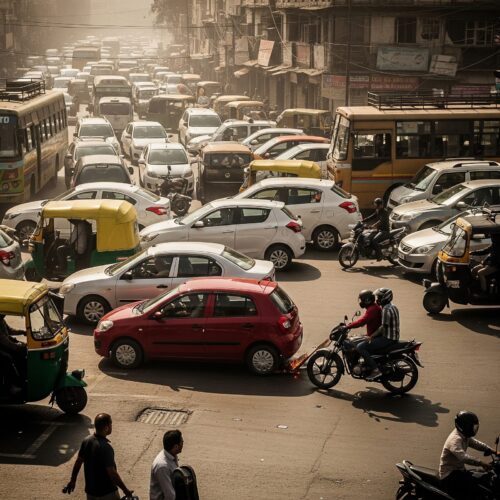
It’s an understandable assumption. These cities have the largest populations, the highest vehicle volumes, and the most chaotic roads in the country. And yes, their death tolls are enormous in absolute terms.
But the 2023 data from MoRTH (Ministry of Road Transport and Highways) data and adjusted for population size, tells a very different story , one that most national road safety conversations completely miss.
Delhi Tops the List. That’s Not the Whole Story.
Delhi recorded 1,457 road accident deaths in 2023, the highest of any Indian city. Bengaluru followed with 915. Jaipur came third with 848.
But these numbers are shaped as much by population size as by danger. A city of 30 million will always record more deaths than a city of 2 million, even if its roads are far safer. To understand how dangerous a city truly is for the people who actually live there, you need to look at deaths per lakh (100,000) residents.
That’s where the story flips entirely.
City by City: What the Numbers Are Really Telling Us
Delhi: 1,457 Deaths, and Still Not the Most Dangerous City
India’s capital recorded the highest absolute death toll in 2023, four people killed every single day. Its sheer scale, freight movement, and vehicle density make that figure almost inevitable. Yet once you account for population, Delhi’s per-capita risk lands among the lowest of any major Indian city. The headline number is real. The impression it creates is misleading.
Bengaluru: A 16-Year High — and a Pedestrian Crisis
Bengaluru’s 915 deaths marked a 16-year high. Pedestrians, motorcyclists, and cyclists together accounted for 91% of those fatalities, and the city recorded the highest pedestrian death toll of any Indian city for the second consecutive year. Three of its five most dangerous road corridors are concentrated in north Bengaluru. Despite an expanding metro network, the city’s street-level infrastructure continues to fail its most vulnerable road users.
Jaipur: Dangerous by Every Measure
Most cities rank either high on total deaths or high on per-capita risk not both. Jaipur manages the grim distinction of doing both. With 848 deaths and roughly 20 per lakh, it sits near the top of either ranking you choose. Wide arterial roads, rapid urban expansion, and high-speed traffic corridors create conditions where crashes are more likely to turn fatal.
Kanpur and Prayagraj: Uttar Pradesh’s Overlooked Emergency
These cities almost never appear in national road safety coverage. They should. Kanpur recorded 638 deaths in 2023 the highest in Uttar Pradesh with a per-capita rate of roughly 15 per lakh. Prayagraj recorded 582. Lucknow, despite being the state capital and most accident-prone city in UP by total crashes, recorded 568 deaths.
Jabalpur: India’s Most Dangerous City That Nobody Talks About
Jabalpur recorded 545 road deaths in 2023, roughly a third of Delhi’s total. But its per-capita fatality rate of approximately 32 per lakh is the highest of any major city in the country. A resident of Jabalpur was nearly eight times more likely to die in a road crash than a resident of Delhi. The city receives virtually no national road safety attention.
Raipur: The Crisis Hidden in Plain Sight
At roughly 28 deaths per lakh, Raipur ranks second nationally in per-capita road fatality risk. Like Jabalpur, it sits far outside the coverage zone of most national road safety discussions despite numbers that would cause alarm if they belonged to a larger city.
Ahmedabad and Chennai: Evidence That Safer Cities Are Possible
Both cities handle enormous traffic volumes yet post per-capita rates of 6 and 4 per lakh respectively dramatically lower than Jaipur, Kanpur, or Raipur. This is not an accident of geography. It reflects differences in road design, enforcement, and infrastructure investment.
Mumbai: Where Traffic Jams Save Lives
Mumbai doesn’t feature on the deadliest lists at all. A mass transit network that moves millions daily, chronic congestion that suppresses speeds citywide, and shorter average road journeys likely explain why. Heavy traffic, counterintuitively, may be acting as a speed-limiting mechanism that reduces crash severity.
The Full Picture: Two Ways to Read the Same Data
A note on methodology: Death figures are from the NCRB Accidental Deaths and Suicides in India 2023 report, covering 53 major cities. Deaths per lakh population are calculated using urban agglomeration estimates, as no post-2011 Census data is available. Treat these figures as indicative for comparison, not as precise official statistics.
Table 1 — Absolute deaths vs individual risk
| City | Road Deaths (2023) | Deaths per Lakh (est.) |
|---|---|---|
| Delhi | 1,457 | ~4 |
| Bengaluru | 915 | ~8 |
| Jaipur | 848 | ~20 |
| Kanpur | 638 | ~15 |
| Prayagraj | 582 | ~11 |
| Lucknow | 568 | ~13 |
| Jabalpur | 545 | ~32 |
| Ahmedabad | 535 | ~6 |
| Raipur | 507 | ~28 |
| Chennai | 503 | ~4 |
| Varanasi | ~290 | ~16 |
| Ludhiana | ~270 | ~16 |
| Ghaziabad | ~230 | ~11 |
| Coimbatore | ~190 | ~13 |
Table 2 — Ranked by which cities are most at risk
| Rank | City | Deaths per Lakh (est.) |
| 1 | Jabalpur | ~32 |
| 2 | Raipur | ~28 |
| 3 | Jaipur | ~20 |
| 4 | Varanasi | ~16 |
| 4 | Ludhiana | ~16 |
| 6 | Kanpur | ~15 |
| 7 | Lucknow | ~13 |
| 7 | Coimbatore | ~13 |
| 9 | Ghaziabad | ~11 |
| 9 | Prayagraj | ~11 |
| 11 | Bengaluru | ~8 |
| 12 | Ahmedabad | ~6 |
| 13 | Delhi | ~4 |
| 13 | Chennai | ~4 |
The contrast between the two tables is the entire point of this piece. Delhi sits at the top of Table 1 and the bottom of Table 2. Jabalpur does the opposite. The city that dominates the headlines turns out to be among the safest per resident — and the city that barely registers in absolute numbers turns out to be the most dangerous place in India to be a road user.
Why Smaller Cities Are Losing So Many More Lives Per Resident
Speed Kills and Smaller Cities Build for Speed
Overspeeding accounted for approximately 61% of all road accident deaths in India in 2023. Cities that organically suppress vehicle speeds through dense development, public transport, and natural congestion —consistently produce better outcomes. Mid-sized cities, often built around fast-moving arterial roads with few natural constraints, record the worst rates.
Two-Wheelers: 46% of All Deaths, Zero Protection
Two-wheelers accounted for nearly 46% of all road accident deaths nationally 79,533 lives. Riders have no physical protection in a crash. In cities where two-wheelers are the dominant mode of transport and helmet compliance is weak, the fatality rate reflects that vulnerability directly. This is not primarily a rider behaviour problem. It is a road design and infrastructure problem.
Growing Fast, Building Dangerously
Rapid urbanisation without road safety infrastructure is lethal. Absent footpaths force pedestrians onto carriageways. Informal road crossings create collision points. Weak zoning places residential areas alongside high-speed corridors. Cities like Jaipur and Raipur are expanding fast and their roads are not keeping pace.
Emergency Care: The Invisible Variable
A crash outcome depends on two things: the collision, and what happens in the hour after it. Cities with well-funded trauma networks and fast emergency response save lives that others don’t. Smaller cities with sprawling geographies and fewer hospitals perform worse on this metric. The gap in fatality rates between cities is not only a story about crashes, it is a story about survival after them.
Metro Rail Is Not a Road Safety Policy
Bengaluru has one of India’s most developed urban metro networks. It still recorded 915 deaths in 2023, a 16-year high. Expanding public transport is necessary, but it does not, by itself, make streets safer. That requires protected crossings, lower speed limits, traffic calming on arterial roads, and enforcement that actually changes behaviour.
What Actually Needs to Change
The cities doing better share common features: mixed-use density that suppresses speeds, high public transport usage, accessible trauma care, and street design that protects vulnerable road users. Cities with the worst rates have the opposite.
Improving road safety in India’s mid-sized cities requires treating it as an urban planning problem, not a traffic enforcement one. Road design, pedestrian infrastructure, speed management, emergency response, and land use planning all need to move together. Tackling any one in isolation produces marginal gains at best.
The Bottom Line
The cities that dominate India’s road safety headlines are not the cities where you face the greatest risk. Delhi and Bengaluru lead on total deaths. But residents of Jabalpur, Raipur, Jaipur, and Kanpur face dramatically higher individual risk and receive a fraction of the policy attention, funding, and media coverage.
India’s road deaths are not random. They are the consequence of decisions about how roads are built, how fast traffic moves, how public transport is funded, and how seriously road safety is treated in urban planning. The cities doing better have made different decisions.
The metric that matters is not which city records the most deaths. It is which city gives every road user the best chance of getting home safely. By that standard, India’s most urgent road safety crises are happening in places most people have never thought to look.