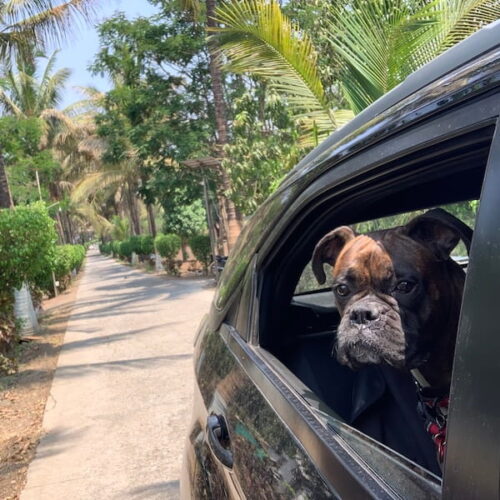
India has over 30 million pet dogs and nearly 9 million pet cats, and more people than ever are taking them along on road trips. Pet travel in personal vehicles has become increasingly common in India. Yet, very few pet owners use any form of restraint while driving.
Here is the part nobody talks about: the bigger danger is not what happens to your pet in a crash. It is what your pet does to your driving before one even happens.
A study by Volvo Pet Assist found that an unrestrained pet in the cabin increases driver distraction by up to 400%. In a country that already records over 150,000 road fatalities a year, that number deserves more attention than it gets.
This guide explains how pets distract drivers — and how to prevent it.
1. A Pet on Your Lap Is Not Cute. It’s a Crash Risk
Let us start with the most common one. Dogs on the driver’s lap are practically a rite of passage on Indian roads. It feels affectionate. It looks adorable. It is also one of the most dangerous things you can do behind the wheel.
A dog on your lap physically blocks your lower field of vision, interferes with your steering, and can nudge the gear lever, horn, or handbrake at completely the wrong moment. Your arms are not fully free. Your posture is compromised. And if the dog shifts suddenly, your reflexes go with it.
Crash-tested rear harnesses are available from brands like Ruffwear and Kurgo on Heads Up for Tails and PetKonnect, among others. This is not optional equipment. It is the equivalent of a seatbelt.
⚖️ Legal note: Section 184 of the Motor Vehicles Act, 1988 penalises driving in a manner dangerous to the public. A pet obstructing the driver’s view or control of the vehicle almost certainly qualifies.
2. The Window Hanging Problem is a Two-Car Issue
A dog with its head out of the window does not just distract you. It distracts every driver around you.
You are watching your dog out of the corner of your eye. The car next to you is watching your dog too. The auto rickshaw behind you has slowed down to take a video. Nobody on that stretch of road is paying full attention, and your pet is the reason why.
Beyond the collective distraction, a dog extended out of a window at highway speed is one pothole away from losing its balance. Indian roads offer those in generous supply.
A small crack for fresh air is perfectly fine. Treating your car window like a theme park ride is not.
3. An Unsecured Pet Becomes a Projectile, Then a Distraction
Most people think about this the wrong way. They imagine the danger as something that happens during a crash. In reality, the danger starts well before that.
An unrestrained dog moving freely around the cabin is a constant source of unpredictable movement in your peripheral vision. Your brain registers every shift, every jump from seat to seat, every time they press their nose to a window. Each one pulls a small slice of your attention away from the road.
A secured carrier in the boot or back seat removes this entirely. What you cannot see, you cannot be distracted by. For cats and small dogs, a hard-sided IATA-compliant crate from brands like Trixie or M-Pets is ideal. For larger dogs, a rear harness keeps them in one place.
Tip: Put a familiar blanket or worn t-shirt inside the carrier. The scent keeps them calm, which means less whining, less movement, and more of your focus on the road.
4. Noise and Restlessness Are Distractions Too
Driver distraction is not only visual. It is auditory and cognitive as well.
A whining dog, a yowling cat, or a pet scratching frantically at a carrier door creates exactly the kind of background stress that degrades your reaction time and decision-making. You tense up. You reach back to soothe them. You turn your head. On a busy national highway or a chaotic city street, that is all it takes. At 80 km/h, a two-second distraction means driving over 40 metres without full attention.
The fix is preparation before the journey, not management during it. A rest stop every 2 to 3 hours keeps pets settled. A light meal 2 to 3 hours before departure reduces nausea and restlessness. If your pet has severe travel anxiety, speak to your vet about options like Zylkene or Adaptil sprays, both are available in India and make a genuine difference.
5. A Distressed Pet is an Even More Distracting Pet
Heat distress compounds everything. In Indian summers, a car cabin can climb to 35 to 45 degrees Celsius even with airflow. A pet that is overheated becomes agitated, vocal, and erratic, which means your attention is pulled in multiple directions at once precisely when road conditions demand it most.
Keep the AC on and directed towards the pet’s area of the car. Never leave them in a parked car, even for a few minutes. A parked car in direct sunlight can hit 45 to 50 degrees Celsius inside within minutes, even with windows cracked. Heatstroke in pets sets in fast and is often fatal.
⚖️ Legal note: The Prevention of Cruelty to Animals Act, 1960 covers leaving an animal in conditions that cause unnecessary suffering. Indian courts have been increasingly willing to act on such complaints.
6. Include Pet Paperwork In Travel Documents
This one is less about distraction and more about avoiding the kind of situation that creates it. Getting stopped at a state border checkpoint because you do not have your pet’s vaccination records is stressful. A stressed driver making decisions in a hurry is a distracted driver.
Carry a vaccination booklet, a recent vet health certificate, and a rabies certificate if you are crossing state lines. Checkpoints at Tamil Nadu-Kerala and Maharashtra-Goa borders do ask. Some areas of Sikkim and Uttarakhand have their own entry requirements for pets.
Quick-Reference Checklist Before Travelling With Pets
For the Journey:
✓ Rear harness (medium/large dogs) or carrier (small dogs/cats)
✓ AC directed toward pet area
✓ Familiar blanket in carrier
✓ Water bowl at rest stops
✓ Vaccination documents
Before Leaving:
✓ Exercise pet (tired pet = calmer pet)
✓ Light meal 2-3 hours before
✓ Bathroom break
✓ Check route for pet-friendly rest stops
The Bottom Line
At Attento, we track sudden braking patterns and attention lapses while driving. While we cannot directly identify “pet distraction,” behavioural data shows that drivers travelling with backseat activity often exhibit patterns such as more frequent hard braking events, speed inconsistency on longer drives, and delayed reaction times.
The data confirms what physics and psychology already tell us: unrestrained pets create measurable distraction even before any incident occurs.
If there’s one pattern across everything we’ve covered, from missed road cues to everyday driving lapses, it’s this: most risks don’t come from extreme situations, but from small, repeated distractions that build up over time. Pets simply add another layer to the same problem. They don’t intend to distract you, but without the right setup, they will. The goal isn’t to stop travelling with your pet, it’s to do it in a way that keeps your attention where it belongs: on the road.