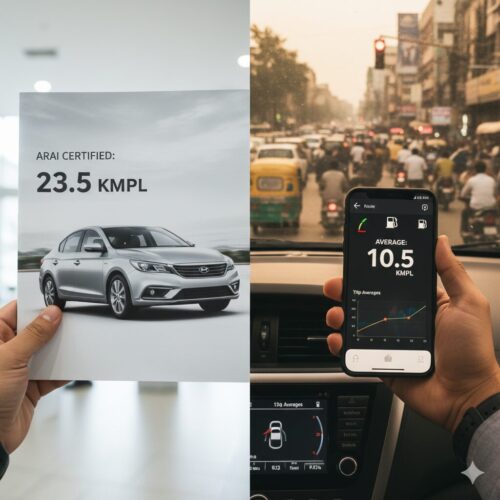
Most Indian car buyers follow a familiar ritual. At the dealership, a sales executive hands over a brochure filled with glossy photographs, trim levels, and one figure that quietly outweighs everything else: the Automotive Research Association of India (ARAI) certified mileage. Numbers such as 17.4 kmpl, 22.3 kmpl, or 16.5 kmpl strongly influence purchase decisions, often more than safety ratings, engine characteristics, or warranty terms. Yet only a few months after taking delivery, the disappointment begins to surface.
Across Reddit threads, Team-BHP ownership reviews, and brand-specific forums, Indian drivers report a consistent gap between brochure claims and lived experience. For example, Hyundai Creta owners routinely see 10–12 kmpl against a claimed 17.4; Tata Harrier drivers report 9–11 kmpl against 16.8; Toyota Innova HyCross hybrids, with their impressive certified 23.2 kmpl figure, usually deliver 14–17; one gets the drift. These variations are not random anomalies or evidence of deception. They reflect the structural mismatch between laboratory test conditions and the complexity of real Indian roads.
Why Real-World Mileage Falls Short of ARAI Ratings
Most Indian cars display “ARAI certified” mileage figures derived from Modified Indian Driving Cycle (MIDC) tests conducted in controlled laboratory conditions. These numbers consistently exceed real-world performance by 20–40%.
The gap isn’t primarily because of manufacturer deception. It reflects the fundamental difference between laboratory testing and actual Indian driving conditions.
Did you know? ARAI mileage is measured on a rolling test bench with zero idling, no AC use, and perfectly smooth acceleration, conditions almost no Indian driver ever experiences.
What Lab Tests Miss About Indian Traffic
ARAI testing simulates idealized driving: smooth acceleration, steady speeds, minimal idling. Indian city driving is the opposite:
- Stop-and-go traffic: Increases fuel consumption by 20–25% compared to steady cruising
- Extended idling: Adds 8–10% fuel drain per trip at traffic signals
- Aggressive acceleration: Can increase consumption by up to 40% compared to gradual acceleration
- Poor road surfaces: Constant speed adjustments for potholes and obstacles reduce efficiency
A Bangalore-based transport researcher tracked his 18 km office commute and found 14 minutes spent idling,nearly 25% of total trip time. No vehicle can deliver brochure numbers under such conditions.
E20 Ethanol Blending: The Energy Security Trade-Off
India is aggressively pushing toward E20 petrol (20% ethanol blend) to reduce crude oil imports and support domestic agriculture. According to government data, ethanol blending has already saved over ₹24,000 crore in foreign exchange.
But there’s a crucial physics reality that gets lost in policy discussions: ethanol contains less energy per liter than pure petrol.
The Energy Density Difference
Ethanol contains less energy per litre than petrol. This is fundamental chemistry. Its energy density is roughly 33 percent lower, which means a higher ethanol blend predictably produces slightly lower mileage. Studies by the US EPA and Brazil’s ANP show a 3–6 percent efficiency reduction when moving from E10 to E20, depending on engine calibration. Indian automakers are already adapting BS6 engines for E20 compatibility, but the energy penalty remains inherent. While individual drivers may notice a modest decline, the national benefits viz. reduced import dependence, increased agricultural demand, and lower carbon emissions justify the trade-off.
Debunking Common Fuel Efficiency Myths
A popular Instagram reel talks about persistent myths that distort Indian drivers’ understanding of what actually affects mileage.
Myth 1: “Coasting in Neutral Saves Fuel”
Modern fuel-injected cars are designed to cut fuel supply completely when you lift off the accelerator while remaining in gear.
This means in-gear coasting uses zero fuel in many scenarios.
Shifting to neutral actually disables this feature the engine must burn fuel to keep idling, which can increase consumption.
Neutral coasting also reduces vehicle control, especially during braking or emergency maneuvers, making it unsafe.
Myth 2: “Open Sunroof Beats AC at Highway Speeds”
At speeds above ~80 km/h, aerodynamic drag shoots up dramatically.
Driving with a sunroof or windows open disrupts airflow, forcing the engine to work harder.
Multiple tests show that at highway speeds, AC may actually be more efficient than driving with the sunroof open.
At city speeds, AC does reduce mileage, but the impact is nowhere near the dramatic claims many drivers believe.
Myth 3: “Higher Octane Gives Better Mileage”
High-octane fuel does not increase power, improve combustion, or deliver better mileage in most Indian cars.
Octane rating only determines knock resistance , not energy content.
Unless your engine is specifically tuned for higher octane (rare among Indian mass-market vehicles), premium petrol offers no real mileage difference despite the higher price.
Myth 4: “Underinflated Tyres Don’t Affect Mileage Much”
This one is actually true, underinflation severely hurts efficiency.
Tyres that are 20% underinflated can reduce fuel economy by 8–10%, sometimes even more. Low pressure increases rolling resistance, forcing the engine to use more fuel to maintain the same speed.
Regular tyre pressure checks are one of the simplest and most effective ways to improve mileage.
Myth 5: “E20 Fuel Gives the Same Mileage as Petrol”
Ethanol has lower energy density than pure petrol.
Real-world testing shows an average 1–6% drop in mileage when switching from E10 to E20, depending on:
- engine calibration
- driving style
- load and road conditions
The drop isn’t massive, but it’s real and grounded in physics, not poor fuel quality. What Actually Determines Mileage in India is understanding real efficiency factors helps set realistic expectations and identify areas where driver behavior actually makes a difference.
Major Impact Factors (20–40% effect)
- Traffic patterns: Stop-and-go vs. steady cruising determines baseline efficiency
- Driving style: Aggressive acceleration and braking dramatically increase consumption
- Vehicle maintenance: Tire pressure, air filter condition, engine tuning affect efficiency significantly
- Load and aerodynamics: Excess weight and roof carriers create measurable drag
Moderate Impact Factors (5–15% effect)
- AC usage: Particularly in city driving at lower speeds
- Fuel quality: E20 vs E10 creates measurable but modest differences
- Road conditions: Poor surfaces requiring constant speed adjustment
- Short trips: Cold starts and low-speed operation reduce efficiency
Minimal Impact Factors (less than 5%)
- Premium vs regular fuel (for engines not requiring premium)
- Engine oil brand (within specification)
- Fuel additives and “efficiency boosters”
- Most viral “mileage hacks”
Building Mileage Literacy in India
Indian drivers don’t need more lists of “10 tricks for better mileage.” ARAI ratings are designed for comparison, not prediction. Ethanol blending is an energy strategy, not a fault in fuel quality. Driving behaviour usually characterised by smooth acceleration, reduced idling, proper vehicle maintenance influences efficiency more than any aftermarket product or viral hack.
Modern vehicles increasingly offer real-time efficiency feedback, yet many drivers ignore these indicators or misunderstand them. Apps like Attento show how behavioural data can reveal patterns such as abrupt acceleration, inconsistent speeds, or excessive idling, helping drivers make practical, measurable improvements. Over time, vehicle interfaces will likely provide more contextual guidance, indicating when to shift gears, suggesting efficient routes, or alerting drivers when their habits are trending inefficiently.
Technology’s Role in Efficiency Awareness
Modern vehicles increasingly provide real-time efficiency feedback through onboard computers. However, many drivers ignore these tools or don’t understand how to interpret the data.
Smartphone apps can also help track patterns and identify efficiency opportunities. we at Attento demonstrate how behavioral monitoring can reveal driving habits that impact both safety and efficiency.
The future likely includes more sophisticated systems that provide contextual guidance, suggesting when to shift gears, flagging aggressive acceleration, or recommending optimal routes based on real-time efficiency data.
What Policymakers and Industry Should Do
Improving mileage literacy requires coordinated action:
Clearer Consumer Communication
Automakers should supplement ARAI ratings with real-world ranges based on different driving conditions. European fuel economy labels now show city, highway, and combined figures with realistic ranges. India should adopt similar transparency.
Fuel Labeling Standards
Gas pumps should clearly indicate ethanol blend percentages and expected efficiency impacts. Many drivers don’t realize fuel composition varies by location and season.
Public Education Campaigns
Government and industry should jointly educate consumers about what actually affects mileage, debunking persistent myths while explaining policy rationale for initiatives like ethanol blending.
The Bottom Line on Fuel Efficiency
Most Indian drivers struggle with mileage expectations not because their cars underperform, but because they misunderstand the test conditions, fuel composition, and physics that shape real-world efficiency. ARAI numbers will always exceed everyday performance because they are measured under ideal conditions. Ethanol blends will always reduce energy density slightly because chemistry dictates it. City traffic will always consume more fuel because stop-go conditions punish combustion engines.
Understanding these realities does not lower standards; it raises them. When expectations are grounded in data, drivers can focus on the factors they control, for instance smooth driving, proper maintenance, reduced idling and policymakers can focus on communication and infrastructure.
Better efficiency begins long before the engine starts. It begins with clarity.