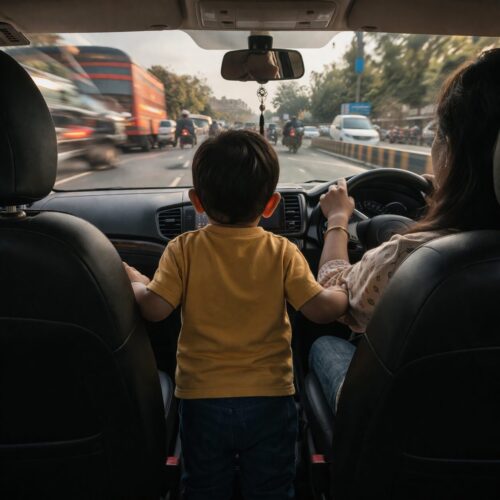
If you look inside most cars with children in India, you will see a familiar scene.
A parent, usually the mother, holding a baby in their lap.
A toddler standing between the front seats.
A child sleeping across the back seat, unrestrained.
It feels natural, feels protective and also feels like care.
“Main sambhaal loongi.”
“It’s just a short drive.”
“We’re going slowly.”
But in a crash, none of that matters. At 40–50 km/h, your body cannot hold onto a child. Not because you don’t care enough. Because physics doesn’t allow it.
If you have a child who travels with you, this is for you.
Why Child Car Seat Use in India Is Still Around 2–6%
You have probably heard about road safety in the context of drunk driving, potholes, or two-wheelers. India loses approximately 45 children to road crashes every single day. Between 2011 and 2022, close to 2 lakh children and adolescents lost their lives on Indian roads.
And yet, despite laws and growing awareness, child car seat usage in Indian cities still sits at just 2–6%.
Many of those deaths happen inside cars. Inside cars, with adults present, in crashes that happened at ordinary city speeds. In crashes that the right kind of seat could have made survivable.
A 2025 joint report by UNICEF and NIMHANS makes a point worth sitting with: this is not primarily a roads problem. It is an enforcement, awareness, and vehicle safety problem. Which means most of it is preventable.
What Indian Law Says About Child Car Seats
Under the Motor Vehicles (Amendment) Act of 2019 and a 2022 revision of central traffic rules, a child under 135 cm or up to 12 years must be in a child restraint device. Children under four need a dedicated seat.
The fine for ignoring this is Rs 1,000. Enforcement is inconsistent, and traffic police rarely check. So if you are waiting for external pressure, it probably will not come. This has to be your decision.
If you are buying a seat, look for the AIS-072 certification mark. That is India’s tested standard. A seat without it is not compliant, regardless of what the brand claims. Many cars from Maruti Suzuki, Hyundai, and Kia now come with ISOFIX anchor points — check if yours does, because it makes installation far more secure.
How to Choose the Right Child Car Seat in India
Here is a handy list of what parents must pay attention to while travelling with younger ones in a car. Check this video out as well for quick reference.
A. Age 0–12 Months: Always Rear-Facing
What you need: Group 0+ infant seat (rear-facing only)
Why it matters: In a crash, a rear-facing seat spreads the force across your baby’s entire back. Forward-facing concentrates it on the neck and spine—areas your baby isn’t developed enough to protect.
Where to place it: The centre rear seat is safest. Never use the front seat—an airbag deploys at adult chest height, directly into your baby’s head.
What most people get wrong: Your arms cannot protect your baby in a crash. The forces involved multiply body weight many times over. Only a properly installed car seat can hold your child safely.
B. Age 1–4 Years: Don’t Rush Forward-Facing
What you need: Group I seat with a five-point harness
When to switch: Most parents turn the seat forward at one year. It’s safer to wait until at least 15 months—and ideally until your child reaches the seat’s rear-facing limit.
How to check the fit: The harness should be snug. You shouldn’t be able to pinch slack at the shoulder straps.
Where to place it: Back seat, always.
C. Children with age above 4 years or height upto 135 cm
Why seatbelts alone don’t work: Car seatbelts are designed for adults (~165 cm tall). On a child, the lap belt rides up onto the abdomen and the shoulder belt cuts across the neck—causing injury instead of preventing it.
What you need: A booster seat that positions the belt correctly:
- Lap belt across the hips
- Shoulder belt across the chest and collarbone
When to move to a booster: Only after your child outgrows a harness seat by height or weight—not based on age or preference.
When to stop: Around 135 cm, when the seatbelt fits properly without assistance.
4 Common Mistakes Parents Make With Car Seats
- Turning the seat forward before 15 months. The child looks cramped, someone around you might say they seem uncomfortable. The discomfort is temporary. A spinal injury from whiplash is permanent. Cramped legs are not.
- Switching to the adult seatbelt before 135 cm. The belt crosses the throat, not the collarbone. In a crash it causes internal organ damage and neck injuries that the belt was meant to prevent.
- Installing the seat incorrectly. The most common error by far. After fitting, grab the seat and pull side to side. It should not move more than 2.5 cm. If it does, reinstall. Use ISOFIX if your car has it. A poorly installed seat can eject from the car in a crash, taking your child with it.
- Putting any child in the front seat, for any trip length. The airbag risk is not theoretical, it is physics. Short distance does not change what happens at impact. Airbags deploy with explosive force designed for adult protection. For a child, that force can be fatal.
Someone in your family has probably told you that children survived car rides for decades without seats… They are not wrong that people survived. They are wrong about why.
Frequently Asked Questions About Child Safety in Cars
Is it legal to travel with a child without a car seat in India?
Indian law requires child restraint systems for children under 135 cm, but enforcement remains limited.
Is holding a baby in a car safe?
No. In a crash, the force exceeds human grip strength, making it impossible to hold a child safely.
At what age can a child use a seatbelt in India?
Only when they are over 135 cm tall. Until then, a booster seat is required.
What is ISOFIX in cars?
ISOFIX is a system that allows car seats to attach directly to the car frame, reducing installation errors.
What’s The Cost of Safety
Certified seats run from Rs 5,000 to Rs 30,000. Even at the lower end, certified seats provide real protection. Certification matters more than brand. Avoid uncertified seats sold at traffic signals, regardless of price; they have not been tested to survive a crash.
On used seats: if you know the full history i.e. never in a crash, harness intact, not past its expiry date (usually 6 to 10 years from manufacture), it can be acceptable. If you do not know its history, it is not worth the risk.
ISOFIX vs Seatbelt Installation
ISOFIX (if your car has it): Metal anchor points built into the car frame. Simpler, more secure, harder to install incorrectly. Look for two metal loops between seat cushion and backrest in rear seats.
Seatbelt installation (all cars): Thread belt through seat according to manual. Common error: using the wrong belt path (rear-facing vs forward-facing paths are different).
Installation check: Grab seat at belt path and pull firmly side-to-side and front-to-back. Movement should be less than 2.5 cm (about one inch). If it moves more, reinstall.
Watch installation videos for your specific seat model. Every seat is slightly different. The manual matters.
Final Thoughts
At Attento, we see how quickly normal drives turn into high-risk moments — sudden braking, missed reactions, unpredictable traffic.
Especially harsh braking events are those moments when unrestrained children are at maximum risk. Our data shows that even cautious drivers experience sudden stops due to unpredictable road conditions: a vehicle cutting in, a pedestrian stepping out, debris on the road.
No matter how we feel about safety and taking it casually, physics doesn’t negotiate with us. The right seat matters in routine trips, not just highway drives.
Because crashes don’t announce themselves. They happen in ordinary moments viz. a sudden brake, a missed reaction, a split-second decision.
And in that moment, nothing you feel matters. Only what you did before it.
If this made you rethink what “safe driving” really means, you might want to look at some of our other work. We’ve broken down how small distractions inside the car turn into real crash risks in “The 5 Types of Phone Users Behind the Wheel”, and why even something as simple as music choice can affect your reaction time in our playlist and driving focus blog. child safety in cars isn’t a separate issue — it sits on top of everything else happening inside the vehicle. And most of those risks don’t come from rare, extreme situations. They come from the way we drive every single day.