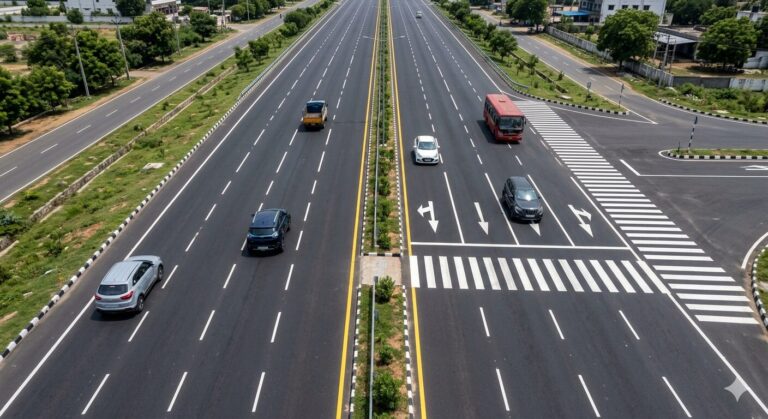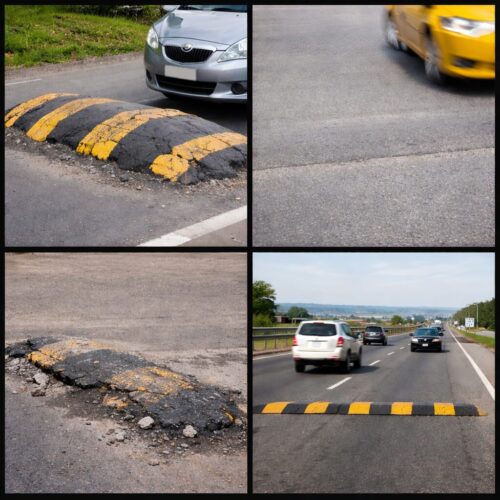
Drive anywhere in India and you’ll encounter them every few hundred metres: speed breakers rising abruptly from the road. Some are painted yellow or white. Most aren’t. They appear on residential streets, arterial roads, highways – even outside private shops.
In October 2024, a video from Gurugram went viral showing vehicles literally flying over an unmarked speed breaker on Golf Course Road. That wasn’t traffic calming, it was a death trap.
But here’s the question we rarely ask:
What kind of speed control was actually needed there? And who decided this was it?
Because the uncomfortable truth is this: India doesn’t just build too many speed breakers. It builds the wrong kind, in the wrong places, for the wrong reasons.
The Simple Logic That Starts the Problem
The thought process usually begins with genuine concern.
- A child was nearly hit crossing the street.
- Trucks race through residential areas.
- Accidents keep happening at the same spot.
The conclusion feels obvious: slow cars down and people will be safer.
And this logic isn’t wrong. Studies consistently show that when vehicle speeds drop from 80 km/h to 50 km/h, crash fatality risk can fall by nearly half. Speed kills. Reducing speed saves lives.
The problem is where the thinking stops. Because building a speed bump feels easier than everything else.
Why Speed Bumps Become the Default Solution
If you want to slow traffic, your options look like this:
- More traffic police: expensive, inconsistent, hard to sustain
- Speed cameras: require coordination, technology, and enforcement
- Road redesign: needs approvals, studies, budgets
Or hire a contractor. Pour concrete. Have a speed breaker by next week. It’s visible. Immediate. Politically convenient.
This is where India jumps from “we need to slow cars” to “build a bump” skipping the most important step: choosing the right traffic-calming tool.
Did you know?
Indian Roads Congress (IRC) guidelines specify that a correctly designed speed breaker should slow vehicles without jolting them. If your car scrapes or jumps, the bump is almost certainly illegal.
Not All Speed Breakers Are the Same
This is where the conversation usually collapses. In traffic engineering, “speed breaker” is not a single thing. It’s a loose term Indians use to describe very different tools, each meant for different speeds, roads, and risks. The following types of speed breakers are stipulated in India as per IRC 99-2018 guidelines.
1. Speed Bumps (Modular / Precast)
Where used
- Local, residential, neighbourhood roads
- Road width ≤ 9 metres
- Not permitted on arterial or high-traffic roads
Design & Specs
- Material: Precast rubber or plastic (modular units, bolted to surface)
- Width (along direction of travel): 300 mm
- Height: 75 mm
- Profile: Circular
Key Notes
- Intended for very low speeds
- Can dislodge under heavy traffic
- Often misused on larger roads where they become dangerous
2. Speed Humps (Permanent, Bituminous / Concrete)
Speed humps are the most common legal speed breaker on urban roads and come in two sub-types.
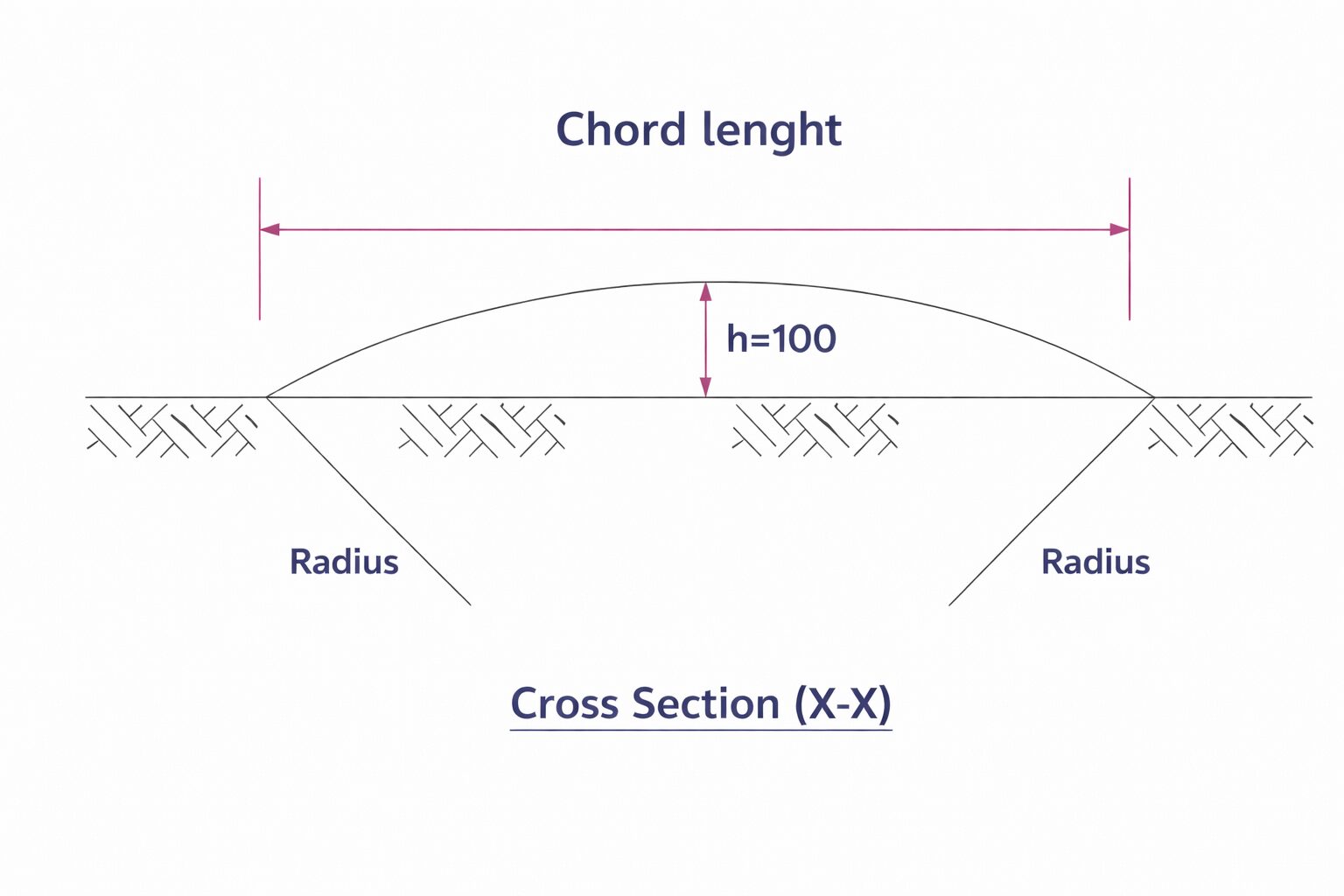
2A. Circular Speed Hump
Where used
- Collector roads and minor arterial roads
- Road width 12–24 m (and above, with controls)
Design & Specs
- Height (rise): 100 mm (10 cm)
- Shape: Circular arc
- For roads ≥ 24 m:
- Desired speed: 30 km/h
- Radius: 20 m
- Chord length: 4.0 m
- For roads 12–24
- Desired speed: 25 km/h
- Radius: 15 m
- Chord length: 3.5 m
Vehicle Impact
- Cars pass with moderate discomfort
- Buses slow to 10–15 km/h
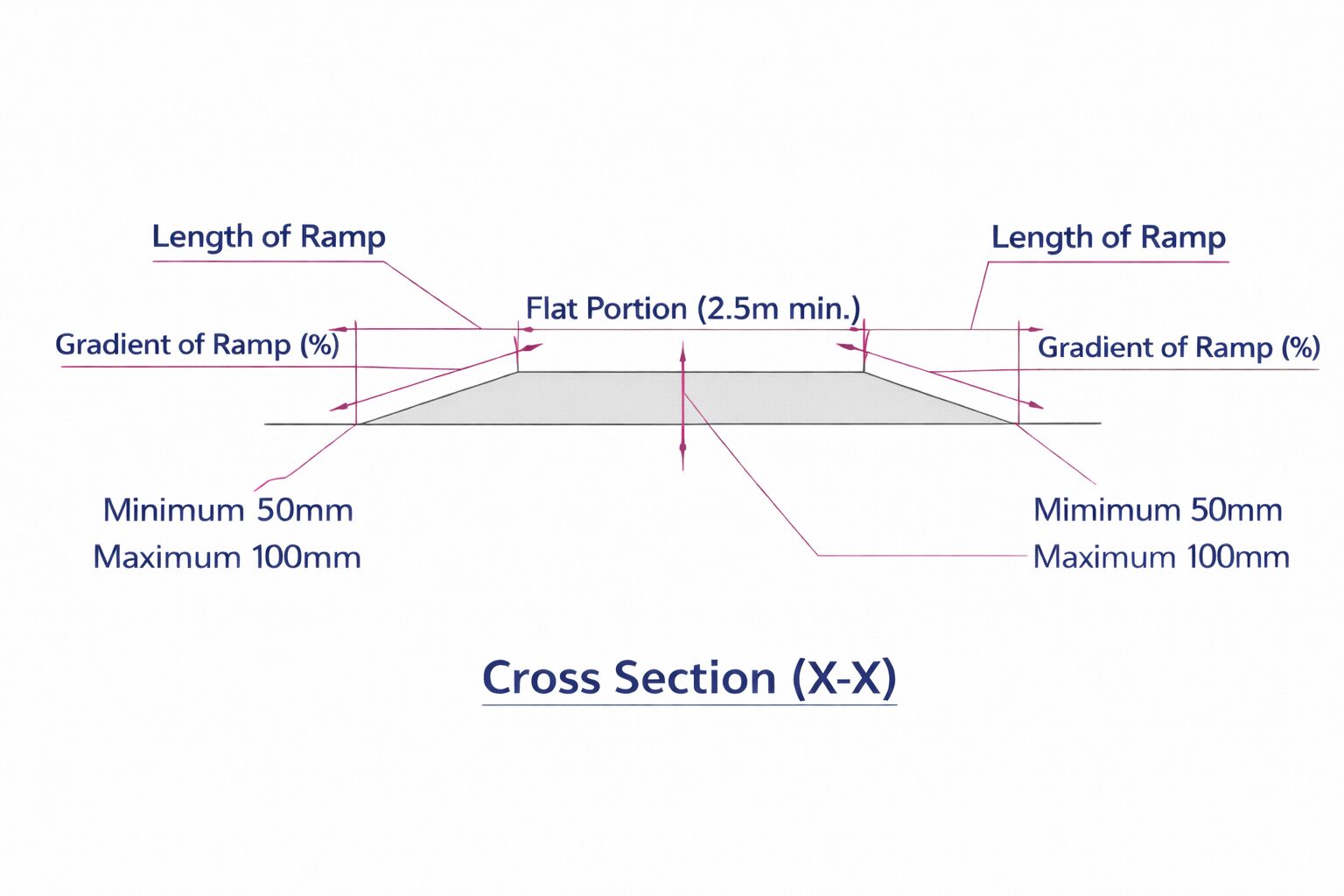
2B. Trapezoidal Speed Hump
Where used
- Similar roads as circular humps
- Often preferred near pedestrian zones
Design & Specs
- Height: 100 mm
- Flat top with ramps on both sides
- For roads ≥ 24 m:
- Ramp length: 1.0 m
- Gradient: 10%
- For roads 12–24 m:
- Ramp length: 0.8 m
- Gradient: 12.5%
Vehicle Impact
- Cars: manageable discomfort
- Heavy vehicles: must crawl (5–10 km/h)
3. Speed Table / Raised Pedestrian Crossing (RPC)
Where used
- High Pedestrian Activity Zones (HPZ)
- Near schools, hospitals, transit stations
- Mid-block crossings with footpaths on both sides
Design & Specs
- Platform width: 5000 mm (minimum acceptable: 3000 mm)
- Height: Matches footpath level (max 150 mm)
- Ramp length: 1700 mm
- Material:
- Platform: concrete blocks (100 mm)
- Ramps: bituminous
Why it’s preferred
- Slows vehicles and provides safe pedestrian crossing
- Universally accessible (wheelchairs, prams)
- Much safer than random bumps
4. Raised Junctions
Where used
- Local roads in high pedestrian zones
- Non-signalised intersections
Design Concept
- Entire junction is raised to footpath height
- Forces slow, cautious movement through conflict points
Key Benefit
- Reduces vehicle dominance at intersections
- Improves pedestrian visibility and priority
Basic Requirements To Build A SpeedBreaker
The guidelines have clearly outlined the mandatory design rules and yet these are often violated.
Some of the guidelines are listed below that apply to all speed breakers:
- Must span full width of carriageway
- Minimum 100 m gap between two breakers
- Retro-reflective paint (IRC 35-2015)
- Warning signs 40–50 m in advance
- Cat’s eyes road studs along full length
- Rumble strips before the breaker
- Adequate street lighting
- No construction during monsoon (June–Oct)
When Good Intentions Kill
The tragic irony: poorly designed speed bumps kill the people they’re meant to protect.
MoRTH data indicates a significant number of crashes occur annually at improperly designed speed breakers on national highways. How unauthorized bumps cause accidents:
- Sudden braking: Leading to rear-end collisions, especially with trucks unable to stop quickly
- Loss of control: Motorcyclists hitting unmarked bumps at night
- Vehicle damage: Cars with damaged suspension from excessive bump height losing control on subsequent roads
The initial logic was correct. The execution, design, placement, visibility, approval – never happened.
Did you know?
Every additional 10 seconds of delay in emergency response can reduce survival chances by up to 7–10% in cardiac and trauma cases. Poorly placed speed bumps quietly eat into the “golden hour.”
The Enforcement Vacuum
Building unauthorized speed bumps is illegal. Courts, including the Delhi High Court, have clearly stated that residents cannot create traffic infrastructure on their own. Citizens must apply to traffic authorities, who assess and approve requests through proper procedures.
However, enforcement is largely reactive:
- Unauthorized bumps appear overnight
- Accidents and vehicle damage occur
- Complaints and media pressure follow
- Authorities eventually remove some bumps
In 2024, Mumbai police removed 56 illegal speed breakers. This likely represents only a small fraction of those that exist.
Removal is also difficult. Officials often face organised resistance and even threats when attempting to demolish illegal structures. This creates a system where it is often easier to leave dangerous infrastructure untouched.
What the Thought Process Should Be
Step 1: Diagnose the Real Problem
Speed is not always the root cause. Poor visibility, missing pedestrian crossings, weak street lighting, and distracted driving often play larger roles. MoRTH data shows nearly two-thirds of road accidents occur on straight roads, which indicates attention failure rather than just speeding.
Step 2: Consider All Solutions
Speed bumps should be a last resort. Alternatives include:
- Clear road markings and signage
- Signalised pedestrian crossings
- Better street lighting
- Targeted traffic police deployment
- Speed enforcement using cameras
Physical bumps slow emergency vehicles, damage vehicles, increase noise, and reduce ride comfort.
Step 3: Follow Proper Approval and Design
Speed breakers must be approved by municipal traffic authorities after engineering studies and public consultation. They should be designed by qualified traffic engineers following IRC specifications (3.7m width, 10cm height), with proper materials, signage, and night visibility.
The Role of Behavioral Data
Modern speed management relies on behavioral data instead of blanket physical barriers. Platforms like Attento help identify where and why speeding actually occurs, enabling targeted enforcement, better road design, and focused driver education.
Speed bumps treat symptoms. Behavioral data helps address causes.
Final Thought: Design First, Concrete Last
Speed breakers are not inherently unsafe. Misuse creates risk.
When legally approved, correctly designed, and evidence-based, they improve safety. When built informally, they create new risks.
Road safety should depend on engineering, data, and enforcement, not influence or convenience.
Before building a speed breaker, the real question should be:
“Is this the right solution for this road?”