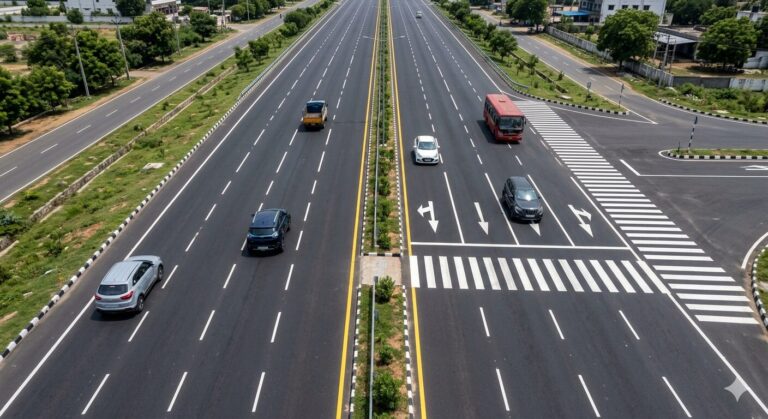
Numbers make tragedies feel distant. They allow us to negotiate with death. The below widely shared road safety video captures this discomfort with unsettling clarity. It shows how easily we accept a “reasonable” number of deaths when lives are reduced to statistics, and how quickly that logic collapses when those numbers are reimagined as people we know.
When deaths remain faceless, they feel manageable. When they acquire names, relationships, and proximity, tolerance disappears. Vision Zero begins precisely at this rupture. It rejects the idea that any loss of life can be justified as an acceptable trade-off for speed, convenience, or economic efficiency. It refuses to treat death as a rounding error in mobility planning.
This shift is not emotional rhetoric. It is a foundational policy choice. And one country chose to build its entire road safety system around it.
But there is a country that chose a different path.
Sweden’s Radical Reset
In 1997, Sweden’s parliament unanimously adopted Vision Zero: no road death or serious injury is acceptable. Not fewer deaths. Zero.
Traditional road safety blames users. Vision Zero flips that logic. Humans will always make mistakes. The system’s job is to ensure those mistakes aren’t fatal.
The core insight: At 50 km/h, a pedestrian has a 20% chance of survival. At 30 km/h, that rises to 90%. Road safety is an engineering problem, not just a behavioural one.
What Sweden Actually Did
Sweden rebuilt infrastructure systematically. Over 12,500 dangerous intersections became roundabouts, reducing serious crashes by up to 80%. Pedestrian crossings got raised platforms. Bicycle lanes were separated with concrete barriers, not paint.
Speed limits in residential zones dropped to 30 km/h, enforced by 2,000 automated cameras nationwide. Rural roads with high collision rates got median barriers preventing head-on crashes.
Accountability expanded beyond drivers. Urban planners, engineers, and manufacturers became jointly responsible. Traffic engineers now conduct safety audits throughout construction. If someone dies, the system failed.
The result: Sweden’s road fatality rate fell from 7 deaths per 100,000 people in the late 1990s to 2.2 by 2022. India’s rate is 11 per 100,000, despite having far fewer vehicles per capita.
India Has the Intent, Not the Implementation
India has committed to reducing road deaths by 50% by 2030 under the UN Decade of Action. The Motor Vehicles (Amendment) Act of 2019 introduced stricter penalties and safe-system principles.
Despite these policies, road deaths increased by 12% between 2014 and 2022. Many states diluted penalties within months due to public backlash. Enforcement remains sporadic. Infrastructure projects treat safety as an add-on.
The gap isn’t aspiration. It’s execution.
Why Sweden’s Model Won’t Work As-Is
Swedish roads operate in controlled environments: 90% car ownership, disciplined lanes, 99% helmet and seatbelt compliance.
Indian roads are fundamentally different:
- Two- and three-wheelers account for 44% of road deaths, yet infrastructure is designed for cars
- Mixed traffic is the norm: ox-carts, bicycles, motorcycles, rickshaws, buses, and cars share space
- Pedestrians account for 18% of deaths. A 2023 study found 63% of Indian roads lack basic footpaths
- Construction zones kill disproportionately: 22% of highway deaths occur in construction zones representing just 5% of road length
- Informality dominates: unauthorised vendors and parked vehicles narrow carriageways unpredictably
Vision Zero assumes predictability. India’s challenge is negotiated chaos.
Vision Zero, Redesigned for India
Design for two-wheelers first
Concrete barriers with sharp edges kill motorcyclists who might have survived. Kerala has piloted motorcycle-friendly barriers with rounded edges. These need national scaling.
Accept pedestrian behaviour as it exists
Indians won’t walk 500 metres to use foot-overbridges. Raised crossings, refuge islands, and continuous footpaths work. Chennai’s Venkatnarayana Road pilot reduced pedestrian fatalities by 40% through these interventions.
Make speed self-enforcing
Painted signs are ignored. Narrow lanes, chicanes, and textured pavements change behaviour automatically. Pune reduced average speeds from 55 km/h to 32 km/h in residential areas without additional enforcement.
Treat construction zones as high-risk
International best practice requires contractors to maintain finished-road safety standards during construction: proper channelisation, advance warning, lighting, and pedestrian walkways. Performance bonds should tie to safety metrics, not just timelines.
Invest in data and enforcement infrastructure
Sweden’s success relies on comprehensive crash data identifying high-risk locations. India’s Integrated Road Accident Database captures only 8% of accidents. Hyderabad’s 400 speed cameras led to a 17% reduction in fatal accidents within the first year.
One reason this gap persists is that India largely measures safety after crashes occur, not before. Vision Zero depends on identifying risk early, long before fatalities force attention. This is where telematics-based behavioural data becomes critical. Platforms like Attento capture aggregated, privacy-first insights from everyday driving such as sudden braking, speed drift, and recurring near-miss patterns. When analysed at scale, these signals reveal where road design, traffic flow, or enforcement is quietly inducing risk, even in the absence of reported accidents. Instead of waiting for deaths to mark a black spot, such data allows planners and authorities to see safety failures as they emerge and intervene earlier, which is central to any serious Vision Zero implementation.
Early Progress, Fragile Gains
The India Vision Zero Forum, launched in 2021, has united government, WHO, Bloomberg Philanthropies, and civil society.
Mumbai’s redesign of 50 junctions reduced pedestrian fatalities by 33% between 2021 and 2023. Gurugram’s segregated cycling tracks cut cyclist casualties by 45%. Pune’s school zone programme dropped accidents by 28%.
Where infrastructure, enforcement, and communication align, fatalities fall. Where one element is missing, gains reverse. Vision Zero is a system, not a checklist.
Why “Zero” Isn’t Naive
Vision Zero refuses to accept death as the price of mobility. Sweden took 25 years to halve deaths. What changed was institutional mindset: every death triggered investigation and systemic response.
India accounts for 13% of global road deaths despite having just 1% of the world’s vehicles. The country loses more people annually to road accidents than to terrorism, Naxalism, and communal violence combined.
The economic cost equals building 2,300 kilometres of metro systems annually, or providing free universal healthcare to India’s entire population.
What’s Next for India
India has committed to halving road traffic deaths by 2030. With deaths still rising, this target appears increasingly out of reach without dramatic acceleration.
What’s needed isn’t more policies but implementation of existing ones. The Motor Vehicles Act remains poorly enforced. The National Road Safety Board lacks authority to compel state action. Road construction tenders prioritise lowest cost over safety. Urban planning accommodates cars first, pedestrians last.
India has the technical capacity, financial resources, and successful pilots. Swedish and Dutch engineers have trained Indian officials. International funding is available through the World Bank and Bloomberg Initiative.
What’s missing is political will to prioritise safety over convenience, hold bureaucrats accountable for crash data, and sustain focus beyond headline-grabbing accidents.
Road deaths are design failures. They represent failures of engineering, planning, enforcement, vehicle standards, and political prioritisation that treats mobility as the only metric of success.
The question isn’t whether safer roads are possible. Evidence from Sweden, Netherlands, Spain, and India’s own pilot cities is overwhelming. The question is whether citizens will demand them loudly enough to force systemic change, and whether politicians will implement solutions that may be initially unpopular but will save thousands of lives.