In early 2014, a short crash-test video began circulating among Indian car buyers. It showed a Maruti Suzuki Alto 800, one of the country’s most trusted household cars, hitting a barrier at 64 km/h. Within seconds, the cabin collapsed, the steering wheel lurched upward, and the crash-test dummies folded into the crushed front end.
The verdict was blunt: zero stars.
But the number mattered less than the feeling it provoked. This was not just a car failing a test. It was the car that ferried children to school, carried parents to work, and symbolised middle-class aspiration. Watching it crumple frame by frame shattered a trust built over generations.For decades, Indian car buyers prioritised mileage, affordability, and resale value. That video forced a reckoning. The family car was not keeping families safe, and for the first time, the evidence was impossible to ignore.
A decade later, as India becomes the world’s third-largest passenger vehicle market, understanding safety ratings has shifted from niche curiosity to essential consumer literacy.
Why Safety Ratings Matter in India’s Driving Reality
India accounts for nearly 11 percent of global road deaths, according to the Ministry of Road Transport and Highways and the WHO, translating to one family affected by a road accident roughly every four minutes. As roads have expanded and engines have become more powerful, safety adoption and enforcement have struggled to keep pace. The consequences are visible every day in official data, in news reports, and in lives altered permanently.
For years, car-buying psychology in India revolved around maximum value per rupee. Heavier doors and thicker sheet metal were seen as signs of safety, with solid build quality becoming shorthand for protection, even though real crash safety depends on energy absorption, restraint systems, and structural design rather than weight alone. Manufacturers were rewarded for low prices and high mileage, while safety was rarely treated as a priority feature. A safety rating is not a marketing badge but a technical assessment of how a car manages impact forces, preserves cabin integrity, and protects occupants. It does not guarantee survival, but it meaningfully improves the odds.
Understanding NCAP: The Ecosystem Behind the Stars
NCAP stands for New Car Assessment Programme, a family of independent crash-testing organisations that evaluate vehicle safety. There is not one NCAP, but many, including Global NCAP, Euro NCAP, US NCAP, ASEAN NCAP, ANCAP, Latin NCAP, Japan NCAP, and now Bharat NCAP.
Each programme tests safety through a regional lens. Protocols differ in speeds, equipment requirements, injury criteria, and scoring emphasis. As a result, star ratings are not interchangeable across NCAPs, even when the number looks identical.
This distinction matters far more than most buyers realise.
Bharat NCAP: India’s First Home-Grown Benchmark
Launched in 2023, Bharat NCAP marks a turning point. For the first time, India has a safety rating system calibrated to local crash patterns and, critically, to the exact variants sold in the domestic market.
Before this, Global NCAP’s advocacy and testing filled a regulatory vacuum, forcing manufacturers to strengthen body structures, improve restraint systems, and standardise airbags. Bharat NCAP builds on that momentum by embedding safety assessment within India’s own framework.
Its tests evaluate adult and child occupant protection at realistic speeds and apply directly to Indian-spec models. This closes a long-standing loophole where globally safe cars were structurally or equipment-wise diluted for domestic sale. A car engineered safely for international markets can perform very differently once cost reductions are introduced locally, and Bharat NCAP ensures buyers see the result of those choices clearly.
The effect is already visible. Cars like the Tata Nexon and Mahindra XUV300 pushed safety into mainstream conversation and changed what buyers ask about in showrooms. Bharat NCAP formalises that shift by making safety measurable and comparable.
Global NCAP and Euro NCAP: Setting the Reference Points
Global NCAP’s Safer Cars for India programme exposed critical weaknesses across mass-market vehicles in the mid-2010s and triggered tangible improvements across the industry.
Euro NCAP represents the most demanding global benchmark. Its focus extends beyond crash survival to crash prevention, heavily weighting advanced driver assistance systems such as autonomous emergency braking, lane support, and pedestrian detection. As Indian vehicles increasingly adopt these technologies, Bharat NCAP is expected to evolve in the same direction.
The table below shows why safety ratings are not directly comparable across regions. Global NCAP, Euro NCAP, and Bharat NCAP follow different testing priorities, protocols, and equipment assumptions. Euro NCAP places heavy emphasis on crash avoidance and advanced driver assistance systems, while Global NCAP and Bharat NCAP focus more on structural integrity and occupant protection. Bharat NCAP’s key distinction is that it tests the exact variants sold in India, making its results the most relevant reference point for Indian buyers today.
| Aspect / Protocol | Global NCAP (India Programme) | Euro NCAP | Bharat NCAP (India) |
| Primary Focus | Adult and child occupant protection in key crash modes | Comprehensive safety including crash avoidance | Occupant protection for Indian-spec vehicles |
| Frontal Crash Speed | ~64 km/h offset | 64 km/h offset | 64 km/h offset |
| Adult Occupant Protection | Yes (points & stars) | Yes (higher scoring detail) | Yes |
| Child Occupant Protection | Yes | Yes | Yes |
| Side Impact Test | Limited (older protocols) | Yes | Planned/phased |
| Pedestrian Protection | No | Yes | Not yet required |
| Autonomous/Active Safety (ADAS) | Not included | Strongly weighted (AEB, lane assist, etc) | Future phases proposed |
| Tested Vehicle Variant | Often base/Indian version | European-spec version | Indian market variant |
| Equipment Level Considered | Based on what is sold locally | Euro spec equipment | Exactly what Indian buyers get |
| Scoring Style | Adult + Child combined star/points | Weighted multi-domain scoring | Adult + Child with Indian calibration |
| Relative Demand Level | Moderate | High | Calibrated to local conditions |
Did You Know? A car’s star rating can vary across countries: the same model may score 5 stars in Europe but 3 stars in India due to differences in safety equipment.
What Safety Ratings Do Not Tell You
Crash tests simulate controlled scenarios, not the full unpredictability of real-world driving. They do not account for suspension stress caused by poor road surfaces, where repeated pothole impacts can weaken components and alter crash dynamics over time. A vehicle that performs well in a laboratory test may behave very differently on the road if its alignment is off or structural mounting points are already compromised.
Crash tests also assume correct loading conditions. In reality, many vehicles operate with more passengers or cargo than they were designed for. Overloading shifts the centre of gravity, affects crumple zone behaviour, and can change how airbags deploy. While crash tests use precisely weighted dummies, real-world driving conditions, especially on Indian roads, rarely follow such precision.
Standard testing protocols further struggle to reflect India’s unique crash patterns. Most tests are designed around car-to-car or car-to-barrier impacts, yet a significant share of serious accidents involve two-wheelers. The impact angles, injury patterns, and protection requirements in collisions with motorcycles and scooters are fundamentally different from those assumed in standard tests.
Maintenance is another major blind spot. Safety ratings assume good tyres, effective brakes, and intact suspension systems. Poor maintenance can quickly negate even the best safety engineering. Finally, ratings apply only to the exact variant tested. A base model without features like electronic stability control or side airbags cannot inherit the safety performance of a higher variant, even if advertisements suggest otherwise. A safety rating is a strong baseline, not a promise.
What Buyers Should Look for Beyond the Stars
The engineering behind the rating often matters more than the rating itself. Structural stability, restraint calibration, and electronic intervention systems play decisive roles in real-world outcomes.
For Indian buyers, priorities should include a stable or reinforced body shell, at least six airbags with side and curtain coverage, electronic stability control, ISOFIX child-seat anchors, and independently verified test results rather than manufacturer claims.
Real-world outcomes reinforce this. In 2023, a Tata Nexon involved in a high-speed truck collision in Kerala retained cabin integrity, allowing occupants to survive with injuries. The images went viral not because of how badly the car was damaged, but because of what the structure prevented.
Safety is a system, not a single feature.
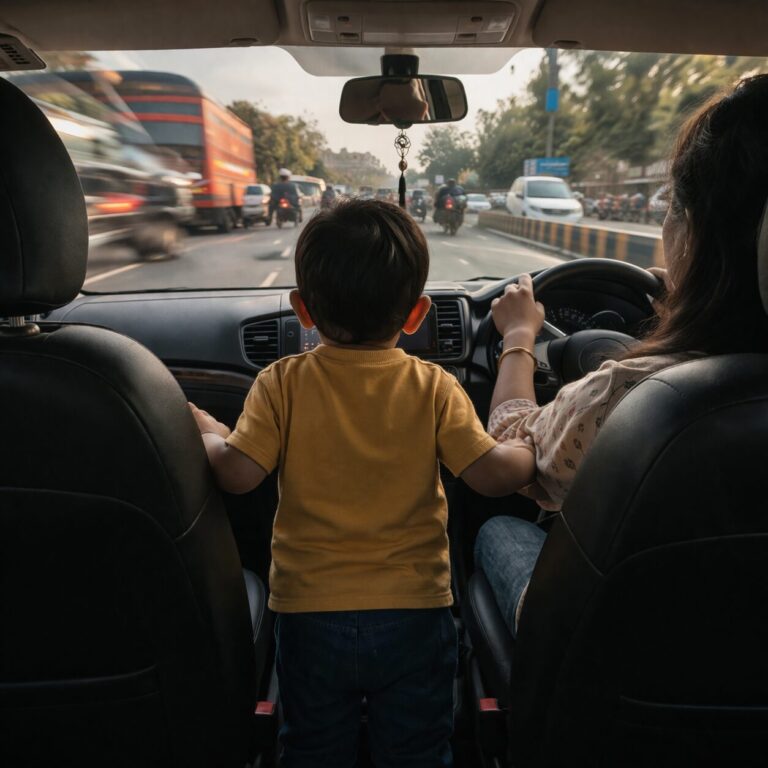
Even the safest car isn’t truly safe with an unsafe driver behind the wheel. Crash-test ratings measure how well a vehicle protects occupants once an accident occurs, but they assume ideal conditions that rarely exist on Indian roads. Most serious crashes are triggered by driver behaviour, overspeeding, late braking, distraction, tailgating, or fatigue, long before the car’s safety systems are tested. This is where the driver becomes the most critical safety feature, and where Attento makes a real difference. Using mobile telematics, Attento monitors driving patterns in real time and delivers gentle, actionable prompts, like slowing down on risky stretches, maintaining smooth braking, or avoiding harsh turns, to help drivers adjust their behaviour immediately. Over time, these nudges encourage safer, more consistent driving habits, ensuring that the protection promised by high safety ratings actually works in real-world conditions, on everyday roads, before a crash ever happens.
Did You Know?A higher star rating does not automatically mean better accident avoidance. ESC and ADAS play a major role outside crash protection.
The Road Ahead
India’s safety transition is underway but incomplete. Future regulations are likely to mandate electronic stability control universally, strengthen side-impact norms, and introduce pedestrian protection and ADAS evaluation. The pace remains uncertain, but the direction is clear.
What is changing faster than regulation is consumer awareness. Social media, accident footage, and shared experiences have reshaped how buyers define value. Safety is moving from optional to expected.
The real inflection point will come when structural integrity is evaluated with the same seriousness as fuel efficiency or infotainment inside a dealership.
Coming Full Circle
Ten years after that Alto crash test went viral, safety is no longer an abstract concern. Sales trends, buyer behaviour, and the success of safer models all confirm this shift.
The remaining question is whether the market and regulators can move fast enough to reflect that awareness before more lives are lost. Because safety is not just engineered into a car. It is chosen through design decisions, regulatory priorities, and purchasing behaviour. The stars on a rating chart do not save lives by themselves. The decisions behind them do.